


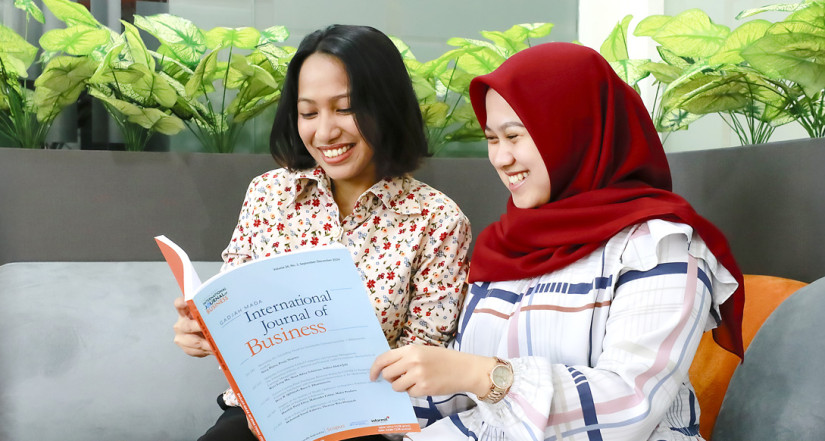
The Journal of Indonesian Economy and Business (JIEB) and the Gadjah Mada International Journal of Business (GamaIJB), managed by the Faculty of Economics and Business, Universitas Gadjah Mada (FEB UGM), have successfully been indexed by the Australian Business Deans Council (ABDC) as of March 2026. This achievement marks an important milestone in strengthening the international reputation of business research in Indonesia.
Dr. Widya Paramita, editor-in-chief of JIEB, stated that this accomplishment was not achieved overnight. It is the result of a long process built on a strong foundation laid by predecessors, enabling JIEB to be indexed in Scopus Q3 and ultimately recognized by ABDC.
“ABDC is an index widely used by countries with more advanced research performance compared to Indonesia. This achievement reinforces JIEB’s reputation as a high-quality journal and strengthens its credibility at the international level,” she said on Friday (Apr. 10).
Dr. Paramita explained that the indexation process required extensive preparation. The process took approximately two years, including an intensive one-year phase prior to submission in 2023.
One of the main requirements for indexation was recognition from international academics, particularly from Australia, to enhance the journal’s visibility within the global academic community.
This ABDC indexation also opens broader opportunities for JIEB to contribute to global issues, including the Sustainable Development Goals (SDGs). Dr. Paramita emphasized that this recognition enhances the journal’s bargaining power in promoting high-quality research relevant to sustainable development.
Meanwhile, Head of the Publication Unit FEB UGM, Dr. Arika Artiningsih, added that JIEB has actively worked to raise awareness among Australian academics.
“Ultimately, JIEB received recommendations from around 16 international professors from various universities in Australia,” she explained.
However, this achievement also comes with several challenges, including maintaining consistent article quality, building and sustaining an international reviewer network, increasing citations, and managing a cross-country editorial board.
To address these challenges, JIEB has implemented several strategies, including improving editorial processes by inviting more international editors, reviewers, and authors, and implementing a transparent, efficient double-blind peer review system. Another equally important strategy is enhancing visibility through collaborations, promotions, and international conferences.
“Some initiatives we have undertaken include organizing the GAMAICEB Conference, collaborating with accredited business schools to support conferences, conducting workshops with ITB and BINUS, and establishing international collaborations with universities in Malaysia, Singapore, and Vietnam to attract international authors,” Dr. Artiningsih said.
Looking ahead, JIEB is pursuing indexation in other international databases, such as Web of Science, to further expand its global impact.
“We will continue to consistently maintain article quality, strengthen internal governance, and improve our ranking within ABDC,” Dr. Artiningsih concluded.
Support from the FEB UGM Scientific Publication Unit has also been a crucial factor in strengthening the reputation and accreditation of journals within FEB. Through various strategic initiatives, all journals are expected to gain broader global recognition.
Reporters: Shofi and Kurnia Ekaptiningrum/FEB Public Relations
Author: Salwa
Editor: Gusti Grehenson
Post-editor: Jasmine Ferdian
Photo: FEB UGM Public Relations