


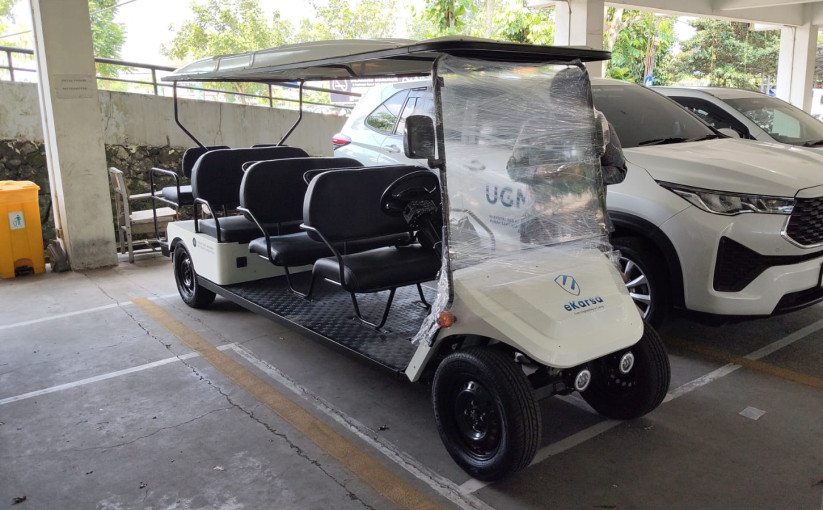
Innovation continues to be championed by researchers at Universitas Gadjah Mada (UGM), as evidenced by the development of a new electric vehicle, eKarsa. This vehicle is specifically designed to meet mobility needs in confined areas, particularly hospital environments, by prioritizing efficiency, ergonomics, and sustainability.
The Department of Electrical Engineering and Information Technology (DTETI) at the Faculty of Engineering UGM (FT UGM) developed this electric vehicle to serve the needs of the UGM Academic Hospital. The vehicle was subsequently named eKarsa, an acronym for “electric vehicle for RSA.”
The Dean of FT UGM, Professor Selo, stated that eKarsa is a continuation of electric vehicle development carried out by researchers within the faculty. Since 2012, FT UGM has consistently developed electric vehicles for confined areas, targeting markets such as tourism, industrial transport, agricultural services, and other non-roadway needs.
He explained that the Semar car was the first version of the Semar electric vehicle. This was followed in 2014 by the development of the GATe (Gadjah Mada Airport Transporter), designed specifically for airport and tourism services.
“At that time, we registered the GATe trademark,” he said on Wednesday (Apr. 15).
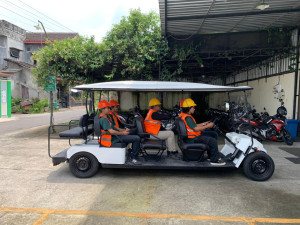
Unlike previous electric-vehicle innovations, eKarsa offers advantages in its lithium ferro phosphate battery pack and motor control system, both of which have been independently developed by the UGM team, although some components still rely on imported products.
“In the future, if the market proves sustainable, all components could potentially be manufactured locally,” he added.
The Head of DTETI FT UGM, Professor Hanung Adi Nugroho, explained that the development of eKarsa was driven by real needs in the field, particularly the need to move from parking areas to the main hospital building at the UGM Academic Hospital.
“The request from the hospital was quite specific and challenging, including a development timeline of only three months, from January to March. However, with the team’s experience led by Dr. Eka Firmansyah and collaboration with industry partners, this vehicle was successfully realized according to requirements,” he said.
During its development, Hanung noted that the UGM team collaborated with PT Inastek, a startup company led by Faculty of Engineering alumni. Technically, he explained that eKarsa was designed with operational needs in hospital environments in mind.
“The vehicle can accommodate up to eight passengers, has a relatively short charging time of approximately three hours, and is designed without sharp edges to ensure user safety,” he said.
In addition, the use of standard components, such as commonly available wheels, is an advantage, as it simplifies maintenance.
“All aspects are designed to be user-friendly, ergonomic, and easy to maintain. We want to ensure that this vehicle is truly ready for use, not merely a prototype that remains conceptual,” Professor Nugroho added.
According to Professor Nugroho, the launch of eKarsa is part of efforts to downscale campus technology, although he acknowledged that the path toward mass production still requires support. As an educational institution, he noted that the department focuses on research and prototype development. He expressed hope for synchronization between research and development and the industrial downstream sector to ensure that innovations do not stop at publications or prototypes.
Through the launch of eKarsa for services at the UGM Academic Hospital, Professor Selo emphasized that researchers at FT UGM possess the capability to customize electric vehicles to meet community needs. With market opportunities opening, he hopes that the industry can grow, absorb labor, and advance product development at the downstream level.
He added that GATe, in its various versions, has the potential to become a market-accepted product, continue evolving into other applications such as industry and agriculture, and enhance the local production capacity of electric vehicle components.
“Both GATe and eKarsa have strong potential to be marketed widely, as long as their specifications meet user needs,” he concluded.
Author: Hanifah
Editor: Gusti Grehenson
Post-editor: Jasmine Ferdian
Photo: Courtesy of FT UGM