


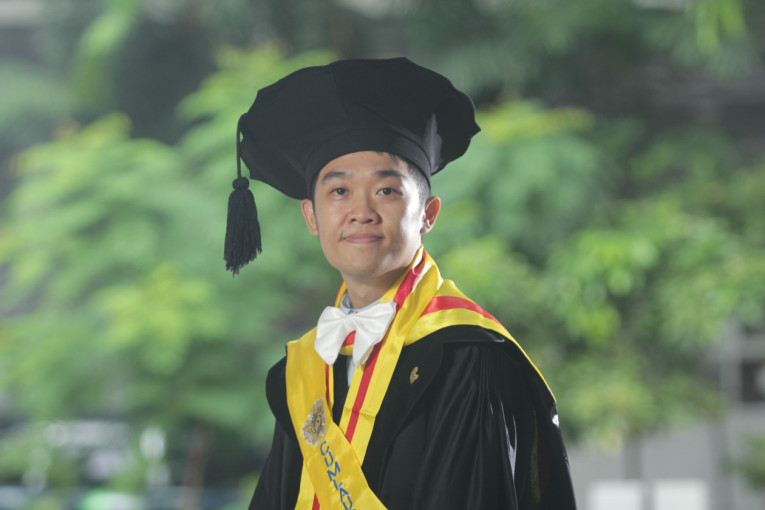
Completing a doctoral degree in under three years is no easy feat for most students. However, Stanley Evander Emeltan Tjoa proved otherwise, becoming the fastest doctoral graduate at the UGM Graduate School commencement held on April 22-23. A graduate of the Doctoral Program in Biology, he achieved the remarkable distinction of completing his studies in just 2 years, 5 months, and 14 days, significantly shorter than the average doctoral study period of 4 years and 10 months.
Stanley shared that his interest in biology, which eventually led him to pursue a doctoral degree in the field at UGM, began unexpectedly during high school. He admitted that he was not particularly interested in science subjects at first. However, being accepted into a special science class opened his perspective on the world of research.
“At first, I casually applied to join the science class and was accepted. From there, I became curious about biology,” he recalled on Wednesday (Apr. 29).
Stanley explained that his status as a research student, funded by his employer, played a key role in accelerating his studies.
“Since I was enrolled through the by-research track, the Biology program facilitated a faster process. From the first semester, I began drafting my proposal, and by the start of the second semester, I had already taken the comprehensive exam. This allowed me to focus more extensively on research,” he said.
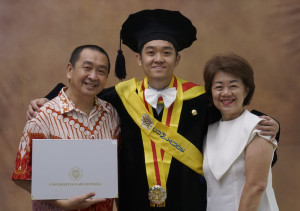
Stanley described his research journey as stemming from the synergy between industry and academia. When he began working in molecular science, discussions between the university and his company marked a turning point in his academic path.
“My interest in molecular science deepened through my work. At that time, Professor Budi Daryono discussed the development of his DNA extraction kit with our company, and the company became interested in further developing it,” he explained.
Stanley noted that the DNA kit he developed is used to prepare samples before PCR (Polymerase Chain Reaction). Unlike conventional methods, he used magnetic nanoparticle technology to improve healthcare efficiency.
“My dissertation focused on developing a DNA extraction kit. It was supported by a multidisciplinary supervisory team from biology, chemistry, and physics, ensuring that the product could become an integrated kit,” he elaborated.
His research innovation in DNA extraction using magnetic nanoparticles demonstrates that Indonesia can produce its own kits without relying on imported products.
“Currently, DNA extraction kits in Indonesia are dominated by imports. In addition to high import duties, distribution also takes considerable time. Through this dissertation, I aim to address these challenges by aligning with the National Industrial Development Master Plan (RIPIN) through 2035,” he said.
Author: Aldi Firmansyah
Editor: Gusti Grehenson
Post-editor: Jasmine Ferdian
Photo: Stanley Documentation