



Amid the tide of industrialization, various labor issues remain unresolved. Indonesia’s employment structure is still dominated by the informal sector, where job quality is relatively low. The prevailing minimum wage often falls short of meeting decent living standards. At the same time, most informal workers are not covered by social protection schemes. In an imbalanced labor market, this situation further weakens workers’ bargaining power. The disparity between the number of job seekers and available employment opportunities leaves workers with limited leverage.
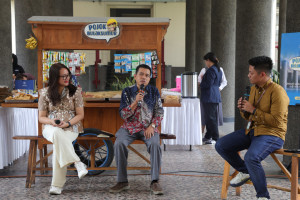
These issues were highlighted during the Pojok Bulaksumur Discussion titled “Menilik Nasib Perlindungan Buruh di Indonesia dalam Arus Industrialisasi” (Examining the State of Labor Protection in Indonesia Amid Industrialization), held on Wednesday (Apr. 30) at the UGM Central Building.
Organized to commemorate International Workers’ Day on May 1, the discussion featured two speakers: a lecturer in Social Development and Welfare at UGM’s Faculty of Social and Political Sciences (Fisipol UGM), Dr. Hempri Suyatna, and a lecturer at UGM’s Faculty of Law (Law UGM), Dr. Nabiyla Risfa Izzati.
Dr. Hempri Suyatna stated that Indonesia’s employment structure remains dominated by the informal sector, with relatively low job quality. He noted that most workers face unstable working conditions with minimal protection. This situation indicates that labor welfare remains a major challenge in development. In practice, workers are often positioned merely as part of the production process rather than as subjects with rights and equal standing.
“Workers may still be viewed as tools of production like machines, and therefore have not been fully recognized as subjects within the industrial process,” he said.
Dr. Suyatna further explained the shift toward increasingly flexible work patterns alongside the growth of the digital economy. The emergence of the gig economy has created new job opportunities for many, particularly younger generations. However, behind this flexibility lie unresolved issues of protection. Many workers in this sector lack social security, health insurance, and income stability.
“Gig workers face vulnerabilities due to the absence of social protection and unclear employment relationships with capital owners,” he explained.
He added that wage issues remain a fundamental concern for workers across regions. The minimum wage often fails to meet the needs of a decent living. Meanwhile, most informal workers are excluded from social protection schemes. This condition reveals a significant gap within the national labor system.
“Most of our workforce is in the informal sector and not covered by social security, making them even more vulnerable,” he said.
Furthermore, Dr. Suyatna observed that the relationship between workers and companies remains unequal. Workers often have weaker bargaining power compared to employers. As a result, many labor demands are difficult to fulfill optimally. He emphasized the importance of the government’s role in mediating industrial relations to create a more balanced dynamic.
“The government must act as a bridge to ensure that relations between workers and companies are more balanced and not unequal,” he stated.
Dr. Nabiyla Risfa Izzati highlighted that labor regulations have undergone significant changes following the enactment of the Job Creation Law. Many aspects of protection previously regulated by the state have now been shifted to agreements between workers and employers. In an imbalanced labor market, this shift further weakens workers’ position. The mismatch between labor supply and job availability reduces workers’ bargaining power.
“When workers’ bargaining power is very low, any agreement reached will never truly be equal,” she said.
She explained that these regulatory changes have contributed to rising job insecurity. Contract-based and outsourcing systems have expanded without strict limitations. Many workers are consequently trapped in unstable long-term employment conditions. This situation has led to the growing phenomenon of job insecurity among workers.
“Workers remain in a constant state of uncertainty and are vulnerable to exploitation,” she added.

Dr. Izzati also pointed to the limited scope of labor law protection in Indonesia. Existing regulations still focus primarily on formal employment relationships between workers and employers. Meanwhile, workers in the informal sector, gig economy, and freelance arrangements remain inadequately protected. As a result, a large portion of the workforce lacks sufficient legal safeguards.
“Many of us work, but not all of us are protected by existing labor laws,” she noted.
On that occasion, Dr. Izzati also discussed the direction of labor law reform, which she believes must be more adaptive to evolving work patterns. She outlined several commonly discussed options, ranging from drafting new regulations and redefining employment relationships to gradually revising existing laws.
However, in Indonesia’s current context, not all options have equal prospects for implementation. Legal-political considerations and legislative dynamics continue to shape policy directions in the near term.
“If asked which option is most feasible now, I believe it is creating specific regulations for platform or gig workers, as this has already entered the legislative agenda,” she emphasized.
In closing, she reminded that labor protection also requires active participation from workers themselves. Collective awareness is key to advocating for rights and driving policy change.
The momentum of International Workers’ Day can serve as a platform for workers to voice their aspirations. According to Dr. Izzati, public participation is essential to ensure that labor issues do not remain merely an annual discourse.
“It is time for us not only to be spectators, but to actively engage in advocating for worker protection,” she concluded.
Author: Triya Andriyani
Post-editor: Jasmine Ferdian
Photo: Donnie