


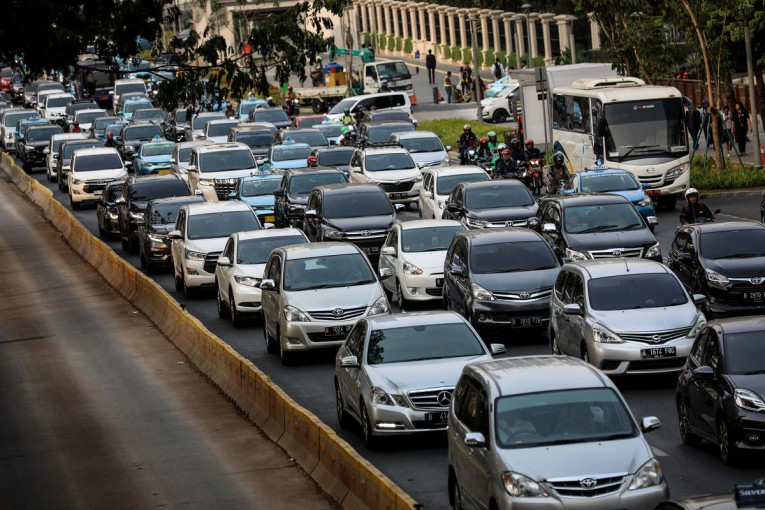
Traffic congestion in urban areas remains a major challenge in Indonesia’s transportation system. Static traffic control approaches are considered insufficient to respond to the dynamic movement of vehicles in real time. This condition has led to increased travel times, long queues, and inefficiencies in road networks.
Director General of Land Transportation at the Ministry of Transportation, Dr. Aan Suhanan, outlined the current state of transportation in Indonesia. He noted that the number of vehicles in 2025 reached 172.9 million units, with an average annual growth rate of 4.5 percent. Congestion levels in five major cities have reached 54.9 percent, with drivers losing up to 118 hours per year. Economic losses due to congestion have reached Rp77 trillion, or around 2.2 percent of Jakarta’s GDP.
“These conditions highlight the need for a transformation toward a data-driven and integrated transportation system,” said Dr. Suhanan during a webinar titled “Mengurai Kemacetan Kota dengan Artificial Intelligence: Transformasi Manajemen Lalu Lintas Menuju Smart Mobility di Indonesia” (Unraveling Urban Traffic Congestion with Artificial Intelligence: Transforming Traffic Management Toward Smart Mobility in Indonesia0 on Tuesday (Apr. 28).
As part of efforts to address these issues, the government has developed Intelligent Transportation Systems (ITS)- based systems, such as the Area Traffic Control System (ATCS) and the Arterial Transport Management System (AtMS). These systems have been implemented at hundreds of intersections and dozens of road segments to improve traffic management efficiency.
In addition, ITS has been applied to public transportation through the Teman Bus program, which now operates in 14 metropolitan areas. The program is supported by 817 buses and 57 feeder units, achieving an occupancy rate of 71.42 percent. The service has successfully encouraged 72 percent of users to shift from motorcycles and 23 percent from private vehicles.
“Moving forward, ITS implementation offers significant opportunities for traffic data analysis and adaptive system control, although it still faces challenges related to regulation and institutional readiness,” he concluded.
Acting Head of the Center for Transportation and Logistics Studies at Universitas Gadjah Mada (Pustral UGM), Professor Ikaputra, stated that the transformation of transportation systems must be directed toward adaptive, data-driven approaches. He emphasized that advances in artificial intelligence present significant opportunities to enhance the performance of modern transportation systems.
Technologies such as machine learning and Large Language Models enable real-time processing of traffic data and more accurate congestion prediction. However, the implementation of these technologies still faces challenges, including limited digital infrastructure, data integration issues, and human resource readiness.
“AI is not only a supporting analytical tool but also has the potential to become a core component of modern traffic management systems,” he said.
Professor M. Zudhy Irawan, a professor in the Department of Civil and Environmental Engineering at UGM, explained the role of artificial intelligence in future transportation systems. He noted that the need for AI is becoming increasingly urgent as transportation systems grow more complex and data volumes continue to expand. Large Language Models are capable of understanding human language, analyzing complex data, and making adaptive decisions. This capability enables transportation systems to become more responsive to changing conditions on the ground.
“LLMs can make intelligent decisions similar to humans in optimizing traffic signals and predicting traffic flows,” he said.
Professor Irawan also outlined four main roles of LLMs in transportation systems. First, as processors of information from various sources such as sensors, cameras, GPS, and user reports. Second, as knowledge encoders that organize traffic rules and road user behavior. Third, as component generators to support the development of AI-based systems. Fourth, as decision facilitators capable of providing optimal solutions in traffic management.
Furthermore, Professor Irawan highlighted that LLMs have been applied in various aspects of modern transportation. This technology is used in autonomous vehicles, adaptive traffic signal systems, public transportation, and intelligent navigation. It also plays a role in improving road safety and logistics efficiency. However, several risks must be anticipated in its implementation.
“This technology offers many conveniences in managing transportation, but we must not overlook its risks, particularly regarding information accuracy and data security, which must be carefully safeguarded,” he said.
On the other hand, challenges in implementing AI in transportation also include data privacy and cybersecurity issues. Modern transportation systems rely on user travel data, which carries the risk of information leakage. In addition, bias in AI systems may affect decision-making, particularly for remote areas or vulnerable groups. Other concerns relate to regulatory frameworks and legal accountability.
“Without clear governance, the use of AI may introduce new risks, making ethics, regulation, and user protection key priorities,” Professor Irawan emphasized.
Reporter: Andi Kurniawan/Pustral
Author: Triya Andriyani
Post-editor: Jasmine Ferdian
Photo: Kompas.com