


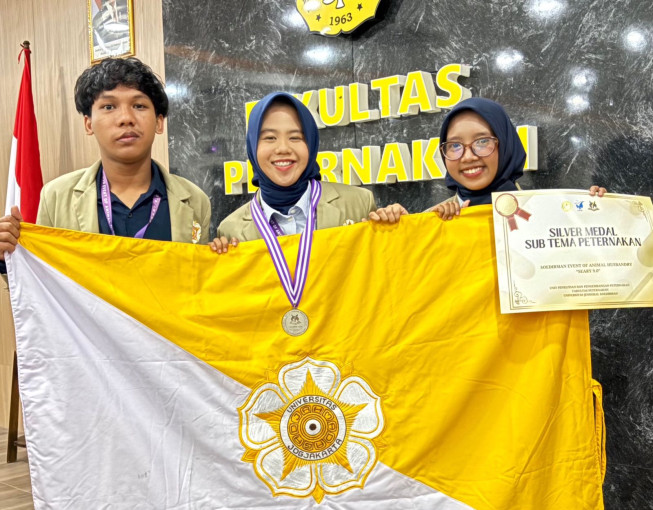
Three students from the Faculty of Animal Science of Universitas Gadjah Mada (Animal Science UGM), led by Prima Cendekia Nirmala Afiatri and joined by Bangkit Setiyoko and Aisyah Bening Azzahra Putri, won second place in the Soedirman Event of Animal Husbandry 9.0 scientific competition. Held on May 1 and 2, the event took place at the Faculty of Animal Science of Universitas Jenderal Soedirman and involved students from various universities across Indonesia.
The competition carried the theme of sustainable youth innovation in managing local resources to support the achievement of the Sustainable Development Goals (SDGs) and food self-sufficiency. Each team was challenged to present innovative solutions relevant to food security and sustainability issues. The UGM team distinguished itself through a technology-based approach to processing livestock waste.
Prima Cendekia explained that the competition began with a proposal selection stage, requiring all participants to submit innovative ideas aligned with the designated theme. The proposals were then curated by a panel of judges consisting of lecturers, experts, and practitioners from Universitas Jenderal Soedirman. The evaluation process was conducted rigorously to identify the best works considered to offer applicable solutions to current food and sustainability challenges. Of all submissions, only the top five teams advanced to the final round.
“The curation was carried out with great precision and objectivity. After a strict process, five finalists were selected to proceed to the next stage,” she said at the Faculty of Animal Science UGM on Monday (May. 11).
After being named finalists, all participants were invited to Universitas Jenderal Soedirman to attend the final presentation stage. In this session, each team was required to present its innovative solution and demonstrate the ability to respond to questions from the judges. The presentation was a crucial stage because participants had to demonstrate that their proposed innovations could be implemented effectively and sustainably.
Prima revealed that her team sought to offer solutions relevant to food loss and food waste through a technology-based approach.
“In this session, each team had to demonstrate competence and skill in presenting innovative solutions related to the SDGs and food security that are efficient, sustainable, and beneficial for all parties,” she explained.
In the competition, the UGM team developed a system to process cheese whey, a form of livestock waste, into edible film material. The innovation was designed to reduce food loss and waste while supporting more value-added waste management. The system is also integrated with a machine learning application that can be monitored in real time to ensure data transparency.
According to Prima, this innovation represents the application of animal science knowledge combined with digital technology to support sustainable food security.
“We are very grateful to have received this award. This is the result of the team’s hard work, the guidance and support of our supervisor, Galuh Adi Insani, M.Sc., the prayers of our families, and the contributions of our colleagues at the Animal Science UGM. We hope this achievement can inspire other students to continue learning and innovating,” she said.
Prima believes this achievement demonstrates that Animal Science UGM students are capable of producing innovations that address community needs and advance scientific advancement. This accomplishment is also expected to encourage more creative ideas in the fields of animal science and sustainable food. In addition to bringing pride to the students and the faculty, the developed innovation is considered to have broad potential for application in supporting livestock waste management in Indonesia.
She emphasized that technology-based innovation will remain necessary to address future food security challenges.
“With more students achieving excellence in this field, it is hoped that innovations will continue to be developed to improve productivity and sustainability,” she concluded.
Author: Triya Andriyani
Post-editor: Rajendra Arya
Photo: UGM Animal Science Team