


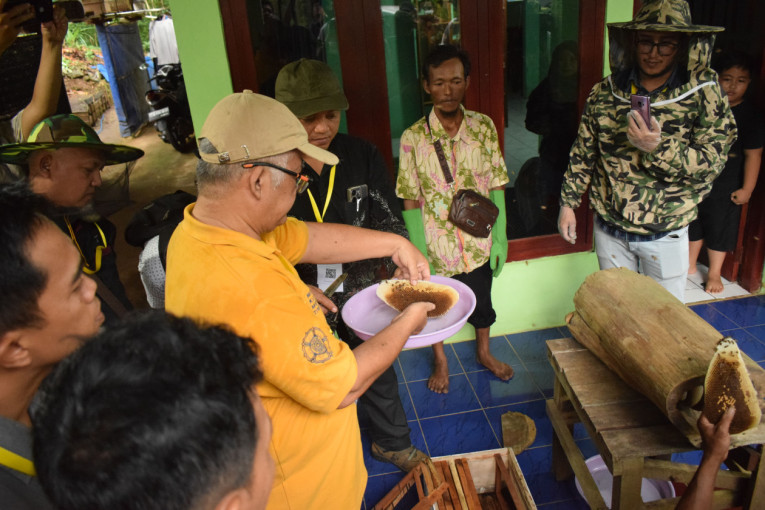
Honey continues to show its potential as a leading commodity capable of meeting domestic demand and penetrating global markets. With Indonesia’s rich tropical forests, the availability of honey as a natural nectar source provides strong capital to develop a sustainable, high-value national honey industry. It is known that there are at least 300 types of honey produced by more than 20,000 honeybee species worldwide. These types of honey are generally determined based on the type of nectar or flower pollen collected by the bees.
Professor Nanang Fakhrudin, Professor of Phytotherapy at the Faculty of Pharmacy, Universitas Gadjah Mada (Pharmacy UGM), stated that honey contains antibacterial, antioxidant, and anti-inflammatory compounds and plays a role in wound healing.
“These benefits are influenced by the phenolic composition, enzymes, sugar content, and physicochemical characteristics of honey,” Professor Fakhrudin said in a statement sent to reporters on Monday (May. 11).
According to Professor Fakhrudin, honey is increasingly favored as a natural sweetener that is low in calories and rich in nutrients. Growing public awareness in Indonesia has also encouraged the growth of honey-related businesses.
However, many business actors still lack a comprehensive understanding of key quality parameters for good honey, including water content, diastase activity, hydroxymethylfurfural (HMF) content, and sugar profiles.
“Business actors’ understanding of international standards such as the Codex Alimentarius and Indonesian National Standards (SNI) also remains limited,” he said.

Professor Fakhrudin explained that several major issues currently face actors in the honey business in Indonesia. These include low literacy about honey quality standards and key physicochemical parameters, limited understanding of scientific methods for detecting fake or adulterated honey, and restricted access to reliable, independent laboratory testing.
“Without adequate understanding, business actors will face difficulties maintaining product quality and competing in an increasingly competitive market,” he stated.
For Professor Fakhrudin, the widespread practice of honey adulteration, ranging from premature harvesting to the addition of substances such as cane sugar syrup and high-fructose corn syrup, has become a serious concern.
In addition to causing economic losses, these practices also reduce consumer trust in honey products. Fraud related to honey origin labeling also frequently occurs, with certain types of honey falsely labeled as wild forest honey or stingless bee honey to increase their market value.
In fact, various scientific methods have been developed to detect honey authenticity, including isotopic ratio mass spectrometry (IRMS), nuclear magnetic resonance (NMR), high-performance liquid chromatography (HPLC), and infrared spectroanalysis.
“These methods are still not widely understood by local honey business actors due to limited access and literacy,” he said.
In response to this situation, Professor Fakhrudin emphasized the importance of literacy approaches that account for the diverse backgrounds of communities, including farmers and actors in the honey business. Education should focus not only on theory but also on practical skills that can be directly applied in the field.
“Improving scientific literacy must be adapted to community contexts. The approach cannot be uniform but must consider their needs and connection to production activities,” he stressed.
Professor Fakhrudin hopes that through strengthened literacy and collaboration among academics, government institutions, and business actors, communities will not only be able to identify fake honey but also improve the quality of the products they produce. In this way, Indonesian honey can gain stronger competitiveness in the global market while also providing sustainable economic benefits for society.
According to him, strengthening the honey sector depends not only on the availability of natural resources but also on improving public literacy, particularly in understanding honey quality and authenticity.
“An applied research-based approach is considered key to addressing the various challenges faced by consumers and honey business actors at the local level,” he added.
Author: Jesi
Editor: Gusti Grehenson
Post-editor: Jasmine Ferdian
Photo: Faculty of Pharmacy Documentation