


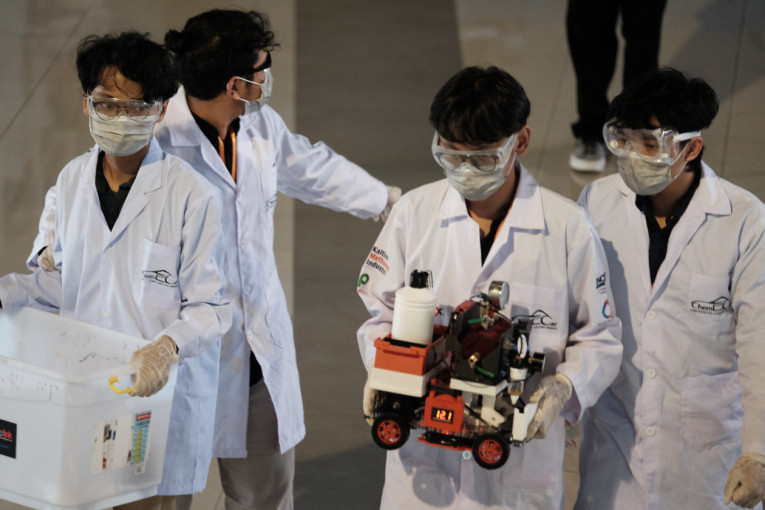
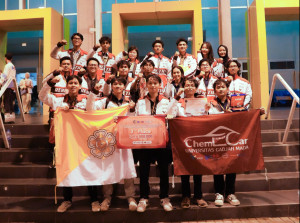
The Chemical Reaction Car Competition, organized by Institut Teknologi Sepuluh Nopember, was held once again from May 1–3. Reactics, a Universitas Gadjah Mada Chemical Engineering student community focused on developing chemical reaction-powered prototype cars, sent three teams to represent UGM in the competition. The hard work of the three teams paid off as they successfully brought home three trophies. The teams were Reactics Antrasena, which secured third place; Reactics Jayantaka, fourth place; and Reactics Antaredja, fifth place.
Asyiq Manarul Hidayah, a member of the Reactics Antrasena team, explained that the car used energy generated by the decomposition of hydrogen peroxide, which produces oxygen gas and water.
“Naturally, this reaction occurs slowly, so we needed a catalyst or substance mixed into the reaction to accelerate the reaction rate,” Asyiq said on Tuesday (May 12).
The Reactics team conducted research on several catalysts, including yeast (microorganisms), potassium iodide, and FeCl₃ (iron(III) chloride). Based on the testing results, FeCl₃ delivered the best performance in terms of economic value, reaction rate, and conversion percentage. Furthermore, Asyiq stated that the vehicle’s stopping mechanism was designed to automatically halt once the oxygen gas had been fully consumed.
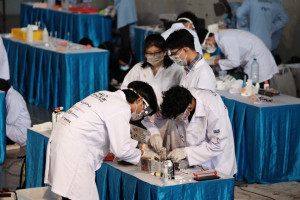
During the preparation stage, high levels of focus and precision were required from the initial design planning phase through to the vehicle’s full operational readiness in the competition arena. Evaluation processes, testing, monitoring, and routine maintenance were consistently carried out by each team to ensure that the physical model accurately realized the 3D design and produced a vehicle with optimal performance. On the day of the competition, however, the challenge shifted toward calibration accuracy.
Head of the Reactics Antrasena team, Ikbar Habibi, emphasized that the team’s strength lay not in individual abilities but in each member’s self-control and adaptability, which enabled the team to keep moving forward despite various pressures and uncertainties.
“From this competition, we learned that leadership means consistently staying focused on the goal amid many uncertainties until the team is able to complete what it has started,” he said.
Ikbar explained that the team member responsible for starting the vehicle was required to precisely control the gas valve opening. Other team members then ensured the entire system operated in an integrated manner, enabling the vehicle to stop precisely at the designated target point.
For Ikbar, this achievement was not merely about rankings but represented the outcome of a long design process that demonstrated the team’s resilience in overcoming technical challenges and pressure ahead of the competition.
Although the teams had not yet achieved their ultimate target, they regarded the experience as both an opportunity for evaluation and a motivation for continued growth. The student team is committed to strengthening its strategy, improving technical quality, and enhancing team synergy.
“By focusing on continuous research and development, the UGM Reactics Team hopes to achieve the best results in future national and international competitions,” he concluded.
Author: Aldi Firmansyah
Editor: Gusti Grehenson
Post-editor: Zabrina Kumara
Photo: Reactics Team