


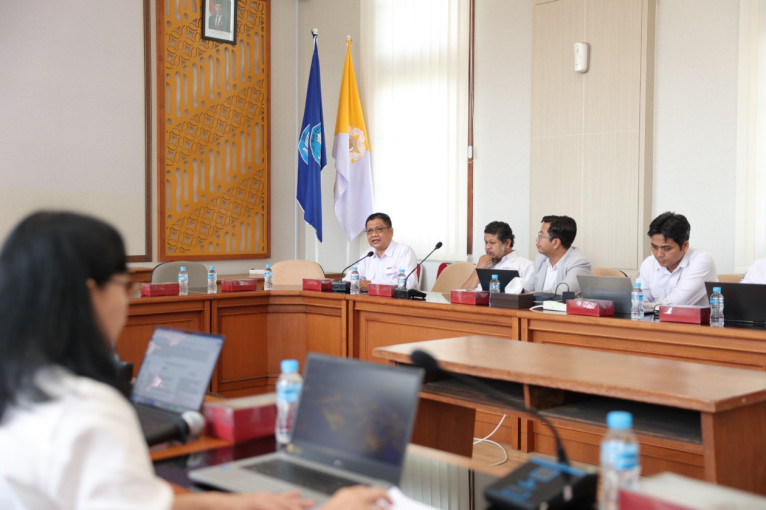
Universitas Gadjah Mada (UGM) welcomed a delegation from Universitas Sriwijaya at the UGM Central Office Building on Monday (May. 11). The visit was conducted as part of a benchmarking study and discussion on the development of integrated information systems following Universitas Sriwijaya’s transition to a Legal Entity State University (PTN-BH).
The meeting discussed various aspects of university governance, ranging from information systems, financial management, procurement of goods and services, to digital transformation within the university environment. The activity served as a platform for universities to exchange experiences in developing campus governance based on digital systems.
Vice Rector for Human Resources and Finance, Professor Supriyadi, stated that UGM had undergone the PTN-BH transition process earlier and therefore possessed extensive experience in developing university governance systems. He explained that the institutional status change had prompted UGM to continually make adjustments, including developing information systems to support academic and administrative services.
According to Professor Supriyadi, digital transformation in a university environment cannot be implemented immediately because it requires adjustments to regulations, human resources, and integration across work units. Therefore, UGM continues to gradually develop its systems so that all services can operate more effectively and be interconnected.
“We have probably spent around 10 years improving the system,” he said.
Vice Rector for Finance, Resources, Procurement, and Logistics at Universitas Sriwijaya, Professor Bernadette Robiani, stated that Universitas Sriwijaya is currently making various adjustments following its transition to PTN-BH status.
One of the main priorities is the development of an integrated information system that connects financial services, asset management, taxation, and the procurement of goods and services.
She noted that the development of such a system has become a major concern for the university because it is directly related to institutional governance and accountability. To accelerate the process, Universitas Sriwijaya has formed a cross-functional team involving experts in information technology, finance, assets, and procurement.
“We need to develop an integrated information system because the existing systems are not yet interconnected,” she explained.
Professor Robiani explained that the system development team began working a month ago, involving lecturers and students from the field of information technology. According to her, the visit to UGM was conducted because Universitas Sriwijaya sees UGM as having a mature and integrated information system across various campus service sectors. She hopes UGM’s experience in developing digital systems can serve as a reference to accelerate Universitas Sriwijaya’s transformation process.
In addition to being required to build an integrated system, Universitas Sriwijaya is facing demands from various internal stakeholders to accelerate the implementation of financial systems.
“We believe there are many things we can learn from UGM and hope we can catch up in terms of information systems more quickly,” she remarked.
In response, the Director of UGM’s Directorate of Information Technology, Professor Ridi Ferdiana, explained that the development of information systems at UGM initially operated separately within each faculty and work unit. This condition kept data and services disconnected, making the integration process lengthy.
UGM then began developing systems based on shared data structures to consolidate various services into a single digital ecosystem. According to Professor Ferdiana, the integration process was not easy because each unit had different service needs and characteristics.
“All systems have started to become integrated, although not all are yet perfect,” he explained.
Professor Ferdiana stated that service integration at UGM has been realized through Simaster, which is now used by lecturers, students, and educational staff. Through the single sign-on (SSO) system, all members of the university community can access various services with a single account.
He said the system covers academic services, finance, human resources, procurement, taxation, and campus data management. UGM has also developed supporting platforms such as hybrid cloud, data warehouse, open data services, and Internet of Things (IoT)-based systems.
“Once someone becomes a member of the university, whether as a lecturer, student, or educational staff member, they can access Simaster using a single account,” he added.
Furthermore, Professor Ferdiana explained that UGM is currently developing the concept of an intelligent university to support artificial intelligence (AI)-based data management and services. The development is being carried out by strengthening data infrastructure, AI servers, and integrating digital campus services.
According to him, AI utilization in the future will support various decision-making processes and data analysis within the university environment. In addition, UGM is developing an integrated dashboard that monitors various campus activities in real time, including transportation management and campus facilities.
Professor Ferdiana added that UGM has also started developing various campus services based on digital technology and IoT. One of the innovations being developed is a green transportation system that includes campus bicycle and vehicle access management using cameras and QR codes. The system is directly integrated with Simaster, enabling digital monitoring of user activities. According to him, the development of these services is part of UGM’s efforts to build a more efficient and environmentally friendly campus.
“We are trying to integrate campus services with digital systems so that management becomes more effective,” he said.
Director of UGM’s Directorate of Finance, Professor Syaiful Ali, explained that UGM’s financial system is currently being developed to support organizational integration and university governance. He stated that all budgeting processes, fund receipts, payments, and financial reporting are now conducted digitally through an integrated system.
The process is supported by a host-to-host system with several banks, allowing tuition payments and other financial transactions to be automatically recorded. According to Professor Ali, system integration has made administrative processes faster and more efficient than before.
“Everything has been integrated, so payment processes that previously took three to four days can now be completed within one day,” he explained.
Professor Ali said that UGM’s digital financial system also supports virtual account management, ID-based billing systems, and e-wallet-based payments for campus operations. Through the system, financial transactions among work units can be monitored more accurately and transparently. He believes system integration makes it easier for the university to control financial flows while accelerating administrative services for the university community. Even payment approval processes can now be carried out online without relying on physical documents.
“If documents are received before 3:30 p.m., payments can be completed on the same day,” he stated.
Meanwhile, Head of the Procurement Office, Teguh Sudibyo, Ph.D., explained that UGM’s procurement system has now been integrated with financial systems and other administrative services through a digital platform called Sipintar. The system is used to manage various procurement stages, ranging from planning and vendor data to e-catalogs and payment monitoring.
According to him, system integration has made procurement processes more organized and easier for the university to monitor. UGM has also begun developing an internal e-catalog to support more transparent procurement of goods and services.
“The current directive from university leadership is for all procurement to be based on e-catalogs so the process becomes more transparent and minimizes the potential for fraud,” he explained.
Sudibyo added that UGM continues to encourage changes in work patterns within procurement processes so that all transactions are conducted through digital systems. He noted that the biggest challenge in the transformation is changing the habits of procurement managers within work units.
Therefore, UGM is gradually limiting manual transactions and expanding the use of electronic systems in all procurement processes. According to him, digital systems make supervision easier while reducing the potential for irregularities in transactions.
“We continue trying to build a procurement system that is more accountable and integrated with other university services,” he concluded.
Author: Triya Andriyani
Post-editor: Jasmine
Photo: Firsto