


The World Health Organization (WHO) recorded Indonesia’s maternal mortality rate at 197 deaths per 100,000 live births in 2023, declining from 328 deaths in 2000. However, infant mortality in Indonesia remains among the highest globally, as the country is still listed among the ten largest contributors to the global maternal mortality burden.
According to data compiled in the 2023 Indonesian Health Survey (SKI), Indonesia’s maternal mortality rate remains around 177 to 189 deaths per 100,000 live births. Meanwhile, the infant mortality rate stands at approximately 16 deaths per 1,000 live births. These figures indicate the need for more comprehensive and integrated interventions to reduce maternal and child mortality, ranging from preventive measures and improved healthcare quality to the utilization of medical technology innovations.
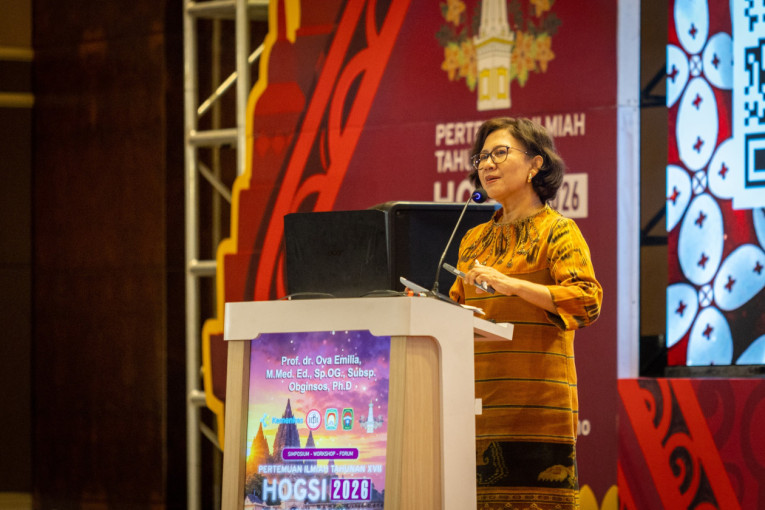
These issues were discussed during the 17th Annual Scientific Meeting of the Indonesian Society of Social Obstetrics and Gynecology (HOGSI) 2026 held at the Royal Ambarrukmo Hotel, Yogyakarta, on Tuesday, May 12. During Symposium VI, themed “Menurunkan Angka Kematian Ibu dan Anak dengan Pendekatan Strategi Terpadu” (Reducing Maternal and Child Mortality Through Integrated Strategic Approaches), three academics from Universitas Gadjah Mada presented comprehensive strategies, ranging from preconception care and strengthening the role of higher education institutions to the use of genomic medicine in reducing maternal mortality, infant mortality, and stunting.
Rector of UGM, Professor Ova Emilia, emphasized that universities play a central role in reducing maternal and infant mortality. She noted at least five strategic roles universities can undertake: education and training, research and innovation, healthy behavior campaigns, cross-sector collaboration, and healthcare services through teaching hospitals.
“Universities can serve as the brain and evidence providers, the government as regulator and large-scale implementer, while NGOs and corporations can act as facilitators and supporters,” said Professor Ova Emilia.
She further explained that universities have long implemented numerous programs to support maternal and child health, ranging from curriculum development, research, and technological innovation to community service programs, public education, and services at teaching hospitals. However, these initiatives often operate separately and remain disconnected from one another within a coordinated system.
Therefore, she encouraged the establishment of an integrated program connecting all core university functions—education, research, community service, and healthcare services—into a mutually supportive ecosystem.
“Let us create programs that are not only coordinated, but also interconnected and collaborative across initiatives,” she urged.

Echoing this concern, Shinta Prawitasari, a lecturer in the Department of Obstetrics and Gynecology at the Faculty of Medicine, Public Health, and Nursing, Universitas Gadjah Mada (FK-KMK UGM), highlighted the importance of preconception care as an initial step toward reducing maternal and infant mortality. According to her, many pregnancy complications can actually be prevented if health risk factors are detected and addressed early.
“We can identify risk factors before pregnancy, so beneficial interventions can be carried out prior to conception,” she explained.
She described preconception care as encompassing biomedical, behavioral, and social interventions provided to women and their partners before planning a pregnancy. Biomedical interventions include nutritional assessments, anemia screening, detection of non-communicable diseases such as diabetes and hypertension, immunization, and screening for infections.
From a behavioral perspective, couples are encouraged to adopt healthier lifestyles, including quitting smoking, improving dietary habits, and planning pregnancy at the appropriate time. Meanwhile, the social aspect includes education, women’s empowerment in decision-making, and the prevention of domestic violence.
“By detecting risk factors before pregnancy, interventions can be carried out earlier and more effectively,” she added.

Meanwhile, Professor Gunadi at FK-KMK UGM explained how genomic medicine could create new opportunities to reduce infant mortality and the prevalence of stunting in Indonesia. According to him, this approach utilizes individuals’ genetic information to improve diagnostic accuracy, predict disease risks, and determine more precise treatments based on each patient’s biological characteristics.
“Genomic medicine is no longer a future concept. One of its applications is reducing infant mortality and stunting,” he said.
He explained that genomic technology can be used to detect genetic disorders in newborns, diagnose rare diseases that often go unidentified, and support precision therapy, making treatments more effective. In the context of stunting, he emphasized that the condition is not solely caused by inadequate nutritional intake, but is also influenced by genetic, epigenetic, gut microbiota, infectious, and environmental factors.
Indonesia has also developed the Biomedical and Genome Science Initiative (BGSi), with Dr. Sardjito Hospital and UGM serving as referral centers for rare diseases. Through this program, Indonesia has collected more than 20,000 whole-genome sequencing datasets from the Indonesian population to develop genomic-based healthcare services.
Nevertheless, he noted that the broader implementation of genomic screening still faces challenges, particularly the high cost of testing and the need for accessible, affordable therapies.
“Its wider implementation still requires regulatory support, infrastructure, and accessible diagnostic and treatment services so the benefits can be enjoyed more equally by the public,” Professor Gunadi concluded.
Author: Cyntia Noviana
Editor: Gusti Grehenson
Post-editor: Zahra
Photo: Donnie