


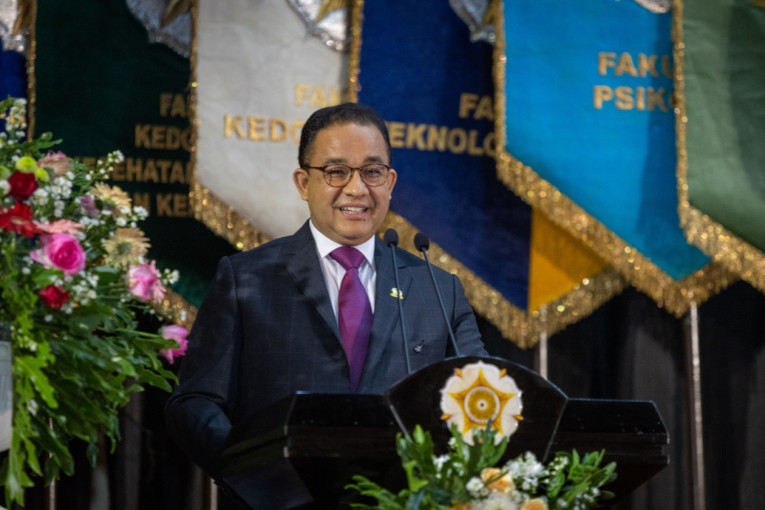
Before thousands of Universitas Gadjah Mada (UGM) graduates, Anies Baswedan reminded them that graduation day is indeed special, but the journey afterward will be filled with ordinary days. According to him, it is precisely during those ordinary days that a person’s character is truly tested. Anies believes this year’s graduates are entering more difficult economic conditions and a more competitive job market compared to previous generations. However, history has shown that generations raised during difficult times often become the strongest.
“Tomorrow is an ordinary day, and the real test does not happen on special days like today, but during the long ordinary days that follow,” he said in a speech representing the Advisory Board of the Central Executive Board of KAGAMA on Wednesday (May. 20) at Grha Sabha Pramana.
Anies explained that life’s challenges will always come and go in different forms. Difficult times and easier times, according to him, are not the primary factors determining the direction of one’s life. What matters most is an individual’s ability to learn and endure in every circumstance. He encouraged graduates not to fear uncertainty, as every generation faces its own challenges.
“Generations graduating during difficult times often become the strongest because they learn to persevere and find solutions amid limitations,” he remarked.
He then spoke about first jobs, which are often viewed as too small or less than ideal by young graduates. Anies explained that a first job is not about position or high income, but rather a space for character formation. Through a first job, individuals learn to uphold responsibility, keep promises, and complete simple tasks sincerely. Small experiences that may appear insignificant often become the foundation of a long-term career journey.
“Do not wait for the perfect job to give your best, because character is built precisely through small things carried out with full responsibility,” he said.

Anies also reminded graduates about the challenges of entering institutions and professional work systems. In professional environments, individuals can gradually lose their idealism as they become accustomed to unhealthy practices. He emphasized the importance of maintaining supportive friendships, cultivating reading habits, and continuously remembering the original reasons for choosing a particular path in life. According to him, principles must be upheld even as positions and circumstances continue to change.
“Positions may change over time, but principles must endure across generations,” Anies advised.
In his speech, Anies noted that every UGM graduate carries a social responsibility after leaving campus. He said UGM has long been known as a university of struggle with a strong concern for society. Therefore, UGM graduates are expected to become part of the solution to the nation’s problems. He encouraged graduates not to stop at ideas alone, but to courageously engage directly in social life.
“If good people choose to remain silent, then the problems in this country will never be resolved,” he stated.
Anies then shared the personal message he remembers most from his mother. According to him, the most valuable thing a person possesses in life is a good name. Positions, wealth, and status may change at any time, but one’s good name will always remain attached to them. Anies believes that the measure of success in life is not praise, but the benefit one brings to others.
“What we truly possess is only our good name, so protect it well,” he said.
Closing his speech, Anies encouraged graduates to realize that the future is built through small decisions made every day. He recalled once sitting as a graduate in the same place, unaware of what life journey awaited him after graduation. According to him, a person’s life is shaped not by a single major decision, but by the accumulation of simple choices made consistently over time.
“Congratulations on embracing the future, because the real journey of life begins with the simple decisions you make after leaving this campus,” he concluded.
Author: Triya Andriyani
Post-editor: Jasmine Ferdian
Photo: Donnie