


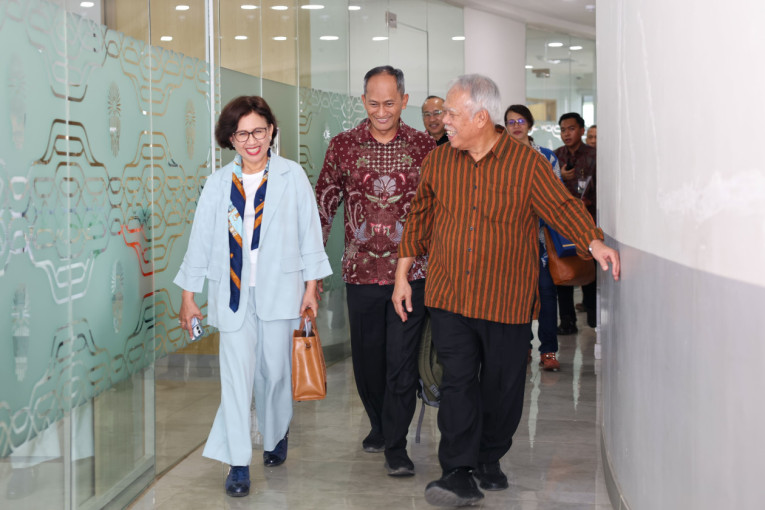
Universitas Gadjah Mada (UGM) continues to strengthen its contribution to the development of Indonesia’s future capital, Nusantara (IKN), through the management of the Wanagama Nusantara area and the utilization of the Institute for Future Life (IFL) Building, entrusted by the Nusantara Capital Authority (OIKN) to support the implementation of the university’s Three Pillars of Higher Education (Tri Dharma Perguruan Tinggi).
This strengthened synergy was marked by an audience between OIKN Head Basuki Hadimuljono and UGM Rector Professor Ova Emilia at the OIKN Office on Friday (Jun. 5). During the meeting, OIKN officially transferred management of the IFL Building to UGM. The audience also served as a forum for the signing of a Cooperation Agreement and discussions on plans to establish UGM postgraduate programs in IKN.
Professor Ova Emilia stated that the IFL Building will serve as a center for academic activities, including education, research, scientific discussions, training programs, and various community service initiatives.
“The presence of this facility is expected to strengthen UGM’s role in developing human resources, research, and innovation that are relevant to the needs of IKN’s development,” she said on Monday (Jun. 8).
In addition to supporting the implementation of Tri Dharma Perguruan Tinggi, the IFL Building is projected to become one of the centers for developing UGM’s postgraduate programs in Nusantara. The presence of these programs is expected to strengthen the higher education and research ecosystem while supporting the need for future talent and leadership in the development of IKN.

During the event, Professor Ova Emilia said that both parties also discussed opportunities for collaboration in education, research, technological innovation, environmental management, and the development of science-based policies. These initiatives are considered important in supporting the development of IKN as a future city that integrates technological advancement, environmental sustainability, and human resource capacity building.
“This collaboration confirms that the development of IKN is not solely focused on physical infrastructure, but also on advancing science, innovation, education, and environmental conservation as the foundation for Nusantara’s long-term development,” she said.

According to Professor Ova Emilia, the collaboration forms part of the joint efforts of UGM and OIKN to build an education, research, and innovation ecosystem that supports the realization of IKN as a Smart Forest City.
“UGM’s presence in Nusantara further underscores the role of higher education institutions in supporting the development of a sustainable, science-based national capital,” she explained.
As is known, Wanagama Nusantara, located within the IKN area, is managed by UGM as a natural laboratory for the development of education, research, and community service. The area is expected to become a center for the development of science and technology, with a focus on environmental management, forestry, biodiversity conservation, and sustainable development.
Through the management of Wanagama Nusantara, UGM, and OIKN, they are committed to strengthening collaboration to support the realization of IKN as a Smart Forest City and a modern, inclusive, and sustainable national capital.
Author: Jelita Agustine
Editor: Gusti Grehenson
Post-editor: Jasmine Ferdian
Photo: OIKN Documentation