


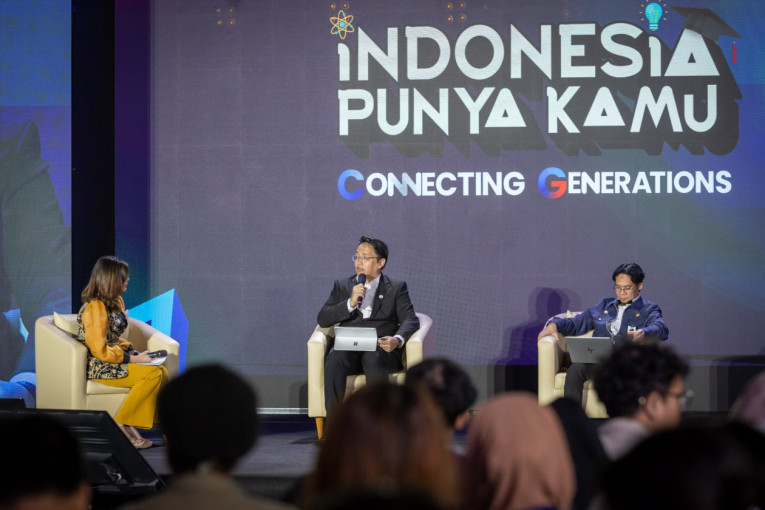
The waste issue can no longer be viewed solely as an environmental concern. With the right approach, waste can become a valuable economic resource while contributing to national energy resilience. Therefore, the government continues to promote the development of waste processing technologies, including Waste-to-Energy Power Plants (PLTSa).
In support of this agenda, the Ministry of Higher Education, Science, and Technology (Kemdiktisaintek) serves as a driving force for the national research ecosystem through three main priorities: governance improvement, social transformation, and technological development.
“Kemdiktisaintek has three primary roles: governance improvement, social transformation, and technology itself,” said Director General of Research and Development at Kemdiktisaintek, Dr. Mohammad Fauzan Adziman, during the Indonesia Punya Kamu Dialogue titled “Peran Perguruan Tinggi dalam Mendukung Ketahanan Energi Nasional” (The Role of Higher Education Institutions in Supporting National Energy Resilience), organized by UGM and Garuda TV at UGM’s Innovation and Creativity Hub (GIK) on Friday (Jun. 12).
Dr. Adziman further explained that approximately 50 percent of Indonesia’s waste consists of organic waste that can still be processed, while another 25 percent has recycling potential. The remaining residual waste can be utilized as an energy source through electricity generation technologies.
Despite its significant potential, the development of waste-to-energy technologies continues to face several challenges, particularly at the industrial scale. To address these obstacles, the government is strengthening collaboration among universities, industry, research institutions, and international partners to accelerate the downstream implementation of research outcomes related to waste processing.
Dr. Adziman noted that universities make substantial contributions to research on waste management and energy.
“Based on the ministry’s mapping, UGM is among the institutions with the highest number of studies in this field,” he said.
According to Dr. Adziman, successful waste management also depends heavily on behavioral change within society. Waste segregation at the household level is the most fundamental step to ensure that processing systems operate effectively. To support this effort, universities are encouraged to engage in community empowerment and service programs that directly involve students.
Meanwhile, Head of the Energy and Manufacturing Research Organization at the National Research and Innovation Agency (BRIN), Professor Cuk Supriyadi Ali Nandar, emphasized the importance of strengthening waste management from upstream sources.
He revealed that Indonesia’s national waste volume is projected to continue increasing, reaching more than 146,000 tons by 2029. This situation requires management systems that begin at the source, particularly at the village level.
“To support this program, we must start upstream, namely from villages,” he said.
According to Professor Nandar, villages occupy a strategic position because most organic waste can be managed before it mixes with inorganic waste. Once waste becomes mixed and ends up at a landfill, the processing system becomes much more difficult and less efficient.
In addition to strengthening management systems, Professor Nandar believes that private-sector involvement is essential to building a waste-based circular economy ecosystem. He hopes that more investors and business actors will be interested in developing Indonesia’s waste processing industry.
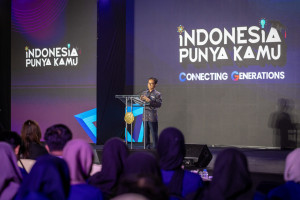
UGM Vice Rector for Research, Business Development, and Cooperation, Dr. Danang Sri Hadmoko, highlighted the strategic agenda of energy transition, which will shape the future of sustainable energy utilization in Indonesia.
According to him, efforts to create a clean, reliable, affordable, and equitable energy system require the participation of all elements of society, including younger generations.
“For Indonesia, the energy transition is an extremely important agenda. The challenge is how to achieve a clean, reliable, affordable, and equitable energy transition that aligns with the nation’s characteristics,” he said.
According to Dr. Hadmoko, the energy transition cannot be addressed through a single academic discipline. The complexity of energy challenges requires a multidisciplinary approach integrating technological, economic, environmental, social, and public policy perspectives.
As a comprehensive university with expertise across diverse fields, UGM seeks to promote cross-disciplinary collaboration to generate solutions that meet societal needs.
“Energy issues cannot be solved by only one field of study. Therefore, as a comprehensive university, UGM employs an interdisciplinary approach to address these challenges,” he explained.
He also emphasized the importance of the media’s role in supporting a successful energy transition. According to Dr. Hadmoko, the media holds a strategic position in building public communication, improving public literacy, and expanding understanding of the various energy issues facing Indonesia.
“This collaboration demonstrates how important the media’s role is in public communication,” he said.
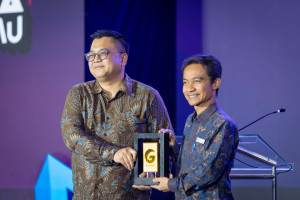
On the sidelines of the dialogue, UGM also showcased the eKarsa electric vehicle, an innovation developed by the Department of Electrical Engineering and Information Technology (DTETI) UGM. The vehicle was designed to support visitor mobility at the UGM Academic Hospital (RSA UGM) while serving as a tangible example of the downstream implementation of university research.
Head of the Electrical Engineering Study Program at DTETI UGM, Dr. Iswandi, explained that the development of eKarsa is the result of synergy among education, research, community service, and industry collaboration. Through this partnership, innovations developed on campus do not stop at the research stage; they can be applied directly to address community needs.
Dr. Iswandi added that eKarsa uses components readily available in the domestic market, making maintenance and part replacement easier. This approach also supports efforts to strengthen national technological independence in electric vehicle development.
“We use components that are available on the market, so if something breaks, there is no need to purchase parts from abroad. We use components that are easy to obtain,” he concluded.
Author: Zabrina Kumara
Editor: Gusti Grehenson
Post-editor: Jasmine Ferdian
Photo: Donnie