


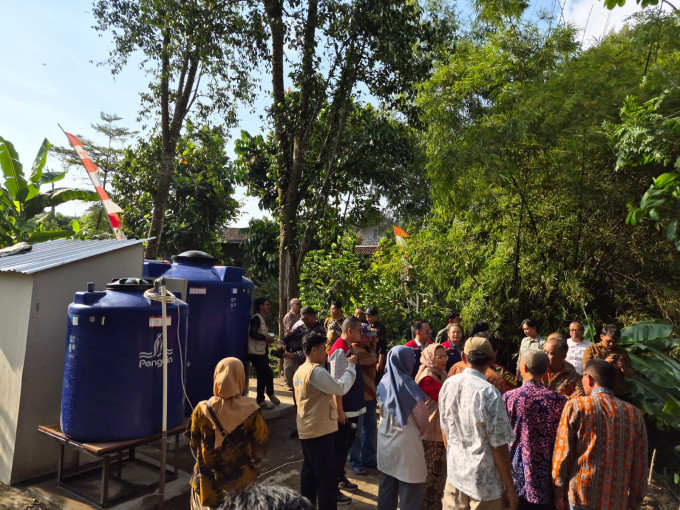
The Vocational College of Universitas Gadjah Mada (SV UGM) is supporting sustainable access to clean water for the residents of Gemawang, Sinduadi, Sleman Regency, through the HK WASH Infra (Water, Sanitation, and Hygiene Infrastructure) program. As part of the “Nandur Tuk Banyu” initiative, the program is implemented through a collaboration between Kinarya Anak Bangsa Foundation, PT Hutama Karya (PT HK), and UGM’s technical team to improve access to clean water while conserving water resources.
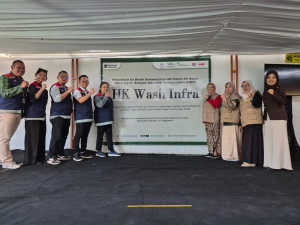
The HK WASH Infra program was officially handed over to the community of Gemawang Hamlet by Dianita Saraswati, Head of PT HK’s Social and Environmental Responsibility (TJSL) Unit. The event was attended by the Sleman Regent, Harda Kiswaya, Head of the Sleman Environmental Agency, Junaidi. Representatives of the Serayu Opak Progo Watershed Management Agency (BPDAS), officials from the Mlati District Administration and Sinduadi Village Administration, as well as Rosita Yuwanasari Suwardi Wibawa, Founder of the Kinarya Anak Bangsa Foundation.
In this program, the Department of Civil Engineering of SV UGM provided technical support from planning through implementation. The system developed includes the Gama Rain Filter Rainwater Harvesting Installation (IPAH), combined with Reverse Osmosis (RO) technology, ultraviolet (UV) treatment, and the management of spring water sources long utilized by locals.
The UGM technical team consists of Professor Agus Maryono, Pratama Tirza Surya Sembada, Hendra Agus Herlambang, and students participating in the Teaching Factory (TeFa) Water Resources and Rainwater Harvesting program through a Project-Based Learning scheme, namely Sandhy, Wichak, and Aji.
Pratama Tirza Surya Sembada, Laboratory Assistant at the Hydraulics and Environmental Engineering Laboratory and Workshop of the Department of Civil Engineering, SV UGM, explained that the program originated from an assessment of water resource conditions in the Gemawang area.
“For years, residents have relied on spring water located along the Code River to meet their daily needs. However, during prolonged dry seasons, water discharge tends to decline, affecting water availability for the community,” said Tirza on Tuesday (Jun. 23).
According to Tirza, observations indicate that water currently managed by the community shows signs of iron (Fe) contamination. This condition requires alternative water sources that provide high-quality, sustainable availability.
“Gradually, locals are being educated about alternative water sources with good quality that can meet their daily water needs, namely rainwater,” he said.
In addition to improving clean water through rainwater harvesting in densely populated areas, the UGM team is encouraging the reduction of surface runoff to mitigate flooding. The selection of the Gama Rain Filter technology was based on scientific considerations that rainwater is naturally of good quality, provided the collection surface, such as a clean rooftop.
Therefore, the Gama Rain Filter system is equipped with three primary filtration stages: a leaf filter, a coarse dust filter, and a fine dust filter. The resulting water meets clean water standards. The system is further enhanced with Reverse Osmosis (RO) and ultraviolet (UV) technologies to remove bacteria and extremely small particles that may not be caught during the initial filtration process.
“Rainwater already has good quality if the collection surface, such as a roof, is clean. Therefore, the Gama Rain Filter Rainwater Harvesting Installation is equipped with three main filtration stages: a leaf barrier filter, a coarse dust filter, and a fine dust filter that can purify rainwater to meet clean water and even drinking water quality standards,” explained Tirza.
Tirza noted that optimizing rainwater harvesting is one of the key strategies for creating sustainable water resource availability. Conservation efforts under the Nandur Tuk Banyu initiative include constructing infiltration wells, biopores, and water retention pits, as well as planting conservation vegetation to balance the hydrological cycle.
“The Nandur Tuk Banyu program aligns with SDG 6 on Clean Water and Sanitation. Optimizing the potential of rainwater can be one way to ensure sustainable water resource availability,” he said.
As the pioneer of the Indonesian Rainwater Harvesting Movement (GMHI), UGM views programs such as HK WASH Infra as tangible implementations of science-based innovation capable of addressing water resource management challenges at the community level.
“In the future, there should be no areas that experience flooding during the rainy season but require water assistance during the dry season,” added Sembada.
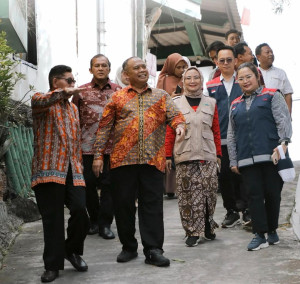
Rosita Yuwanasari Suwardi Wibawa, Founder of the Kinarya Anak Bangsa Foundation, stated that the program embodies the spirit of the “Nandur Tuk Banyu” initiative, which is registered as SDGs Action #51577. The program focuses not only on access to clean water but also on environmental conservation, protection, and maintenance of springs and tree planting in upstream and downstream areas.
Meanwhile, Dianita Saraswati, Head of the TJSL Unit of PT HK, emphasized that the HK WASH Infra program reflects the company’s commitment to delivering infrastructure that directly contributes to community welfare and environmental sustainability.
Sleman Regent Harda Kiswaya praised the collaboration among educational institutions, industry, government, and local communities in addressing residents’ basic needs.
“This program is in line with the Sleman Regency Government’s efforts to improve community welfare through the provision of adequate basic infrastructure,” he said.
Through this multi-stakeholder collaboration, the HK WASH Infra program in Gemawang Hamlet serves as an example of applying science-based innovation to support access to clean water, environmental conservation, and sustainable development while delivering direct benefits to the community.
Author: Zabrina Kumara
Editor: Gusti Grehenson
Post-editor: Jasmine Ferdian
Photo: Kinarya Anak Bangsa Foundation Documentation