


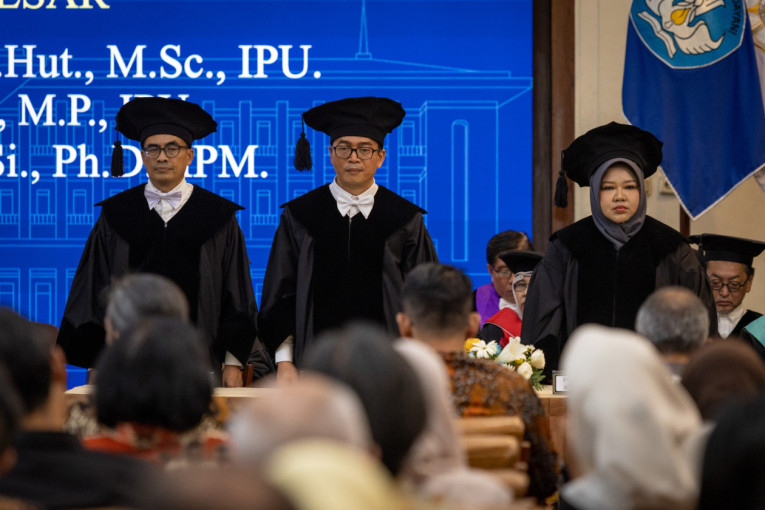
The Faculty of Forestry at Universitas Gadjah Mada (Forestry UGM) has expanded its ranks of active professors with the inauguration of three faculty members during a ceremony held on Thursday (Jun. 25) at the UGM Senate Hall. The newly inaugurated professors are Professor Denny Irawati, Professor Sena Adi Subrata, and Professor Sapto Indrioko.
Chair of the UGM Professorial Council, Professor Baiquni, stated that the three newly inaugurated scholars bring the total number of active professors at UGM to 544. Within Forestry UGM, there are 19 active professors out of 33.
Inaugurated as Professor of Wildlife Ecology, Professor Sena Adi Subrata delivered his inaugural address titled “Kontribusi Teknologi Genomik Untuk Konservasi Satwa Liar dan Ekosistem Hutan” (The Contribution of Genomic Technology to Wildlife Conservation and Forest Ecosystems). In his speech, he highlighted that Indonesia’s management of wildlife species diversity has yet to reach its full potential. The importance of applying genomic technology for wildlife conservation and protecting forest ecosystems that are increasingly threatened by extinction.
Research conducted by Professor Sena and his team over the past five years has demonstrated the advantages of genomic technology in detecting genetic variation within populations in greater detail. The technology also provides evidence of inbreeding in the management of species with small population sizes. Genomic technology can identify the composition of living organisms by analyzing DNA fragments found in the environment.
However, the research has faced numerous challenges in sample collection. Indonesia’s warm and humid tropical climate causes samples to deteriorate quickly and DNA strands to degrade. As a result, blood and tissue samples from deceased animals remain the gold standard for sample collection. The research is further supported by high-throughput sequencing technology, which generates tens of millions of DNA sequence reads.
“All of this requires a solid understanding of wildlife ecology, expertise in classical population genetics, mastery of molecular techniques, and the ability to process big data. Cross-disciplinary collaboration is therefore essential to accelerate research,” he explained.
The application of genomic technology has made significant discoveries about Indonesia’s native wildlife, including strategies for protecting the maleo bird’s population and habitat, identifying the prey species of the Javan leopard, revealing the ecological role of forest rodents, and documenting wildlife diversity in Kalimantan’s forests. These findings provide valuable information for improving wildlife population and ecosystem management.
“Wildlife represents an extraordinary evolutionary history. Genomic technology opens a window into that history, and we have a responsibility to preserve it,” Professor Sena concluded.
Meanwhile, Professor Sapto Indrioko was inaugurated as Professor of Tree Breeding. In his inaugural address, titled “Pelestarian, Pemanfaatan, dan Pengambilan Sumber Daya Genetik dalam Mendukung Pembangunan Hutan Tropika Berkelanjutan di Indonesia” (Conservation, Utilization, and Acquisition of Genetic Resources to Support Sustainable Tropical Forest Development in Indonesia), he discussed the importance of genetic resources in maintaining the diversity of tropical forest flora and fauna.
Genetic diversity plays a crucial role in sustaining reproduction and survival in the short term while facilitating adaptive evolution over the long term. As a result, organisms are better protected against risks such as inbreeding, environmental change, pest outbreaks, and climate change.
Professor Sapto Indrioko explained that species distribution is shaped not only by natural processes but also by human activities. Human intervention can have positive impacts through the establishment of high-quality seed sources and well-managed forest rehabilitation, both of which help maintain genetic diversity within populations.
Conversely, low genetic diversity increases vulnerability to pathogens and ultimately threatens the sustainability of forest resources. He stressed the need for stronger government support for genetic resource conservation.
“Collaboration among stakeholders is essential to support the conservation, utilization, and wise development of natural resources,” he said.
He explained that genetic diversity plays an important role in improving forest productivity through tree breeding. Strong genetic diversity enables genetic recombination that produces more productive individuals.
One practical application is enhancing the productivity of humid tropical forests dominated by Dipterocarp species, which naturally occur in Kalimantan.
“Although Dipterocarps are native to Kalimantan, challenges remain regarding adaptation, growth rate, and species characteristics. Efforts are therefore needed to obtain genetic material that is better suited to specific planting objectives,” he said.
The inauguration ceremony continued with an address by Professor Denny Irawati, inaugurated as Professor of Biomaterial Conversion Science. In her inaugural lecture, titled “Konversi Biomaterial Ramah Lingkungan dalam Mendukung Transisi Energi dan Ekonomi Sirkular Masyarakat” (Environmentally Friendly Biomaterial Conversion to Support the Energy Transition and a Circular Economy), she discussed biomaterial conversion for energy-producing products as a key component of social and economic development.
Professor Denny Irawati noted that Indonesia possesses abundant renewable energy resources. The country’s geographic location also supports year-round biomass production. However, only about 7 percent of its estimated 23,000 MW biomass energy potential has been utilized.
Biomass offers numerous advantages as a renewable energy source, including year-round availability, lower costs, and the flexibility to be processed into a variety of products.
“The valuable components contained in biomass determine the most suitable products and processing methods,” she explained.
She also introduced the concept of biorefineries, which are classified based on feedstock and process flexibility. In sugar-based biorefineries, sugars are fermented into biofuels and high-value chemicals. Meanwhile, thermochemical processes convert biomass into energy through controlled heat treatment at specific temperatures.
“Biorefineries are expected to meet both current and future market demands, enabling sustainable production while creating employment opportunities,” she said.
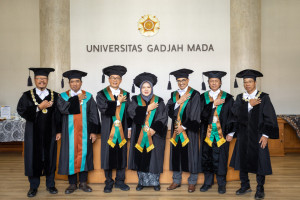
Given Indonesia’s abundant biomass resources, Professor Denny Irawati emphasized that biomass conversion is a strategic approach that integrates the use of biological resources with sustainability principles. She called for various stakeholders to promote the widespread and sustainable implementation of biomass conversion technologies.
“With a well-directed approach, biomass conversion can become more than an alternative energy source. It can serve as the foundation for building an independent, equitable energy system based on Indonesia’s local potential,” she concluded.
Author: Cyntia Noviana
Editor: Gusti Grehenson
Post-editor: Jasmine Ferdian
Photo: Donnie