


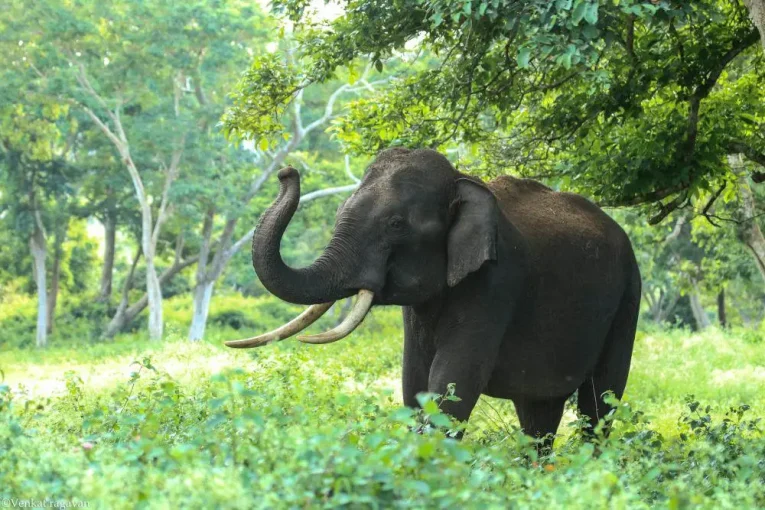
A farmer in Lampung was reportedly killed after being attacked by a herd of wild elephants in the Bukit Barisan Selatan National Park (TNBBS) in West Lampung Regency. The victim is believed to have died after the hut was surrounded by a passing elephant herd. When authorities discovered the site, the hut had been severely damaged. According to TNBBS officials, they had repeatedly warned the public not to build shelters in the area because it is a traditional elephant corridor frequently used by the animals.
Responding to the incident, Professor Wisnu Nurcahyo of UGM’s Faculty of Veterinary Medicine (FKH UGM) said human-elephant conflicts are rising mainly because elephants’ natural habitat is shrinking and fragmenting. Forest conversion, oil palm expansion, and deforestation are pushing herds out of their habitat in search of food and water.
“Elephant herds usually approach or enter human settlements because their natural habitat has been reduced or fragmented. This compels them to seek food and water in areas now occupied by people. This behavior is essentially a natural survival response rather than an act of aggression,” he said on Friday (Jul. 3).
Professor Nurcahyo added that elephants are particularly attracted to agricultural crops cultivated by local communities, such as oil palm, rice, and bananas. These crops offer nutrition compared with the increasingly limited food available in their natural habitat.
In addition to food scarcity, Professor Nurcahyo explained that every elephant herd follows traditional migration routes passed down through generations. When these routes are blocked by roads, settlements, or other infrastructure, elephants will still attempt to pass through, as this is part of their natural behavior.
“Elephants have traditional movement routes inherited from previous generations within the herd. If these routes are blocked by roads or buildings, they continue to move through those areas because of their natural instincts,” he said.
Nevertheless, Professor Nurcahyo emphasized that elephants generally do not behave aggressively without reason. Attacks on humans are typically defensive responses when elephants perceive threats to themselves or their calves. Inappropriate attempts to drive elephants away, such as violence, loud noises, or throwing objects, can trigger panic and increase the risk of attacks.
According to Professor Nurcahyo, temporary shelters and people staying overnight within forest areas also increase the likelihood of conflict. When elephant herds move through the forest in search of food or along their natural migration routes, structures built within these corridors may be knocked down, putting anyone inside at serious risk.
“When elephant herds pass through in search of food or along their natural routes, shelters occupied by people can become targets or be destroyed by the herd, potentially resulting in fatal attacks,” he explained.
For this reason, Professor Nurcahyo stressed the importance of enforcing regulations that prohibit land clearing, farming, and the construction of shelters in core zones and conservation forests. These rules are essential to protect elephant habitats and reduce human-wildlife conflict.
Furthermore, Professor Nurcahyo noted that elephant attacks also indicate a broader ecological crisis. Habitat loss, deforestation, and habitat fragmentation threaten the long-term survival of elephant populations. As habitat quality declines, elephants increasingly leave the forest in search of resources, resulting in frequent interactions with humans. Consequently, conflicts between elephants and people are becoming more common as the animals’ habitat continues to shrink.
“As their living space becomes more limited, the potential for conflict increases significantly,” he said.
Professor Nurcahyo said the safest way to respond to encounters with wild elephants is to maintain a distance of at least 50 meters, seek shelter behind a large tree, and move against the wind so human scent is less likely to be detected. The public should remain calm and avoid actions that could provoke elephant herds and trigger defensive behavior.
“The most important thing is to stay calm and avoid panicking because elephants have highly developed hearing and a keen sense of smell. Panic or shouting can trigger their defensive response,” he said.
From an animal health and conservation perspective, Professor Nurcahyo emphasized that conflicts not only reduce animal welfare through injuries and chronic stress but also threaten the survival of elephant populations. Chronic stress weakens elephants’ immune systems and reduces reproductive success.
Systems to monitor and mitigate human-elephant conflicts have already been introduced through various measures, including GPS-based movement tracking, local response units, and habitat zoning. However, implementation remains largely reactive and should be strengthened through more preventive approaches grounded in animal behavior science and landscape management.
“Current implementation is still largely reactive. Effective prevention requires stronger scientific approaches to animal behavior and landscape management,” he said.
Several technologies have been adopted to minimize conflicts, ranging from electric fences to carbide cannons and smoke bombs to safely redirect elephant herds. Habitat restoration through food enrichment within forest areas is also essential to discourage elephants from leaving the forest in search of crops. Digital tools such as IoT-based early warning systems, LoRaWAN technology, AI-powered smart camera traps, and bioacoustic detection should be further strengthened to monitor elephant movements and alert nearby communities before conflicts occur.
On the other hand, Professor Nurcahyo emphasized that resolving human-elephant conflicts cannot rely solely on technology but requires collaboration among multiple stakeholders. The government needs to integrate elephant migration corridors into spatial planning to prevent development from fragmenting wildlife habitats. Conservation area managers should strengthen habitat restoration, patrols, and rapid response units in high-risk areas. Meanwhile, locals are encouraged to implement community-based mitigation measures, such as planting crops that elephants tend to avoid along forest boundaries, maintaining shared early warning systems, and developing alternative livelihoods, including elephant-based ecotourism. Through these collaborative efforts, Professor Nurcahyo hopes conservation initiatives can go hand in hand with protecting communities living near elephant habitats.
“To achieve balanced protection for both people and elephants, collaboration among all stakeholders is essential. The government must integrate wildlife habitats into spatial planning, conservation managers need to restore habitats and strengthen patrols, while communities should adopt mitigation measures such as living fences or productive crops that elephants dislike,” he concluded.
Author: Zabrina Kumara
Editor: Gusti Grehenson
Post-editor: Jasmine Ferdian
Photo: Pexels