


Dien Muhammad Scientivan Kurnia Pramono, a 2024 batch student in the Information Technology undergraduate program at the Faculty of Engineering, Universitas Gadjah Mada (FT UGM), has brought international recognition to Indonesia through his achievements in a blockchain technology competition. Dien, who also serves as Technical Lead of the UGM Blockchain Club (UGMBCC), won two award categories at the UHI9 Hookathon, the final competition of the Uniswap Hook Incubator (UHI) Batch 9 incubation program organized by Atrium Academy.
His success earned him first place in both the Impermanent Loss & Yield Systems Track and the Reactive Network Track. Each category carried a prize of USD 1,000, bringing his total award to USD 2,000. Competing individually against participants from around the world, Dien secured the achievement in a competition with a total prize pool of USD 25,000 across three categories: Impermanent Loss & Yield Systems (USD 13,000), General Track (USD 7,000), and Reactive Network (USD 5,000). The winners were officially announced by Atrium Academy through its X (formerly Twitter) account on Friday (June 19).
Dien Muhammad explained that the UHI9 Hookathon is an international competition held as part of the Uniswap Hook Incubator program. The program brings together blockchain developers from around the world to design hook-based solutions for Uniswap v4.
“Before entering the competition, participants had to go through a selection process involving document submission and interviews, followed by a series of intensive workshops before advancing to the final stage, a hackathon, or what the program refers to as the Hookathon,” he said on Friday (July 3).
Meanwhile, Uniswap is one of the world’s largest decentralized exchange (DEX) protocols, enabling users to trade digital assets without intermediaries. In its latest version, Uniswap v4 introduces Hook, an additional module that allows developers to embed custom logic into each liquidity pool, making liquidity management mechanisms adaptable to the needs of various decentralized applications.

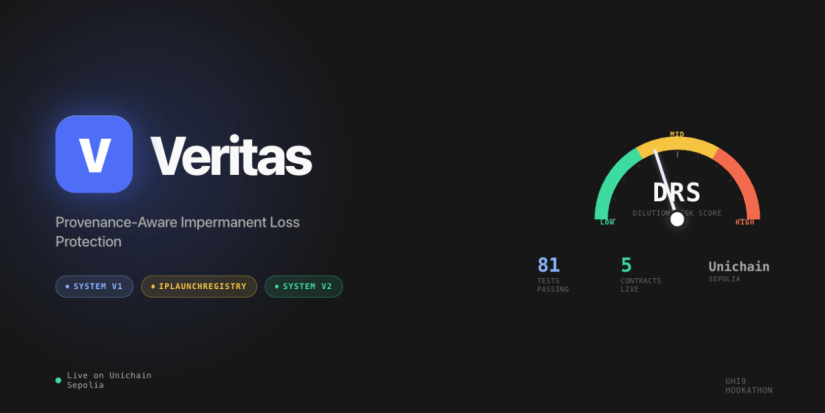
For the competition, Dien developed a project called Veritas, a system built on Uniswap v4 that transforms content authenticity signals into an on-chain risk metric, the Dilution Risk Score (DRS). The score functions as a filtering mechanism to prevent duplicated or AI-generated replicated content from receiving funding while automatically adjusting protection fees for liquidity providers (LPs).
“Through this approach, the risk of impermanent loss, which has long been a challenge for liquidity providers, can be reduced without requiring a centralized authority,” he said.
To enable the system to operate automatically, Veritas leverages Reactive Network, a blockchain network that allows smart contracts to respond automatically to on-chain and cross-chain events without user intervention. Through this integration, the Dilution Risk Score can be updated in real time whenever conditions within a liquidity pool change, even if those changes originate from another blockchain.
“This mechanism has also been successfully tested on a testnet, demonstrating the system’s ability to update the score reactively based on the latest conditions,” he explained.
Dien’s achievement in winning two competition categories individually demonstrates the ability of Indonesian students to develop innovative solutions in decentralized finance (DeFi) infrastructure that can compete on the global stage. The accomplishment also reinforces UGM’s commitment to nurturing outstanding talent capable of advancing digital technologies, particularly in blockchain.
Reporter: Rasya Swarnasta/FT UGM
Author: Cyntia Noviana
Editor: Gusti Grehenson
Post-Editor: Priyanandaningrat
Photo: Documentation of Dien Muhammad