



Macromolecules have evolved since the early 1920s across various fields, including chemistry, biochemistry, food science, and molecular biology, with their applications continuing to expand within these disciplines. In general, macromolecules are defined as large molecules composed of repeating units or complex structures with relatively high energy, originating from either natural or synthetic sources. Indonesia possesses abundant biodiversity that provides rich sources of plant-derived, animal-derived, marine, and microbial macromolecules.
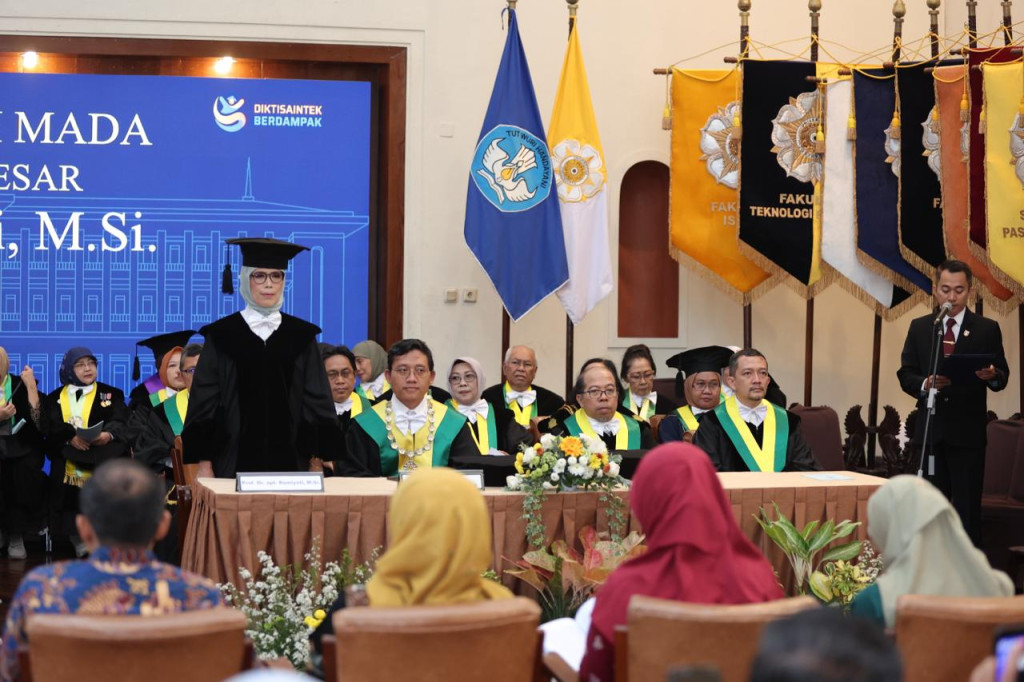
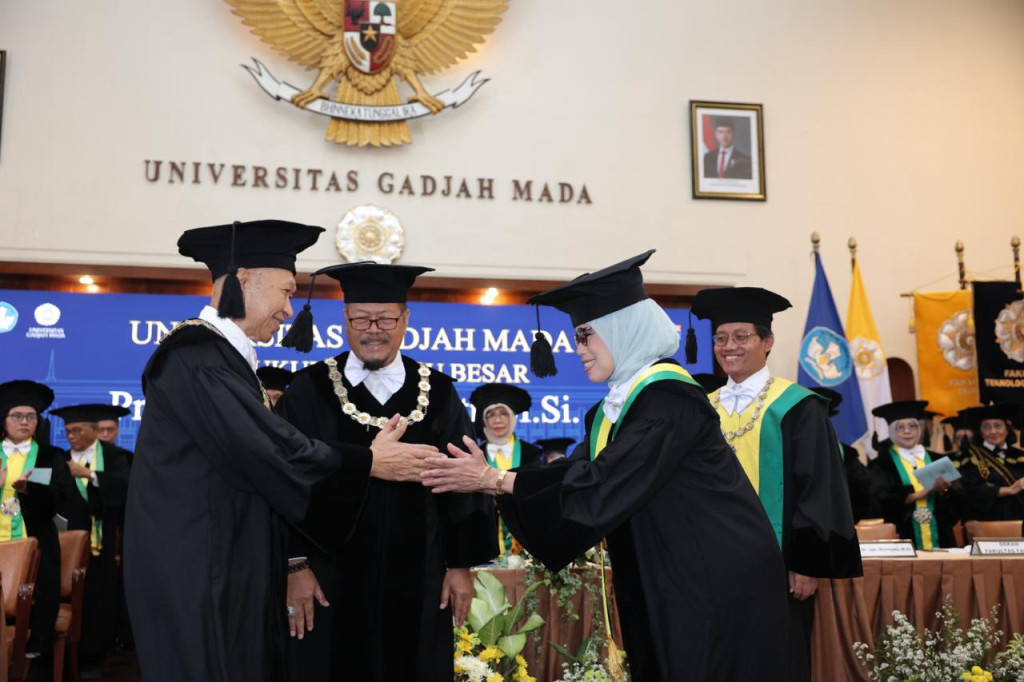
These topics were highlighted in the inaugural professorial lecture delivered by Professor Rumiyati, who was inaugurated as Professor of Food Macromolecular Pharmaceutical Engineering at the Faculty of Pharmacy, Universitas Gadjah Mada (Pharmacy UGM). Her lecture, titled “Pemanfaatan Makromolekul dan Senyawa Bioaktif dari Sumber Hayati untuk Pengembangan Produk Farmasi dan Nutrasetikal,” was delivered on Tuesday (July 7) in the Senate Hall of the UGM Central Office Building.
Professor Rumiyati highlighted the growing burden of global and national health challenges, including cardiovascular disease (PKV), hypertension, diabetes mellitus, cancer, and stunting. She explained that these challenges lead pharmaceutical product development to focus on curative treatment, whereas nutraceutical development emphasizes preventive and health-promoting approaches.
“Given these significant global and national health challenges, the use of macromolecules and bioactive compounds—especially those derived from Indonesia’s rich local biodiversity—remains highly relevant for developing pharmaceutical and nutraceutical products,” she said.
In pharmaceutical development, macromolecules—particularly proteins and nucleic acids from biological sources—have advanced rapidly. In 2023, protein-based macromolecules ranked among the world’s best-selling pharmaceutical products. However, Professor Rumiyati noted that protein-based macromolecular drugs still face major challenges, including instability, delivery limitations, immunogenicity risks, complex manufacturing processes, high production costs, lengthy development stages, and extended timelines.
Alongside the development of therapeutic products, she emphasized the importance of developing products that support preventive and health-promoting approaches. One example is a nutraceutical product, also known as a functional food. In general, nutraceuticals are isolated or purified food components presented in capsule or tablet form, while functional foods are consumed as part of the daily diet.
“Examples of nutraceutical products include fish oil capsules, omega-3 supplements, and glucosamine tablets, while functional foods include yogurt, fortified milk, bread, and high-fiber, antioxidant-rich cakes,” she explained.
Advances in science have opened opportunities to develop personalized medicine and personalized nutraceuticals. Nevertheless, Professor Rumiyati noted that research on macromolecules and bioactive compounds still faces numerous challenges, because many of these substances have shown activity only in in vitro studies and have not yet been validated through in vivo, preclinical, and clinical research.
“Future research should focus on elucidating molecular mechanisms and conducting safety, efficacy, bioavailability, stability, and interaction studies for the components used in the developed formulations,” she explained.
Professor Rumiyati also noted that certain types of macromolecules require specialized handling to prevent degradation, denaturation, or loss of biological activity during production and storage. Therefore, technologies such as nanoencapsulation, nanoformulation, edible coatings, protein engineering, and biopolymer-based delivery systems are essential for further development. Equally important, she said, is establishing regulations to support the downstream commercialization of nutraceutical products, particularly given the absence of a dedicated regulatory category for the industry.
“Strong collaboration among researchers, regulators, industry, and the public is essential to ensure that the products developed are scientifically sound, legally compliant, safe, and accepted by the market,” she said.
Chair of the UGM Board of Professors, Professor M. Baiquni, stated that Professor Rumiyati is one of 543 active professors at UGM. Within Pharmacy UGM, she is one of 23 active professors out of the 349 professors the faculty has had throughout its history.
Author: Leony
Editor: Gusti Grehenson
Post-Editor: Priyanandaningrat
Photo: Firsto