


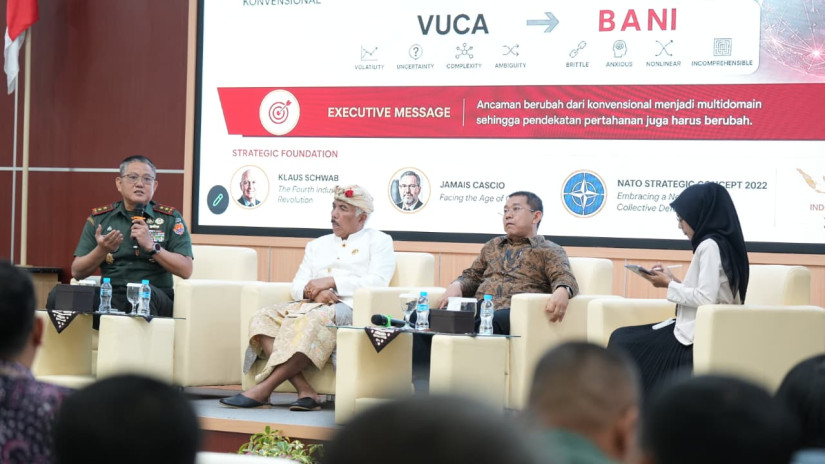
Sabrang Mowo Damar Panuluh, an expert staff member of the National Defense Council at the Indonesian Ministry of Defense, said national resilience education must foster more adaptive thinking in response to changing global dynamics. Developing strategic thinking that goes beyond a normative understanding of the state is essential.
“We must identify the root cause. Why should Indonesia be defended? What exactly are we defending? Only then can we identify the threats,” Panuluh said during the National Seminar on Curriculum Transformation, titled “Membangun Ekosistem Ilmu Ketahanan Strategis Bangsa untuk Meneguhkan Kejayaan Indonesia Raya Menuju Abad Kedua Kemerdekaan” (Building a Strategic National Resilience Knowledge Ecosystem to Strengthen Indonesia’s Greatness Toward the Second Century of Independence), held at the Graduate School seminar hall of Universitas Gadjah Mada (SPs UGM) on Monday (Jul. 27).
Sabrang explained that threats facing the nation continue to evolve, ranging from political, economic, and technological challenges to artificial intelligence, which increasingly influences people’s thinking and decision-making.
These require universities to prepare graduates to change through an adaptive education system. Curricula must keep pace with advances in science and technology to remain relevant to contemporary needs.
“If the education system does not change, I guarantee it will fall behind. The only law of survival is adaptation,” he stressed.
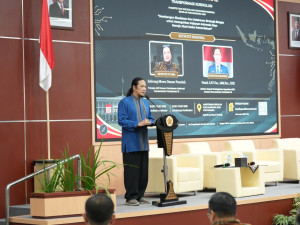
Commander of the Indonesian Army Command and General Staff College, Major General Dr. Agustinus Purboyo, explained that national defense has evolved into a shared responsibility across all elements of society. Geopolitical shifts, information warfare, and nonmilitary threats require a more comprehensive approach to strengthening national resilience. Therefore, education plays a crucial role in preparing human resources to respond to these diverse challenges.
“Modern defense is not merely about military strength but about integrating all national instruments into a harmonious system that enables us to defend Indonesia and thrive in the second century of independence,” he said.
He further emphasized that adaptability is the key to ensuring the nation’s sustainability amid rapid global change. Indonesia must move beyond sectoral interests and strengthen interinstitutional collaboration through a whole-of-government and whole-of-society approach.
Such efforts would reinforce the country’s resilience in addressing future strategic challenges.
“We must eliminate sectoral ego and begin putting Bhinneka Tunggal Ika into practice. Different, yet united,” he said.
Chair of the Indonesian Forum for Religious Harmony (FKUB), Ida Pangelingsir Agung Putra Sukahet, added that social harmony is a fundamental pillar of national resilience. Unity is essential to preserving national integrity while ensuring sustainable development. He hopes that the transformation of the National Resilience Studies curriculum would strengthen the academic ecosystem and produce leaders and scholars with strategic perspectives for Indonesia.
“Through harmony, we can preserve our unity. Only with strong harmony can we build the nation,” he concluded.
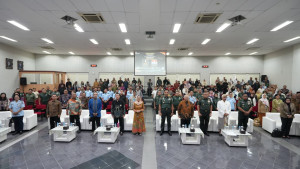
The seminar, organized by the Master’s and Doctoral Program in National Resilience Studies at SPs UGM, brought together academics, government officials, military representatives, and community leaders to shape a curriculum more responsive to future challenges.
Dean of SPs UGM, Professor Siti Malkhamah, said curriculum transformation is a crucial step toward strengthening national capacity through higher education.
“A curriculum should not be understood merely as a collection of course materials. It must serve as the architecture for developing knowledge, research, leadership, early warning systems, and policy networks,” she said.
Head of the Master’s and Doctoral Program in National Resilience Studies at SPs UGM, Professor Priyono Suryanto, stated that the curriculum transformation aims to maintain academic relevance while reinforcing the program’s strategic mandate.
The curriculum was developed through extensive reviews of theoretical frameworks, changes in the strategic environment, and curricula from leading universities worldwide. These findings became the foundation for a new direction in National Resilience Studies education that is more responsive to global challenges.
“We are using this strategic momentum to transform our curriculum,” he said.
Professor Priyono explained that the new curriculum is designed to produce graduates who are not only strategic thinkers but also contributors to knowledge development in national resilience. The master’s program will be strengthened through an intelligence and strategy laboratory to enhance crisis anticipation capabilities.
In contrast, the doctoral program will focus on developing new paradigms and advancing scientific knowledge. Strengthening this academic ecosystem is expected to generate preventive solutions to the nation’s strategic challenges.
“It is within the intelligence laboratory that this ecosystem will be built, enabling the development of crisis navigators,” he explained.
Author: Triya Andriyani
Post-editor: Jasmine Ferdian
Photo: Dwi Purwanto/UGM Graduate School Public Relations