



Students from Universitas Gadjah Mada (UGM), Institut Teknologi Bandung (ITB), and Universitas Diponegoro (Undip), members of Team Cinajawabatak, won first place in the MAPID WebGIS Competition organized by MAPID with support from PT Kereta Api Indonesia (Persero). The competition was held at the Garuda Spark Innovation Hub, FX Sudirman, Jakarta, on Thursday (Sept. 24).
The competition was centered on the theme “Maps That Think: Mass Transportation Edition,” drawing 175 teams from 71 higher education institutions across 57 cities. Among these, 50 teams conducted field surveys, received mentoring, and developed WebGIS solutions, leading to the selection of 10 finalists.
the theme “Maps That Think: Mass Transportation Edition,” the contest attracted 175 teams from 71 higher education institutions in 57 cities. 50 selected teams participated in field surveys, mentoring, and WebGIS development before 10 finalists were selected.
Team Cinajawabatak consists of Andalan Raihad Nobelim (Statistics, UGM), Gerardus Theo Sitinjak (Geodetic and Geomatics Engineering, UGM), Bernardinus Adhika Bramaksatra (Geodetic and Geomatics Engineering, ITB), and Devon Rama Wikunanda (Geodesy Engineering, Undip).
Nobelim, one of the team members, explained that the WebGIS innovation they developed, called Grahantara, can be used to recommend student boarding-house areas in Sleman based on transportation connectivity, price, facilities, and ease of access on foot.
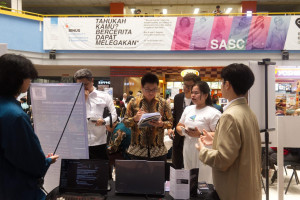
He added that the WebGIS solution was developed using field survey data collected through MAPID Apps, managed through GEO MAPID with MAPID MAPS as its basemap, and equipped with an AI component to help users obtain recommendations.
“Targeting new students, Grahantara provides recommendations by considering priority weights that users can adjust,” he explained.
Wikunanda, a team member from Undip, said the innovation was inspired by his own experience looking for a boarding house as a new student, which motivated him to develop Grahantara. As a new student without a personal vehicle, he had to carefully consider his boarding house location. It was not only about the price, but also access and routes connected to bus transit, places to eat, and other considerations.
“Grahantara makes it easier for new students to choose a boarding house that is aligned with various supporting facilities, especially for those who do not have a personal vehicle,” Wikunanda said.
Author: Jesi
Editor: Gusti Grehenson
Post-editor: Jasmine Ferdian
Photograph: MAPID Team