


Heavy equipment readiness remains a challenge in infrastructure development. The issue is not simply unit availability but also the ability to mobilize equipment, spare parts availability, the readiness of operators and technicians, and equipment productivity at project sites. Discussed at a webinar titled “Tantangan Pasar Alat Berat untuk Mendorong Peningkatan Supply Chain dalam Infrastructure Delivery” (Heavy Equipment Market Challenges in Strengthening the Supply Chain for Infrastructure Delivery) organized by the Center for Transportation and Logistics Studies at Universitas Gadjah Mada (Pustral UGM), in collaboration with the Construction Project Management Laboratory of the Department of Civil and Environmental Engineering, UGM Faculty of Engineering (FT UGM), on Thursday (Oct. 8).
Head of Pustral UGM, Dr. Dewanti, explained that heavy equipment is essential to the infrastructure development supply chain. Demand for heavy equipment follows developments in the construction, mining, plantation, forestry, and energy sectors. Therefore, equipment availability must be matched by operational readiness and logistics to ensure that work proceeds on schedule.
“Having equipment available is not enough. Heavy equipment must be at the right location, at the right time, and in operating condition,” Dewanti said.
From the user’s perspective, Rochman Alamsjah, an advisory board member of the Indonesian Association of Heavy Equipment Experts (PERTAABI), explained that demand for heavy equipment is influenced by the mining sector and production policies. National coal production rose from 615 million tons in 2021 to 836 million tons in 2024, then fell 2.3% to 817 million tons in 2025.
Higher production does not necessarily lead to a proportional increase in fleet demand because equipment efficiency can accommodate additional workloads. Equipment selection should consider life-cycle costs, costs per ton or cubic meter, reliability, and after-sales support rather than purchase price alone.
On the supply side, PERTAABI expert Edi Santoso reported that heavy equipment procurement fluctuated from approximately 20,000 units in 2022 to 14,500 units in 2025, with an estimated 15,100 units in 2026. These fluctuations have been influenced by mining quota policies, the rupiah exchange rate, global commodity prices, developments in the construction sector, and some users’ shift toward rental and used equipment markets.
The construction sector accounts for approximately 45% of the heavy equipment market, while mining accounts for around 35%. National demand reaches 16,000–18,000 units annually, while domestic assembly capacity stands at approximately 8,000–10,000 units per year.
“National supply is currently sufficient in terms of volume, but the industry is not yet structurally self-reliant because 45–55% of demand is still met through imports of complete units and core components,” Edi said.
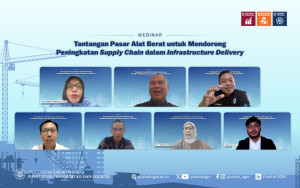
Airyn Saputri Harahap, Director of Construction Services Business and Institutional Affairs at the Ministry of Public Works, presented the government’s perspective. She outlined construction equipment policies, including the requirement to register material and equipment resources through the Construction Materials and Equipment Information System (SIMPK). The Ministry of Public Works had a budget ceiling of Rp114.59 trillion for 2027, of which Rp106.06 trillion, or 92.56%, was allocated to non-labor-intensive development projects.
For construction projects undertaken by the ministry in fiscal year 2025, the ministry recorded 49,917 equipment units, with excavators and dump trucks accounting for 48.95%. Fuel costs account for 30–40% of operating expenses, and operator certification covers 62 occupational competency schemes.
Meanwhile, Dr. Yosephus Ardean K. Prayitno, head of the Heavy Equipment Management and Maintenance Engineering Study Program (TPPAB) at the Department of Mechanical Engineering, UGM Vocational College (SV UGM), highlighted the relationship between technology, energy efficiency, and workforce readiness.
He predicted that the 2027–2031 period would be characterized by mixed equipment fleets, with diesel engines running on B50 fuel remaining dominant, while hybrid and electric technologies would expand in certain segments and hydrogen technology would begin trials in the mining sector. These technological changes require operators and technicians to upgrade their skills while also strengthening equipment performance management.
“Heavy equipment growth will support infrastructure development only if each unit delivers more work per liter of fuel, per hour, and per technician,” Yosephus said.
Yosephus also proposed developing a national equipment database that would record not only the number of units but also operating hours, downtime, energy consumption, and powertrain types. Such data could help stakeholders assess equipment productivity, determine maintenance needs, and set technology development priorities.
He also proposed collaborating to develop Indonesian National Work Competency Standards (SKKNI) modules, conduct B50 fuel testing and equipment retrofitting, and build industry partnerships through teaching factory internship programs. These proposals position skills development and data utilization as essential components of efforts to improve fleet productivity.
The webinar, attended by more than 1,000 participants from various regions across Indonesia, helped disseminate research conducted by the Department of Civil and Environmental Engineering at FT UGM on the state and trends of Indonesia’s heavy equipment market. The research gathered data from distributors, rental companies, contractors, mining and plantation companies, associations, academics, and regulators to map market size, trends, driving factors, and projected heavy equipment demand.
The webinar discussion will help identify priority issues requiring further study, interviews, and additional data collection.
Contributor: Pustral UGM
Author: Triya Andriyani
Post-editor: Jasmine Ferdian
Documentary Photo: Magnific