


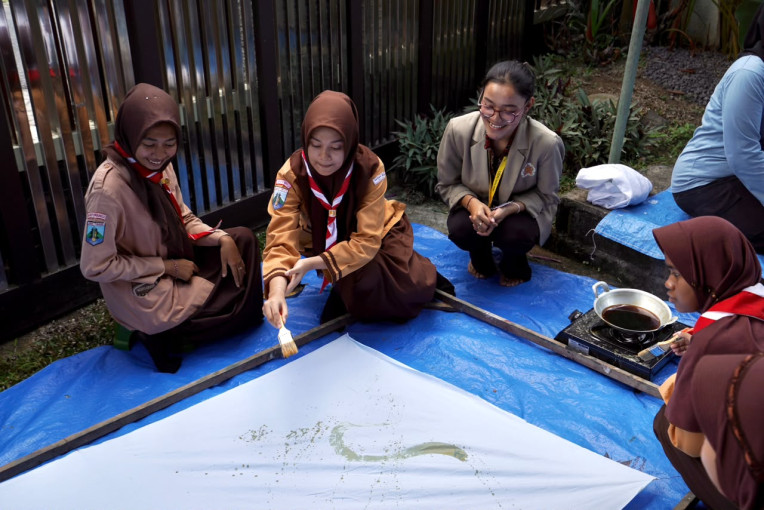
To address the challenges people with disabilities face in accessing employment opportunities, students in the Universitas Gadjah Mada Community Service Program (KKN-PPM UGM) invited 25 students with disabilities to learn batik-making and developed a batik education e-module to guide disability facilitators in Tampo Village, Cluring District, Banyuwangi Regency.
“We greatly appreciate the UGM KKN students for providing our students with the opportunity to learn batik here. Batik-making is not merely a vocational activity, it also helps build character among our students,” said Pipit Suparlin, Principal of Tamanagung Special School (SLB Tamanagung), on Friday (Jul. 31).
According to Pipit, learning batik is expected to build students’ self-confidence, independence, and ability to concentrate, preparing them to enter the workforce or start their own businesses.
“We hope this collaboration among schools, universities, and the community will strengthen inclusive education in this region,” Pipit said.
Pipit added that mentoring provided by KKN-PPM UGM students would also create opportunities for people with disabilities to develop and thrive within society by equipping them with skills that support employment and entrepreneurship.
Niza Aulia Sari (18), a 12th-grade student at SLB Tamanagung, said she was delighted to participate in the batik workshop held at the Najiha Batik Gallery.
“I’m happy,” she said briefly in sign language, with her teacher interpreting.
She shared that she had already made four batik cloths, all of which had been sold.
“I’ve made four. Yes, four pieces,” she said.
Niza is one of 113 students enrolled at SLB Negeri Tamanagung, which serves junior and senior high school students. Batik-making is one of the school’s vocational education programs.
Febriano Agung Nugroho, a KKN-PPM UGM student, said the adaptive batik training was designed for people with limited employment opportunities, including people with disabilities.
“We chose this program because Tampo Village has been designated as Banyuwangi Regency’s thematic batik village. We hope to create a unique selling point for the village by developing it into a batik training center for people with disabilities,” he said.
In addition to the batik training, the KKN-PPM team also developed a batik education e-module guide for disability facilitators working in batik micro, small, and medium enterprises (MSMEs) as well as in schools.
“The module is not only intended for batik artisans but can also be used independently by people with disabilities under the guidance of their facilitators,” he explained.
Agung said the participants were introduced to abstract batik motifs using the splash painting technique on batik cloth. They chose this adaptive approach because it is inclusive of various types of disabilities.
“The technique allows participants to express themselves freely without being restricted to conventional batik patterns. It becomes a medium for them to express their creativity on a piece of cloth,” he said.
Umi Najihah Fikriyati, Chair of the Tampo Village Family Welfare Movement (PKK) and owner of Najiha Batik Gallery, said the training program was highly inspiring because it introduced new approaches to teaching batik-making to people with disabilities.
“This is truly inspiring because we need new techniques for teaching batik. Last year, we also held a training session, and our evaluation showed that some participants with intellectual disabilities and autism found it difficult to use the traditional canting technique. The students then suggested using the splash painting technique instead,” she said.
Najihah also praised the e-module’s development, which can serve as a reference for teachers at special schools and people with disabilities who want to learn batik. The resource would be particularly useful when teachers change.
“Teachers sometimes change, and new teachers need to learn the methods again. With this e-module, they have a practical reference they can access from home without having to repeat the entire training,” she said.
Najihah added that her batik gallery currently employs around four people with disabilities. She believes the training program will further encourage participants to pursue careers as batik artisans or work in the garment industry.
“We, together with the village government and the PKK, are working to ensure that this program does not stop at training. Since we have a gallery, we also help market products created by people with disabilities,” she concluded.
Author: Gusti Grehenson
Post-editor: Jasmine Ferdian
Photo: Firsto