


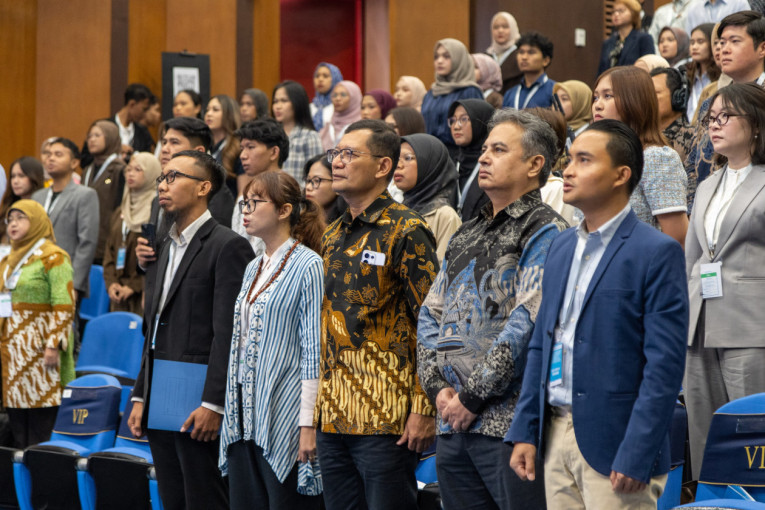
More than 200 participants from various countries attended the fourth International Conference on Community Engagement and Education for Sustainable Development (ICCEESD). This year, ICCEESD collaborated with the One Young World ASEAN Leadership Forum and the RCE Yogyakarta International Youth Conference and was held on Thursday (Oct. 1) at the UGM Faculty of Engineering (FT UGM). Young people from diverse backgrounds gathered to discuss sustainable development challenges in the ASEAN region while formulating actionable steps that can be implemented in communities.
One Young World Coordinating Ambassador for Southeast Asia Janu Muammad said the forum provides a space for young people to build networks and turn ideas into collaborative action.
“Today, ASEAN is facing complex and interconnected challenges, from climate change and food security to digital transformation, education, population well-being, social welfare, and security,” he said.
Janu said the region’s complex challenges require young people to work together. Through the forum, participants are encouraged to exchange experiences, bring together different perspectives, and develop action plans that address issues in their respective communities.
“We are trying to invite you to collaborate through collaborative action plans that can translate ideas into action,” he said.
The spirit of collaboration aligns with UGM’s efforts to encourage youth engagement in sustainable development. UGM Director of Community Service, Dr. Rustamaji, said young people need a strong understanding and commitment so they can play a role in addressing societal challenges in the future.
“UGM also encourages young leaders because young leaders are our leaders. So, if young leaders do not have sufficient information and commitment to sustainable development, we may face several difficulties in community activities in the future,” he said.
According to Dr. Rustamaji, education and environmental issues in Indonesia require students and young people to help find solutions. International forums such as ICCEESD can provide a space to bring together experiences from different contexts and develop actionable ideas.
“We hope this conference will become a dynamic forum for participants to share activities, share experiences, and perhaps produce new policies and other solutions that can benefit the government in the future,” he said.
Sustainable development issues were also examined from a local government perspective. Yogyakarta Mayor Dr. Hasto Wardoyo, who joined the event online as a keynote speaker, emphasized the importance of preparing young people to face demographic changes and the various social issues that accompany them.
Human resource quality is an important factor in maximizing the demographic dividend. Young people also need the ability to work and create jobs so growth in the working-age population can contribute to greater prosperity.
“When young people can create jobs and then absorb workers, we can hope to achieve prosperity,” he said.
Beyond demographic issues, environmental challenges require collective action. In Yogyakarta, the city government has developed community-based waste management involving various stakeholders, including universities and young people.
These efforts include waste sorting and processing, organic waste management, using reusable containers, and developing waste banks. Youth involvement is important to sustain various environmental initiatives while developing solutions that meet community needs.
He also highlighted the challenges faced by micro, small, and medium enterprises (MSMEs) amid the development of the digital economy. Young people need to build economic independence and develop the potential of the creative economy, so they do not become entirely dependent on the existing digital ecosystem.
“Therefore, young people, let us become economically self-reliant, because without digital independence, we will fall into dependence on certain economic groups,” he concluded.
The ideas of collaboration and concrete action were explored further in a plenary session titled “Turning Ideas into Action: Youth Collaborating for ASEAN’s Future.” During the session, Professor Nizam, representing UGM professors, presented the Community Service Program (KKN-PPM) as a learning model that brings students together with real-world problems in communities.
“KKN is about serving communities, living alongside residents, and solving problems together with communities,” he explained.
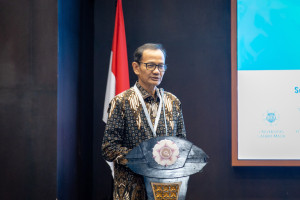
Nizam explained that UGM’s KKN-PPM involves students from various academic disciplines in directly understanding problems and designing solutions together with communities. A multidisciplinary approach enables students to combine knowledge from different fields while learning from local conditions.
“KKN is multidisciplinary and problem-solving. They do not work alone. They have programs that support, develop, and allow them to learn from one another,” he said.
KKN-PPM is also developed based on the needs of communities and local governments. Students first study the issues communities face before designing their programs, ensuring the activities do not end when the students’ community service period ends.
“We learn from local governments about their problems and seek solutions to those problems,” he said.
For Nizam, sustainability is an important component of every KKN-PPM program. Students need to ensure the programs they initiate can be continued by communities after their service period ends.
“These programs should not belong to the students, but should belong to the local communities,” he said.
Nizam explained that several UGM KKN-PPM programs have also integrated the Sustainable Development Goals (SDGs) into field activities, ranging from food security and health to ecology. These experiences show that students can learn the SDGs not merely as concepts, but through the concrete problems communities face.
The KKN-PPM experience has subsequently opened opportunities to expand similar collaborative models at the regional level. Cooperation among countries in Asia could provide a space for students to learn together with communities while contributing to development challenges that vary across different regions.
“Why don’t we expand international collaboration to Asian countries and work together across the region?” he concluded.
Through these sessions, ICCEESD brought together ideas from young people, universities, governments, and various stakeholders to examine sustainable development from diverse perspectives. Cross-sectoral and cross-border collaboration is one approach offered to move ideas from discussion forums into action in communities.
Author: Zabrina Kumara
Editor: Gusti Grehenson
Post-editor: Jasmine Ferdian
Photograph: Donnie