


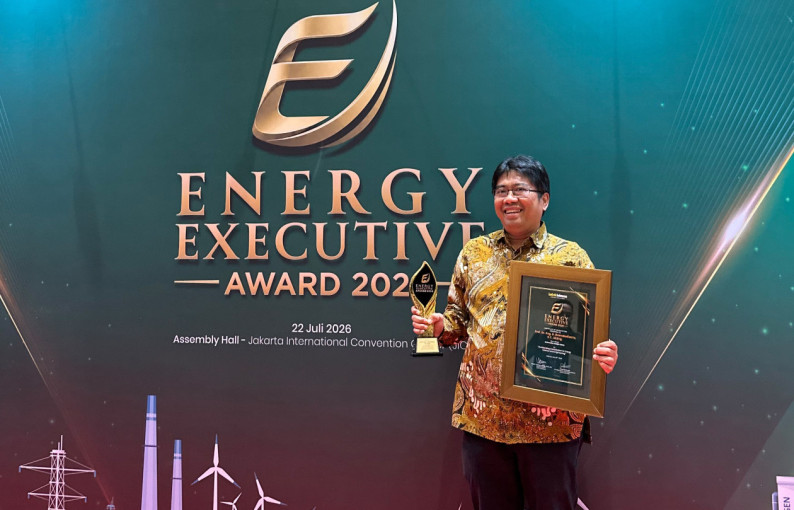
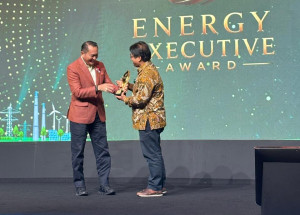
Deendarlianto, Professor at the Department of Mechanical and Industrial Engineering, Faculty of Engineering, Universitas Gadjah Mada (FT UGM), received the Outstanding Contribution to Indonesia’s Energy Sector award at the Energy Executive Award organized by Majalah Listrik Indonesia. The Chair of Commission XII of the Indonesian House of Representatives (DPR RI) presented the prestigious award in Jakarta on July 22.
As one of five figures recognized for significant contributions to Indonesia’s energy and electricity sectors, Professor Deendarlianto, affectionately known as Deen, expressed gratitude that his years of research dedication received national recognition.
In the energy field, Deen focuses on two-phase flow research. This field examines complex fluid flow phenomena in piping systems, machinery, and various energy production systems. He has actively established international research collaborations with partners in Japan, the United States, Germany, the Netherlands, and South Korea. These collaborations have resulted in numerous joint scientific publications and international research grants, further strengthening his contributions to energy engineering.
In addition to his research, Deen served as Head of UGM’s Center for Energy Studies (PSE UGM) from 2013 to 2022. Reflecting on his tenure, he said the role gave him a broader understanding of the multidisciplinary nature of energy studies.
According to him, energy can no longer be viewed solely through the lens of engineering; it requires contributions from multiple disciplines, from law to economics.
“We have conducted extensive multidisciplinary research. When discussing energy sovereignty, we also examine energy poverty, the political aspects of energy, energy law, low-energy politics, and energy economics,” he said on Wednesday (July 29).
Deen further explained that the interdisciplinary research he and his colleagues conduct at PSE UGM extends far beyond theoretical concepts, such as fluid mechanics taught in undergraduate programs. While remaining grounded in community service, their research has produced recommendations for legislation, national energy system planning, renewable energy modeling for Indonesia, national electricity system development, and energy infrastructure innovations implemented in several regions.
“The research conducted by my team at PSE UGM is always guided by the conditions and needs of communities, from the local level to Indonesia as a whole,” he said.
As a researcher involved in multidisciplinary projects, Deen acknowledged that one of the greatest challenges is overcoming researchers’ individual perspectives and disciplinary boundaries. Bringing together experts from different fields naturally leads to differing viewpoints.
However, he believes that adapting to one another and fostering mutual respect ultimately produce research that benefits society and informs public policy. In fact, many studies conducted by PSE UGM have been used as references by industry, the Indonesian House of Representatives, and government institutions.
“Many of the research outcomes from the UGM Center for Energy Studies have become references for several ministries and have even been presented before the House of Representatives,” he said.
Deen said his commitment to applying knowledge for society’s benefit began when he was a UGM student in 1991. After becoming an academic, he became increasingly motivated to develop innovations and research that make tangible contributions to communities and industries alike.
“One thing that continues to inspire me is UGM itself, whose identity as a People’s University means that whatever we create, no matter how significant, must benefit society. Society includes communities at the grassroots level as well as the industrial sector,” he said.
Building Research Collaboration
Deen believes every research project should be designed with a clear end goal to ensure its outcomes deliver meaningful benefits to society. According to him, researchers should first identify who will use the research results and how the findings will be implemented before determining the research topic. This approach helps ensure that research produces not only scientific discoveries but also practical solutions for societal and industrial needs.
At the same time, Deen emphasized that knowledge acquired from developed countries cannot simply be applied in Indonesia without considering local contexts and needs. Therefore, researchers must adapt research into practical applications to local conditions to maximize impact.
He encouraged researchers to begin by identifying the challenges faced by communities and industries and use those challenges as the foundation for their research. In this way, laboratories become not only centers for generating knowledge but also spaces for developing solutions to national problems.
“In other words, the challenges faced by society and industry should be brought into the laboratory and become the focus of research,” he said.
Consistent with this principle, Deen incorporates real-world challenges into his teaching so that students not only understand theoretical concepts but also appreciate their practical applications.
Although he supervises many students, he adopts a collaborative approach involving industry partners, researchers from Indonesia and abroad, and colleagues across laboratories and departments. He believes this model gives students a richer, more comprehensive learning experience.
“Knowledge can come from anywhere, and collaboration can be built with anyone,” he said.

Deen added that these collaborations also create opportunities for students to participate in research projects and industry partnerships. Through these experiences, students not only apply what they have learned in the classroom but also gain firsthand exposure to the realities of research and professional practice. For him, both success and failure are equally valuable parts of the learning process.
“Students who participate are usually very enthusiastic. In addition to applying their knowledge, they gain valuable experience. Both success and failure are important parts of learning,” he said.
Concluding the interview, Deen expressed his hope that UGM will continue strengthening its role as a university that delivers meaningful contributions to the nation. As an autonomous public university with a strategic position in Indonesia, he said UGM has a responsibility to provide solutions through interdisciplinary collaboration.
He also emphasized the importance of strengthening partnerships between faculty members and students to produce innovations that address Indonesia’s development challenges.
“The country needs our contributions. It is time for us to think, create, and collaborate across disciplines to generate meaningful impacts for Indonesia. Collaboration between faculty members and students must also continue to be strengthened,” he concluded.
Along with Professor Deendarlianto, the other recipients of the award were Dr. Suroso Isnandar, Director of Project Management and New & Renewable Energy at PT PLN (Persero); Professor Rinaldy Dalimi, Professor at Universitas Indonesia; Professor Eniya Listiani Dewi, Director General of New, Renewable Energy, and Energy Conservation at the Ministry of Energy and Mineral Resources; and Professor Purnomo Yusgiantoro.
Author: Zabrina Kumara
Editor: Gusti Grehenson
Post-Editor: Priyanandaningrat
Photo: Documentation by Deendarlianto