


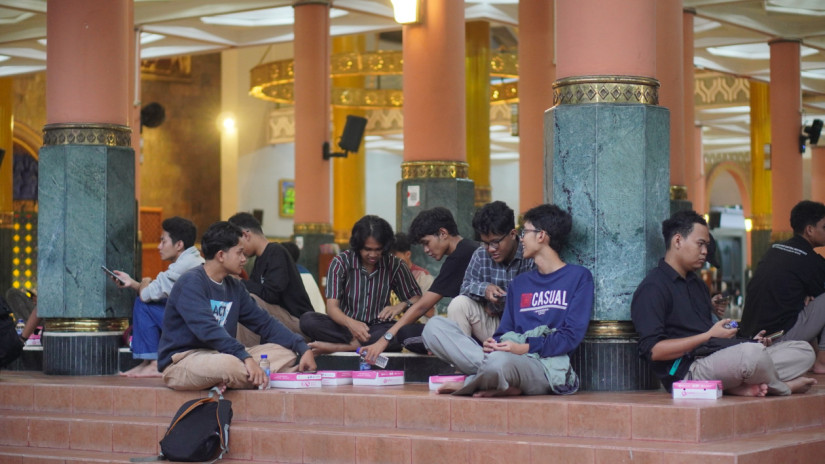
The Universitas Gadjah Mada (UGM) Campus Mosque continues to draw thousands of people who come to enjoy free iftar meals during the month of Ramadan. Every afternoon, long rows of motorcycles line the eastern and northern parking areas of the mosque. Inside, visitors sit neatly in rows, filling the main prayer hall.
Under the mosque’s dome, the wait for breaking the fast turns into a meaningful moment. Laughter blends harmoniously with the tapping of fingers on laptop keyboards and the melodious recitation of Quranic verses. The atmosphere grows even more meaningful with the return of the Ramadan Safari of Knowledge (Samudra), held as in previous years. By presenting discussions on contemporary issues and academic life, the program transforms the long wait into a spiritual journey filled with insight and devotion.
Rasenevan, a student of the UGM Faculty of Cultural Sciences (FIB UGM), who joined the gathering, said one of the main attractions of breaking the fast at the campus mosque, aside from the meal itself, is the lecture topics.
“I attended this afternoon’s session because the topic was interesting. The discussions always make me reflect on matters beyond classroom material. The themes relate to aspects of life and current situations that truly resonate with what we are experiencing now,” he said on Friday afternoon (Feb. 27).
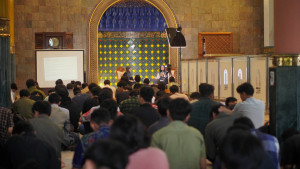
The enthusiasm is not limited to the academic community; residents and students from various universities across Yogyakarta also attend. To accommodate this high demand, the committee prepares 1,500 boxed meals for iftar every day. This remarkable number ensures that the spirit of sharing reaches all segments of society today.
Ade, a student of Universitas Negeri Yogyakarta (UNY), who came with a group of classmates, shared that it was her first time experiencing the atmosphere of iftar at the UGM Campus Mosque. She said she thoroughly enjoyed it.
According to her, the spacious and serene mosque complex provides an ideal setting for gathering with friends and strengthening bonds during the holy month.
“After class, my friends and I chose the UGM Campus Mosque as our place to break the fast. It’s quite close, and the space is large enough to comfortably chat while waiting for the Maghrib call to prayer,” she explained.
Ade added that on that Friday, she managed to receive a free iftar meal, as the previous day she had missed out because the coupons distributed by the committee had already run out.
The high turnout described by Ade also presents challenges in maintaining cleanliness. Recognizing this, the Ramadan at UGM (RDK) committee consistently upholds the green campus mission through strict waste management. As iftar time approaches, committee members can be seen at various points ensuring that waste from the 1,500 meal packages does not accumulate unnecessarily.
By providing designated bins for cardboard boxes, spoons, plastic containers, and food waste, the committee strives to ensure that the spirit of sharing aligns with environmental stewardship.
“We have prepared teams from several divisions collaborating in waste sorting. There are around eight posts to minimize queues. We also guide congregants to dispose of their waste according to its classification,” explained Harris, a member of the RDK committee, on Tuesday (Mar. 3).
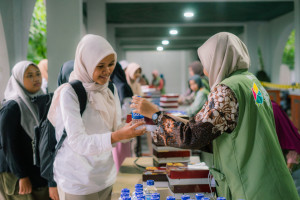
The committee’s attentiveness in managing food waste is the culmination of a long process that begins well before midday. As the Consumption Division Coordinator, Harris explained that behind the scenes, the logistics involve an extensive chain of teamwork among committee members.
He noted that each day, the consumption division is divided into three subdivisions: sahur (pre-dawn meal), communal iftar, and VIP services.
“In total, dozens of committee members are mobilized daily. For iftar, we deploy 25 people to oversee the process, from checking food quality and distributing coupons to distributing thousands of meal boxes,” he said.
Not only the quantity but also the variety of menus becomes a highlight eagerly awaited by congregants. Each day, the dishes served at the UGM Campus Mosque vary, ranging from Indonesian cuisine to familiar comfort foods.
Harris explained that this menu diversity corresponds to catering vendors that have undergone a rigorous selection process. According to him, the mosque maintains high standards.
“Vendors must hold official halal certification from the government. We also inspect kitchen hygiene, ensure standard operating procedures such as the use of head coverings and gloves, and maintain flavorful dishes suitable for all,” he elaborated.
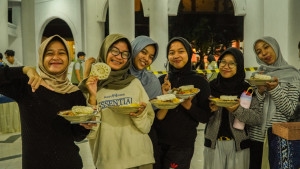
During Ramadan 1447 H, the UGM Campus Mosque provides 36,100 iftar meals. This spirit of sharing also extends to the pre-dawn hours, with 8,500 sahur portions served on odd dates during the first twenty days and provided daily throughout the last ten nights.
Ensuring the consistent provision of thousands of meal packages requires collective effort and broad community support. The fundraising coordinator, Dimas, said that to ensure congregants receive proper and nutritious meals, the committee is working to meet its target budget of Rp934,500,000.
“Our funding sources come from donations, sponsorships, and rectorate funds,” he explained.
To maintain integrity and public trust, the committee and mosque management have centralized all financial flows through a single official channel.
“We open donations through one account only, namely the UGM Campus Mosque account with code 147. This step ensures transparency for every rupiah received so that all funds can be easily audited by donors, reported on social media, and included in activity reports to the university,” he concluded.
Author: Aldi Firmansyah
Editor: Gusti Grehenson
Post-editor: Rajendra Arya
Photo: Courtesy of RDK UGM