


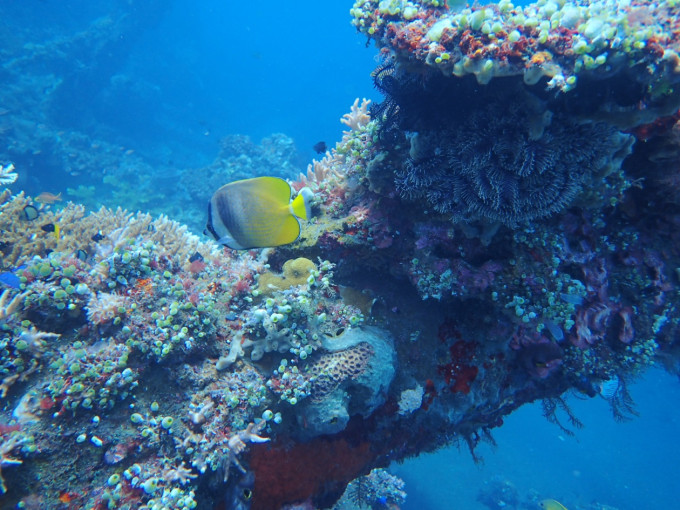
The Universitas Gadjah Mada Diving Student Activity Unit (UKM Selam UGM) recently held its 36th Open Water Training (LPT XXXVI) program in Tulamben, Bali, from April 30 to May 4. A total of 55 students participated in the activity, accompanied by three instructors and five assistant instructors. This annual agenda marks the culmination of the entire series of diving education and training for prospective new members.
All diving sessions were conducted at several points in the waters of Tulamben. One of the iconic locations visited was the USAT Liberty Wreck, a United States cargo ship that sank during World War II. The wreck is now home to hundreds of species of fish, corals, and other marine life.
“Beyond its natural beauty, this site offers a diving experience that is technically challenging and visually rich, especially for new divers,” said Ardhya Nareswari Candrakirana, Chair of UKM Selam UGM on Wednesday (May. 13).
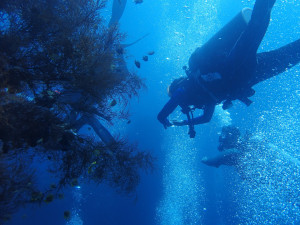
She explained that LPT XXXVI was designed as the final training stage for prospective divers to apply all the competencies they had learned. Starting from classroom sessions and pool training, this practice brought participants into real sea conditions.
“We aim to provide the best diving experience while broadening participants’ understanding of the wonders of Indonesia’s marine ecosystem,” she said.
Ardhya stated that the overall implementation of LPT XXXVI went smoothly, although there were several challenges in the field. She expressed pride in witnessing the high enthusiasm of participants throughout the activity, both those diving in the sea for the first time and those with prior experience.
“Overall, the activity ran well. The participants were enthusiastic, and the training days were very memorable,” she said.

Ardhya added that this activity was not only a technical learning opportunity but also an important process in shaping the character and mental readiness of prospective divers. According to her, the program helped participants develop adaptability and teamwork, and demonstrated real progress throughout the activity.
Through this program, Ardhya noted that participants emerged not only as technically competent divers but also as individuals with a deep awareness of the importance of preserving marine ecosystems.
“This challenging yet meaningful experience reaffirms the unit’s role as a platform that produces not only resilient divers but also individuals who are caring and responsible toward nature,” she said.
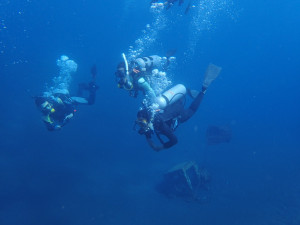
A profound experience was also shared by Andari Pratista Widayani from Training Batch 35, who, for the first time, took on the role of a senior diver to assist prospective trainees. For Andari, the moment was not only an opportunity to share knowledge but also a new experience that brought admiration for the participants’ development.
“This activity was a new experience for all participants. I admire how they were able to adapt, remain environmentally aware, and work well together even though it was their first time diving in the sea,” she said.
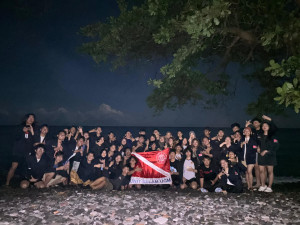
A similar impression was conveyed by Aulia Zahra Pratiwi, one of the participants from Training Batch 36, who admitted to being amazed from the moment she first entered the waters of Tulamben. According to her, the experience of diving in open water felt very different from previous training sessions. She compared pool training with the underwater beauty she encountered, which far exceeded her expectations.
“It felt like entering a different world. I could directly witness the richness of marine life that was truly mesmerizing,” Aulia said.
Contributor: Naja Ganiswara Ramadhani and Ahmad Yuana Putra/Ditmawa
Author: Hanifah
Editor: Gusti Grehenson
Post-editor: Rajendra Arya
Photo: UGM Student Diving Community Documentation