


Mastery of artificial intelligence (AI) development is no longer a technological issue but has also entered the realm of global geopolitics. Nations capable of mastering AI technology have the potential to exert significant influence in the global order.
Even in today’s workforce, there is a growing demand for talent with competencies in AI development. Therefore, the government is encouraging the emergence of digital talent among the younger generation in ways that positively support industry needs and national development.
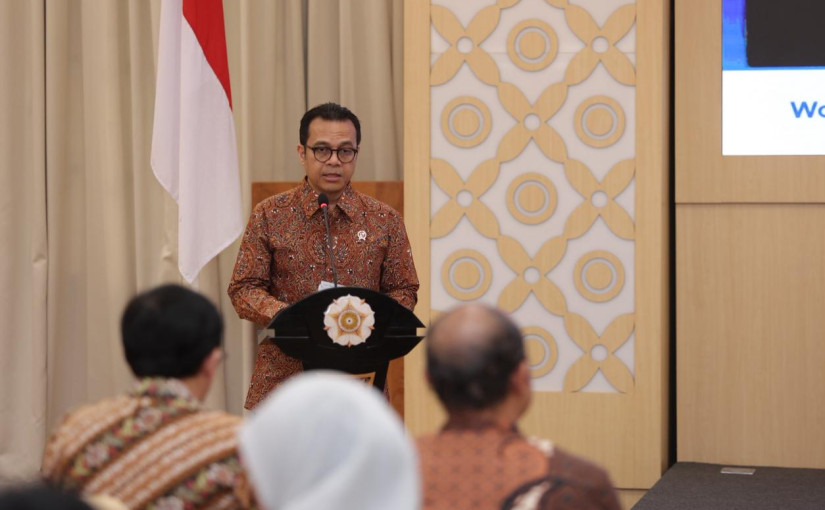
“In the future, the workplace will be a combination of humans and digital humans. This condition presents both a challenge and an opportunity for us to prepare talent who are not only able to use technology but also to develop it,” said the Deputy Minister of Communication and Digital Affairs of the Republic of Indonesia, Nezar Patria, during the opening of the Artificial Intelligence Talent Factory (AITF) Workshop held in Multimedia Room 1 on Friday (Apr. 17).
Nezar emphasized the importance of a problem-first approach in AI development, prioritizing solutions to real societal issues. He identified sectors such as healthcare, food, energy, and fisheries as strategic areas with strong potential for AI-driven development.
In addition to technical capabilities, he also highlighted the importance of non-technical skills such as critical thinking, ethical judgment, and human-AI interaction design.
“AI development must remain human-oriented and should not produce negative impacts,” he stated.
Meanwhile, Vice Rector for Planning, Assets, and Information Systems, Arief Setiawan Budi Nugroho, Ph.D., noted that AI should be understood as a tool whose benefits depend greatly on human capability in using it. He explained that using AI without a strong foundational understanding may lead to misinterpretation.
“AI is a tool. Its value depends on the people behind it. Without strong foundational knowledge, using AI can potentially result in incorrect interpretations,” Arief said.
He also stressed that the younger generation plays a strategic role as agents of change in responding to rapid and unstoppable technological developments. According to him, students must be able to use AI wisely without losing their critical thinking abilities.
“Students must become agents of change, not merely technology users. The use of AI must always be accompanied by critical thinking skills,” he emphasized.
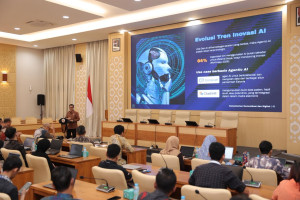
The workshop, attended by 98 students and 28 academic supervisors from Universitas Gadjah Mada, Universitas Brawijaya, and Institut Teknologi Sepuluh Nopember, featured Professor Esther Irawati Setiawan, a recognized Google Developer Expert (GDE) in AI and Cloud Computing, as a speaker. In her presentation, she discussed trends in agentic AI and opportunities for innovation development.
She highlighted the rapid advancement of artificial intelligence, particularly the shift from conventional machine learning to large language models (LLMs) and the emergence of the agentic AI era.
“We have now entered the era of agentic AI, where systems not only respond but also possess the ability to reason, plan, and execute tasks,” she explained.
She also emphasized the importance of selecting technologies that align with specific needs. She noted that not all problems require LLM-based solutions, as conventional machine learning approaches can be more efficient in some cases.
“LLMs are indeed trending, but not every solution requires LLMs. We must tailor our approach to the problem to avoid overkill,” she added.
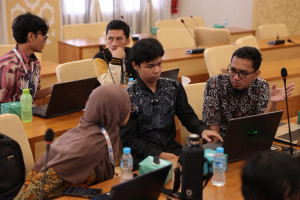
The workshop, organized by the Ministry of Communication and Digital Affairs (Komdigi) in collaboration with UGM, focused on strengthening participants’ capacities through progress discussions, use case mentoring, and expert lectures to deepen understanding and develop AI-based solutions.
This collaboration is expected to produce digital talent that is adaptive, critical, and solution-oriented, while also helping address challenges in the era of digital transformation, particularly by supporting public communication needs and strengthening information resilience in Indonesia.
Author: Cyntia Noviana
Editor: Gusti Grehenson
Post-editor: Jasmine Ferdian
Photo: Firsto