


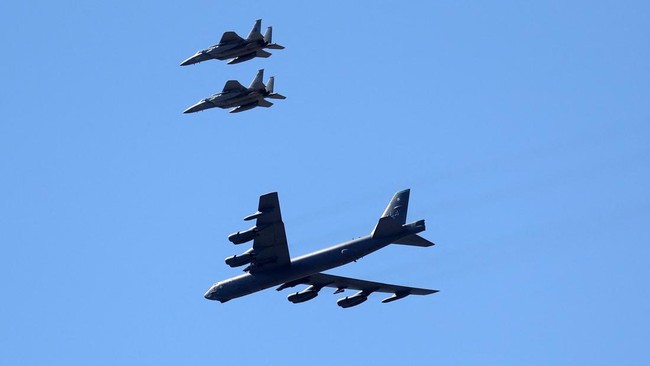
Indonesia and the United States have agreed to establish a Major Defense Cooperation Partnership (MDCP) to strengthen bilateral defense cooperation in the Indo-Pacific region. This cooperation is not considered new and remains consistent with Indonesia’s “free and active” foreign policy principle. However, amid opportunities to enhance defense capacity, discourse over granting the US military overflight access across Indonesian airspace has raised concerns about national sovereignty.
A lecturer at the Department of International Relations, Faculty of Social and Political Sciences, Universitas Gadjah Mada (Fisipol UGM), Rochdi Mohan Nazala, commonly known as Awang, explained that the MDCP defense cooperation had already taken place under previous administrations and continues to be updated to meet the evolving needs of both countries. According to him, this cooperation is part of efforts to strengthen national defense capacity, both through military modernization and training.
“This is part of our cooperation to strengthen defense, so it has nothing to do with deviating from the free and active policy,” he said in an interview on Tuesday (April 21).
Nevertheless, Awang noted that public polemics surrounding this cooperation are largely triggered by the issue of the US military’s overflight access across Indonesian airspace. He emphasized that this practice is not new, as overflight activities by foreign military aircraft and vessels have long occurred across Indonesian territory under certain contexts.
“In fact, US aircraft, and even vessels, have long moved back and forth across Indonesian territory,” he stated.
So far, such access has been granted selectively through a case-by-case mechanism, allowing Indonesia to retain control in approving or rejecting requests. This could become problematic if the scheme changes into a blanket overflight access arrangement, which would allow foreign military aircraft to no longer require prior permission for each passage, but only provide notification to Indonesian authorities. Such a scheme could reduce Indonesia’s control over its airspace, as the state would no longer be able to directly accept or reject requests.
“This scheme has the potential to create gray areas in its implementation, particularly regarding its use for military operations in crisis or contingency situations that lack clear definitions,” he explained.
Awang added that there is ambiguity in the use of such access, particularly regarding the terms “contingency operation” and “crisis response,” which could lead to multiple interpretations. He explained that these terms do not have firm boundaries and could encompass situations ranging from military exercises to operations in conflict. This lack of clarity may create opportunities to use Indonesian airspace beyond the agreed context, including for broader military operations.
Despite this, he did not deny that such an access scheme could provide strategic advantages for Indonesia, particularly from a military perspective. Granting access could open opportunities for indirect support from the United States during times of crisis, even without formally establishing a defense pact.
“Granting blanket overflight access is like asking for reciprocity, that if something happens to Indonesia, the United States would also be willing to help,” he remarked.
However, he warned that the risks posed by such a scheme could outweigh its potential benefits. Moreover, the current cooperation scheme is already considered optimal for Indonesia to offer. Therefore, the discourse on granting blanket overflight access need not be pursued further, as it could cause more harm than good. He also assessed that, in today’s conflict-prone global geopolitics, such a policy could increase Indonesia’s vulnerability to being drawn into large-scale conflicts.
“It would make Indonesia, in the current international situation, vulnerable to involvement in a major war,” he said.
Although the current practice is considered adequate and safer in maintaining a balance between strategic interests and national sovereignty, he emphasized that if such a policy were to proceed, the government must establish clear and strict limitations, particularly regarding definitions such as crisis response and contingency operation, which have the potential to become gray areas.
“Without such clarity, Indonesia risks losing control over its airspace while also facing the possibility of being drawn into broader global conflict dynamics,” Awang concluded.
Author: Cyntia Noviana
Editor: Gusti Grehenson
Post-editor: Rajendra Arya
Photo: Getty Images