


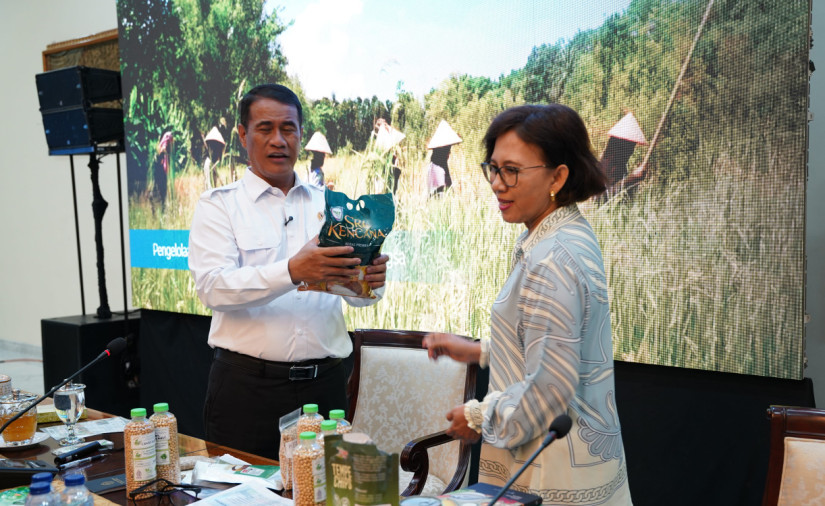
Indonesia’s Minister of Agriculture, Andi Amran Sulaiman, has invited Universitas Gadjah Mada (UGM) to collaborate on the downstream commercialization of research innovations to support national food self-sufficiency and food sovereignty. The invitation was extended during a meeting with a UGM delegation led by UGM Rector Professor Ova Emilia, along with university and faculty leaders, lecturers, and students at the minister’s residence in Jakarta on Monday (Jun. 29).
Amran said that many of UGM’s innovations have strong potential for implementation in Indonesia’s agricultural sector. He emphasized that commercializing research outcomes is a crucial step toward reducing the country’s dependence on imported commodities while strengthening the competitiveness of national agriculture.
“Many of UGM’s innovations can be applied to Indonesia’s agricultural sector,” he said.
He explained that agricultural exports have now reached approximately Rp760 trillion, representing an increase of around Rp166 trillion during the first year of President Prabowo Subianto and Vice President Gibran Rakabuming Raka’s administration. Meanwhile, agricultural imports have declined by approximately Rp41 trillion, although significant opportunities for import substitution remain.
During the meeting, Amran and UGM discussed the development of approximately six strategic commodities under a collaboration valued at around Rp40 billion, which will be granted to UGM. The initiatives include innovations in soybeans, garlic, livestock feed, coal-based fertilizer, and dairy cattle developed through UGM research.
Amran further explained that the soybean variety developed by UGM offers several advantages, including its non-genetically modified organism (non-GMO) status and larger seed size compared to imported soybeans. He described this as an excellent opportunity to leverage locally developed innovations rather than rely on imported products. The government also plans to oversee pilot projects for soybean and garlic cultivation across 1,000–2,000 hectares, proposed for Central Java.
“If we can produce superior seeds ourselves, why should we buy them from abroad?” he said.
He added that the government wants to ensure that university research does not stop at the signing of memorandums of understanding but is translated into practical implementation. According to him, accelerating agricultural development requires close collaboration among the government, universities, and industry.
Meanwhile, UGM Vice Rector for Research, Business Development, and Partnerships, Dr. Danang Sri Hadmoko, said the meeting with the Minister of Agriculture followed earlier discussions between the ministry and the university. He noted that synergy between the government and higher education institutions is essential to sustaining Indonesia’s food self-sufficiency.
According to Danang, Indonesia’s achievement of rice self-sufficiency must be reinforced by strengthening seed sovereignty. Universities play a strategic role by developing superior crop varieties that can be adopted on a wider scale.
“One of the key factors is achieving seed sovereignty. Universities have developed superior varieties, particularly the Gamagora rice variety, which we hope the government will adopt to support national food sovereignty,” he said.
He expressed hope that UGM’s innovations, not only in rice but also in other strategic commodities, would be increasingly utilized in government programs. According to Dr. Hadmoko, stronger government support for university research will accelerate the adoption of innovations to address national development challenges, particularly in the food sector.
“This is the kind of collaboration we have been looking forward to, greater government commitment to supporting universities so that their research and innovations can be adopted and utilized for the nation’s benefit,” he concluded.
Author: Zabrina Kumara
Editor: Gusti Grehenson
Post-Editor: Priyanandaningrat
Photo: Donnie