


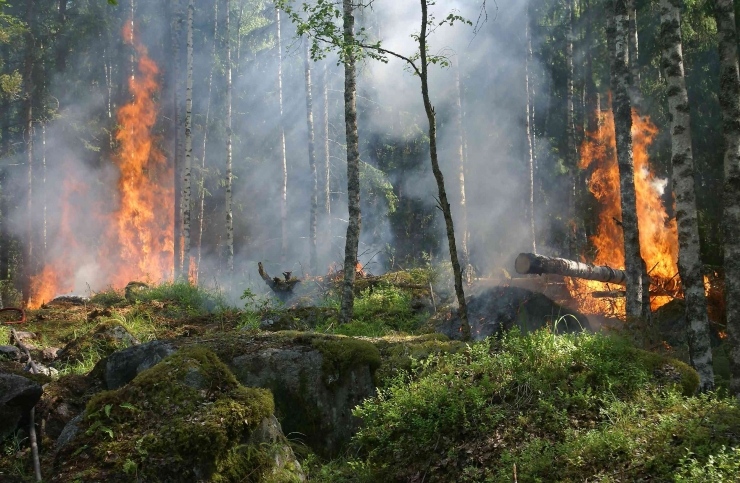
BMKG’s prediction of El Niño in 2026 once again tests the government’s preparedness to face the threat of forest and land fires (karhutla). BMKG forecasts that this year’s dry season will be drier and longer than normal, influenced by global climate variability. By the end of March 2026, around 7% of Indonesia’s Seasonal Zones (ZOM) have entered the dry season, and this number is expected to continue increasing in the coming months.
A lecturer at the Faculty of Forestry, Universitas Gadjah Mada (Forestry UGM), Fiqri Ardiansyah, stated that El Niño is strongly correlated with increased fire risk because it dries forests. However, he emphasized that dry conditions alone are not sufficient to trigger forest fires. The use of fire in land clearing by communities without adequate control remains the dominant factor.
“So, the issue is not related to land management itself, but rather the careless use of fire in managing land,” he said on Wednesday (May. 6).
This shows that community capacity to use fire remains a major challenge. He noted that many land-clearing practices are not accompanied by adequate fire control measures. Slash-and-burn practices are still commonly used because they are considered a quick method, but they are often not accompanied by safety measures such as firebreaks.
“What is generally not considered by the community is the failure to create firebreaks or isolate fuel in the area, so the fire spreads uncontrollably,” he explained.
This condition indicates that the issue at the field level is not only technical in nature but also related to broader forestry governance. He assessed that this problem is most evident in areas directly adjacent to residential communities. The lack of synergy between forest managers, companies, and local communities is considered the root of the persistent problem.
“Forest management requires synergy between forest area managers and communities around the forest,” he stated.
If there is no significant improvement in forestry governance, he warned of the potential recurrence of large-scale fires similar to the 2015 forest and land fire incident, which caused widespread forest damage. He noted that the risk is even greater in peatland forest areas, which are more susceptible to deep underground fires. This could potentially lead to prolonged haze conditions.
“The worst scenario is a recurrence of conditions like the 2015 fires, because deforestation was quite severe. As a result, haze will return for a long period, affecting social activities, economic activities, aviation, and public health,” he said.
In addressing these potential risks, he noted that the government has begun adopting a preventive approach through a structured early warning system. BMKG’s forecasts are seen as an initial step to reduce risks before fires occur, rather than merely responding once disasters happen.
“However, early warnings must be followed by concrete actions in the field, particularly by restricting the use of fire in land management and encouraging alternative land clearing methods without burning,” he said.
In addition, he added that prevention efforts should also be strengthened through regular patrols, monitoring of land conditions and peat ecosystems, and increased public education for communities around forest areas to enhance preparedness against wildfire risks.
“Amid the increasing potential of El Niño, strengthening collaborative and preventive forestry governance is the key to reducing the risk of forest and land fires in Indonesia,” Ardiansyah concluded.
Author: Cynthia Noviana
Editor: Gusti Grehenson
Post-editor: Jasmine Ferdian
Photo: Pexels.com