


Indonesia’s demand for soybeans for tofu and tempeh production continues to increase alongside rising food consumption. National soybean demand ranges from 2.67 million to 2.76 million tons per year and remains very high, while national soybean production in 2024 did not exceed 280,000 tons.
To support the downstream implementation of priority research and innovation with tangible benefits for society while emphasizing the role of technology and digital applications, a research team from the Faculty of Agricultural Technology at Universitas Gadjah Mada (UGM) has implemented Science and Technology through the Saekedelai, or Smart Agro Enterprise Kedelai, program, a smart farming-based agricultural technology innovation. The program involves multidisciplinary collaboration across UGM and is supported by the Yogyakarta Chamber of Commerce and Industry (KADIN DIY), local governments, industry partners, seed producers, and farmers.
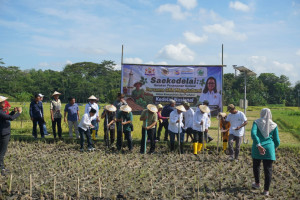
Through a soybean planting movement titled Bangkit Kedelai Yogyakarta (Reviving Yogyakarta Soybeans), the initiative seeks to address the challenge of meeting national soybean demand. Supported by Saekedelai technology, the movement aims to increase productivity by 2.5 to 4 tons per hectare, significantly higher than the current average soybean yield in the Yogyakarta region, which is at most 1.8 tons per hectare.
The activity was conducted simultaneously on Sunday, May 24, 2026, in Gamparan Hamlet, Sumberharjo Village, Sleman Regency, and was attended by representatives from various institutions, including the Center of Excellence for Science and Technology (PUI), UGM’s Directorate of Business Development, the Faculty of Agricultural Technology (FTP UGM), KADIN DIY, and other stakeholders from industry, government, and agricultural agencies.
The head of the Saekedelai program implementation team at the FTP UGM, Dr. Atris Suyantohadi, explained that domestic soybean production has not kept pace with the population’s growing food demands.
He noted that the Saekedelai program aims to reduce dependence on soybean imports by strengthening domestic production through technology-based approaches and collaboration with relevant stakeholders. According to him, consumption of soybean-based foods and beverages in Indonesia remains high; however, most soybean supplies still rely on imports.
“Domestic soybean production has not been sufficient to meet the increasing demand for soybean raw materials, particularly among tofu and tempeh producers in Indonesia. There are many contributing factors, but from what I have observed, farmer productivity remains very low,” he said on Saturday (May 30).
In its implementation, Saekedelai prioritizes smart technologies, including climate and weather monitoring, barcode systems for harvest traceability, and the utilization of the Warehouse Receipt System to improve production and strengthen soybean food sovereignty. Dr. Suyantohadi explained that Saekedelai was developed as an integrated agricultural technology platform covering the entire process, from cultivation to distribution to industry.
According to him, technological applications are implemented comprehensively and sustainably to improve the quality of national soybean food security.
“Through this technology, we have begun developing the soybean value chain from upstream production to downstream utilization in a structured, sustainable, and nearly comprehensive manner. The process includes planting preparation, monitoring through a field monitoring system, and traceability through barcode systems from farmers to industry,” Dr. Suyantohadi explained.
Dr. Suyantohadi further expressed optimism about the program’s success, which has been implemented throughout 2026. The initiative has established partnerships with more than 2,500 farmers and expanded soybean cultivation areas to more than 300 hectares. This implementation is expected to improve agricultural productivity, ensure the sustainability of soybean supplies for the food industry, and produce higher-quality, superior seeds.
“The program involves approximately 2,500 farmers. We hope that the tofu and tempeh we consume in the future will no longer depend solely on imported soybeans but will also come from domestic production,” he said.
Dr. Suyantohadi added that soybean demand has begun attracting interest from international markets. According to him, stronger technological support and synergy among stakeholders are needed to provide farmers with market certainty, higher yields, and improved welfare.
“Several buyers from overseas, including Malaysia and Singapore, have also approached us. There is significant potential if soybean production that meets quality and productivity standards can be substantially increased,” he concluded.
Author: Diyana Khairunnisa
Editor: Gusti Grehenson
Post-Editor: Zabrina Kumara
Photo: Saekedelai Team