


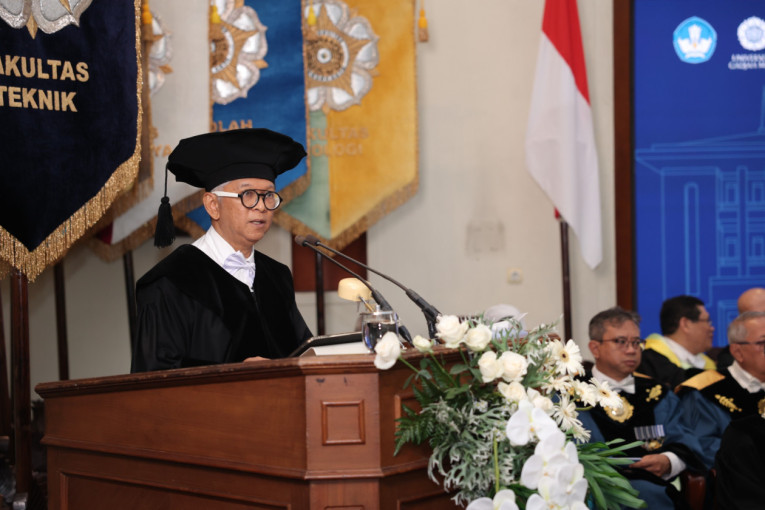
Urban heritage serves as a bridge between the past and the present, offering insight into the conditions of cities before our time. It also carries rich historical information and plays an irreplaceable role in understanding and studying the social structures, economic conditions, political systems, and everyday life of the past that are integrated into today’s urban fabric. Indonesia currently has two urban areas officially recognized by UNESCO as World Heritage sites: Sawahlunto and Yogyakarta. Therefore, effective urban development and planning are needed to manage these urban heritage resources. Such efforts are essential to address the vulnerable position of urban heritage sites, which are increasingly threatened with marginalization amid ongoing development pressures.
This was conveyed by Professor Ikaputra, Professor of Urban Heritage Architecture at the Faculty of Engineering, Universitas Gadjah Mada (FT UGM), during his inaugural professorial lecture on Thursday (Jun. 4) at the UGM Senate Hall. In his speech titled “Marjinalisasi Arsitektur Pusaka Perkotaan” (“The Marginalization of Urban Heritage Architecture”), Professor Ikaputra explained the role of urban heritage and the importance of preserving cultural heritage in a sustainable manner.
Professor Ikaputra highlighted the vulnerability of urban heritage today, influenced by various factors, including building age, technical issues, human activities, and natural conditions. Urban heritage is now more susceptible to changes that threaten its preservation than in previous periods.
“This vulnerability may stem from conditions within the urban architectural heritage itself, such as building deterioration caused by aging structures, technical weaknesses in construction, or new uses introduced without an understanding of the building’s historical value and authenticity,” he said.
According to Professor Ikaputra, effective urban development and planning are necessary to manage urban heritage resources. This would help address the increasingly vulnerable position of urban heritage sites, which risk being marginalized amid competition for development.
He also pointed to the condition of historically significant cities located far from national centers of power, such as Amlapura in Bali, Liwa in Lampung, and Cakranegara in Lombok. Each possesses unique cultural characteristics and heritage that may be unfamiliar to the wider public.
“In some cases, the strong influence of the central government on regions through economic and urban development policies has caused our historic cities to lose their identity,” he explained.
Professor Ikaputra further noted that urban architectural heritage is often overlooked when a structure is not the work of a renowned architect or was not built by a prominent company of its era. Strong visual appeal driven by building size and scale frequently places larger structures in the spotlight while pushing smaller buildings to the margins, despite their equal historical, artistic, and authentic value.

He emphasized the importance of cultivating empathy for marginalized heritage sites, particularly in a rapidly changing world shaped by modernization and globalization.
“Empathy toward urban heritage is not merely a sentimental act but a rational necessity to sustain urban civilization and preserve the social, economic, political, and cultural identities of the past that remain integrated with today’s spatial structure and urban life,” he said.
According to Professor Ikaputra, historic cities as cultural heritage assets with social, cultural, economic, and historical value are currently facing significant pressure from modernization and globalization. Therefore, the sustainable preservation, protection, and management of urban heritage have become essential requirements for urban development.
Chair of the UGM Professorial Council, Professor Dr. M. Baiquni, M.A., stated that Professor Ikaputra is one of 544 active professors at UGM. Within the Faculty of Engineering, he is one of 86 active professors out of the 112 professors the faculty has had throughout its history.
Author: Leony
Editor: Gusti Grehenson
Post-editor: Zabrina Kumara
Photo: Firsto