


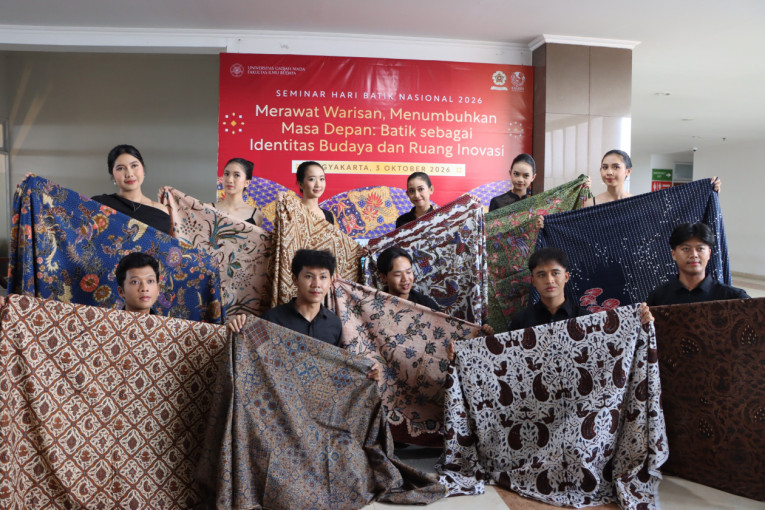
Batik is a cultural heritage with a long history deeply intertwined with society, trade, the environment, and cultural exchange. The diversity of batik across Indonesia shows that it has continued to evolve as communities encounter different cultures, both within and beyond the country.
The diversity of Indonesian batik is one of its strengths, but it needs to be understood in its historical context. Various motifs and techniques have developed in different regions against diverse environmental and cultural backgrounds.
“This development took place through processes of adaptation and knowledge exchange among communities, including through trade relations,” said Dr. Laretna Trisnantari Adhisakti, a UGM emeritus lecturer and Chair of the UNESCO Chair on Heritage Cities Conservation and Management, during the National Batik Seminar titled “Merawat Warisan, Menumbuhkan Masa Depan: Batik sebagai Identitas Budaya dan Ruang Inovasi” (Preserving Heritage, Nurturing the Future: Batik as Cultural Identity and a Space for Innovation) held in the auditorium of the Soegondo Building, Faculty of Cultural Sciences, UGM, on Saturday (Oct. 3).
In her presentation, Dr. Adhisakti traced batik’s development through the movement of knowledge, trade, and cultural relations until it eventually became known in various countries. She highlighted the relationship between batik and the trade in natural dyes. The spice and dye trade, including indigo, also played a role in batik.
“In Java, these trading activities were later associated with the emergence of various industries, including the production of sugar, coffee, tobacco, and indigo,” she said.
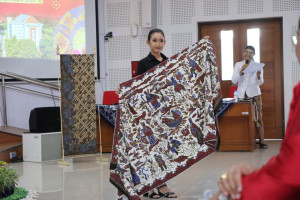
However, the development of synthetic dye technology brought major changes to batik dyes. Synthetic dyes began to be developed in Germany in 1856 and gradually replaced natural dyes. According to Dr. Adhisakti, this change needs attention to revive the use of natural dyes.
“After synthetic dyes emerged in Germany in 1856, natural dyes gradually disappeared. This is something we really need to consider so that we can restore their use in the future,” Dr. Adhisakti said.
In addition to trade, batik’s development also took place through cultural exchange between countries. Dr. Adhisakti highlighted India’s influence on several batik traditions in Java. One example is Patola cloth from India, which was adapted within Javanese culture. This process helped give rise to the Nitik batik tradition, now recognized as one of Yogyakarta’s distinctive batik traditions.
Traces of cultural exchange also appear between Indonesia and Thailand. Dr. Adhisakti recounted King Chulalongkorn of Thailand’s visit to Java in 1871. During the visit, he purchased 307 pieces of batik, which were kept for about a century before eventually being reintroduced through an exhibition in Thailand.
These show that batik has long been part of cross-border cultural relations. Encounters with India, Thailand, Japan, China, and various other regions have contributed to new forms of diversity in batik’s development. Thus, batik’s development cannot be separated from the cultural exchange that has taken place among communities.
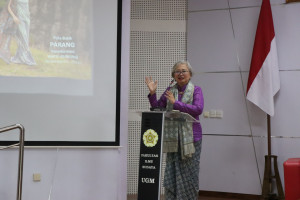
These cross-cultural connections have continued through cultural diplomacy. Dr. Adhisakti cited various exhibitions, performances, workshops, and batik education activities held in countries including Portugal, Japan, Sweden, Latvia, the Netherlands, Sri Lanka, China, and Taiwan. Through these activities, batik has been introduced not merely as a product, but alongside knowledge of its production process and the cultural values associated with it.
In this process, the younger generation plays an important role in continuing cultural diplomacy. Foreign-language skills and cultural understanding can provide a foundation for introducing batik to international audiences. Universities serve as spaces for bringing together academic knowledge with efforts to preserve and develop batik.
At the same time, sustainability is also essential to maintaining batik’s continuity. Batik as cultural heritage requires sustainable artisans, traditional knowledge, and the environment that supports its production.
“Therefore, batik needs to remain rooted in local wisdom while also being able to adapt to contemporary needs,” she explained.
She then linked this perspective to the concept of a regenerative economy. Sustainability is not simply about reducing environmental impacts. More than that, economic activities need to restore the environment while creating new value for communities.
“It should no longer be like an extractive economy that takes all the resources until they are eventually depleted. Nor should it be like a circular economy that only reduces impacts or returns things to their original condition. A regenerative economy must instead restore the environment, create new work, and enable things to be produced again in a better condition than before,” she explained.
Dean of the Faculty of Cultural Sciences UGM (FIB UGM) Dr. Nur Saktiningrum said that batik is part of Indonesia’s cultural identity and embodies knowledge about society, the environment, biodiversity, and the nation’s history. Therefore, National Batik Day offers an opportunity to keep this heritage alive and relevant for future generations.
FIB UGM pursues this effort through both cultural studies and practice. Students not only study batik from various perspectives but also learn the batik-making process firsthand. International students at FIB UGM also attend these practices, helping share knowledge of batik beyond national borders.
“These cultural practice classes are not attended only by Indonesian students. International students studying at FIB UGM also take part in dancing, playing gamelan, and making batik. On average, we welcome around 300–350 international students each year. Through them, these practices cross national borders,” she explained.
Beyond viewing batik from the perspective of preservation, UGM Vice Rector for Education and Teaching Professor Wening Udasmoro emphasized the importance of understanding batik as part of a continuously evolving culture. Batik should not be seen as a product made and used by communities. Viewing batik only as a product can cause the ideas and cultural practices surrounding it to be overlooked.
“When we view batik as part of culture, we often encounter the perception that batik is merely a product. Yet every discussion of culture has at least three aspects. The first is indeed the cultural product itself. However, we should not forget that culture also has other aspects, namely ideas and behavior,” she explained.
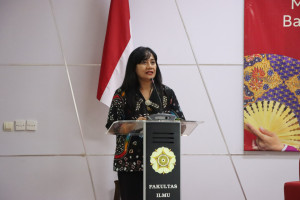
These ideas and behaviors are evident in how batik has developed across different regions of Indonesia. Each region brings its own creativity and character to batik, making it part of the process of forming local cultural identities. Thus, the batik tradition does not stop at established forms but continues to be created and adapted to communities’ lives.
“We can see batik developing everywhere. Every region demonstrates its own creativity in batik. There is batik from Magelang, batik from East Java, and every region has its own. Even Papua has colorful Papuan batik. Although it is made in Pekalongan, at the very least, Papuan batik has emerged as part of a constructed identity,” she said.
As cultural heritage, batik does not have to remain confined to past forms. Batik can continue to evolve alongside changes in society, as long as the knowledge, artisans, environment, and cultural values associated with it are preserved.
At this point, preserving batik means not only maintaining a product but also ensuring that the living culture behind it continues to be passed down and developed.
Author: Zabrina Kumara
Editor: Gusti Grehenson
Post-editor: Jasmine Ferdian
Photograph: Jesi