


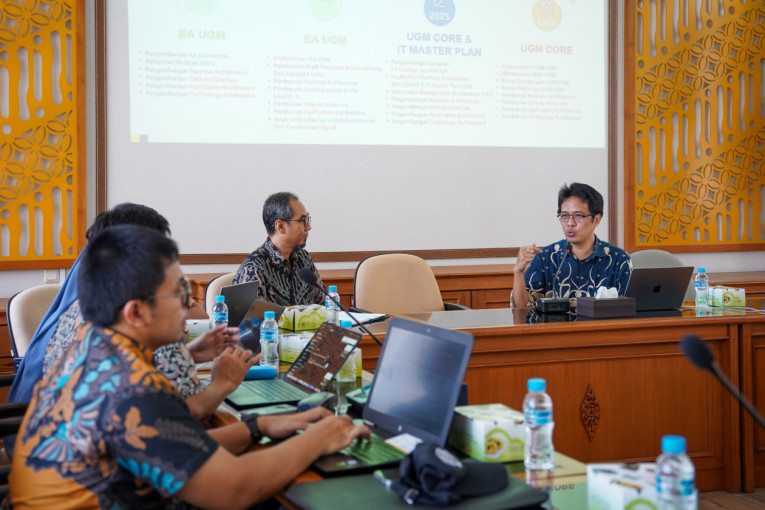
Universitas Gadjah Mada (UGM) welcomed a delegation from Indonesia’s National Cyber and Crypto Agency (BSSN) at UGM Central Office on Wednesday (Jun. 17). The meeting functions as a sharing of experiences on digital transformation and enterprise architecture management practices implemented at UGM to support integrated organizational governance. UGM presented its digital transformation journey over several years, from business process restructuring to the development of interconnected information systems across units. The highly interactive discussion covered challenges, strategies, and best practices applicable to strengthening digital governance within organizations.
Head of UGM’s Bureau of Digital Transformation (BTD UGM), Dr. Mardhani Riasetiawan, explained that digital transformation in higher education cannot focus solely on technology development. Transformation must begin with business process restructuring to ensure that every developed system strictly supports organizational needs.
This is essential because for years, individual units developed systems tailored to each requirement, making data and service integration a significant challenge. As a result, UGM began establishing a governance framework to connect business processes, data, applications, and technology under a unified development direction.
“We realized that information systems had long been developed without a comprehensive architectural design. Enterprise architecture became the solution for building integration and providing a clearer direction for development,” he said.
According to Dr. Mardhani, the journey has been tested by adversity. Digital transformation often faces challenges related to changes in organizational culture because it affects various long-standing aspects of an institution.
However, leadership commitment and support from various work units have been the key to implementing gradual change. Various policies and new mechanisms have been introduced to ensure that digital service development proceeds in a more structured manner and delivers tangible benefits to the academic community.
“Change is not always comfortable at the beginning, but once implemented, we have experienced its benefits in building a healthier, more effective, and more adaptive organization,” he said.
Dr. Mardhani added that UGM’s digital transformation efforts aim not only to improve efficiency but to support better decision-making. Through more systematic mapping, the university can identify organizational needs while determining priorities for service development.
The results of this mapping serve as the foundation for policymaking, system development, and institutional transformation. Consequently, every digital innovation developed has a clear connection to the university’s strategic objectives. This helps UGM ensure the sustainability of future technology development.
Simultaneously, Muhammad Alif Taufiqurrahman explained how enterprise architecture serves as the foundation of UGM’s digital transformation. Every proposal for new applications or features must begin with a clear identification of needs and business process mapping. This ensures that the developed tech genuinely addresses organizational requirements and avoids service duplication. In addition, all development processes are thoroughly documented, making future system integration and maintenance easier.
“Business processes serve as the primary foundation because all data, applications, and technologies need to originate from the organization’s business processes,” he explained.
According to Alif, this has helped UGM establish more structured digital governance. Through comprehensive documentation, the university can understand the interconnections among services, data, applications, and technologies used by various work units.
This information is essential for efficient digital service development while reducing the risk of fragmented systems operating independently. Enterprise architecture functions not as a token but rather as an instrument to ensure organizational transformation remains aligned with its established goals.
“Enterprise architecture serves as the backbone of organizational transformation because it connects business processes, data, applications, and technology within a single integrated framework,” he said.
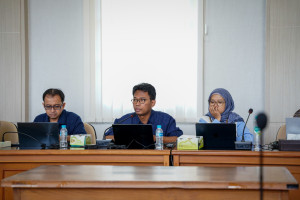
The implementation of digital transformation at the unit level was also presented by Dr. Dian Kesumapramudya Nurputra, a pediatrician and faculty member at UGM’s Faculty of Medicine, Public Health, and Nursing (FK-KMK UGM). In his presentation, he shared FK-KMK UGM’s experience in developing services and governance supported by integrated digital systems.
The implementation has helped the faculty improve service effectiveness while strengthening coordination among units involved in academic and administrative processes. A business process-based approach has also enabled more targeted system development aligned with user needs. FK-KMK UGM’s experience serves as one example of how digital transformation can support improvements in service quality across UGM.
During the discussion, the BSSN team expressed appreciation for UGM’s efforts to establish structured and sustainable digital governance. Various questions were raised regarding data integration, organizational change management, and strategies for sustaining digital transformation within large, complex institutions.
The discussion also highlighted the importance of business process documentation and system development as foundations for strengthening digital services. The exchange between the two institutions was dynamic and provided new perspectives on managing digital transformation. The forum served as a valuable learning opportunity in the evolving challenges of digitalization.
This meeting is expected to strengthen collaboration between UGM and BSSN in developing more effective and integrated digital governance. Through the exchange of experiences and best practices implemented by each institution, both parties can gain new insights to support service enhancement and organizational development.
UGM remains committed to continuing its digital transformation efforts with a focus on user needs and governance improvements. Meanwhile, input from BSSN will refine the various initiatives currently being developed. This collaboration is expected to encourage innovations that provide greater benefits to society.
Author: Triya Andriyani
Post-editor: Jasmine Ferdian
Photo: Donnie