


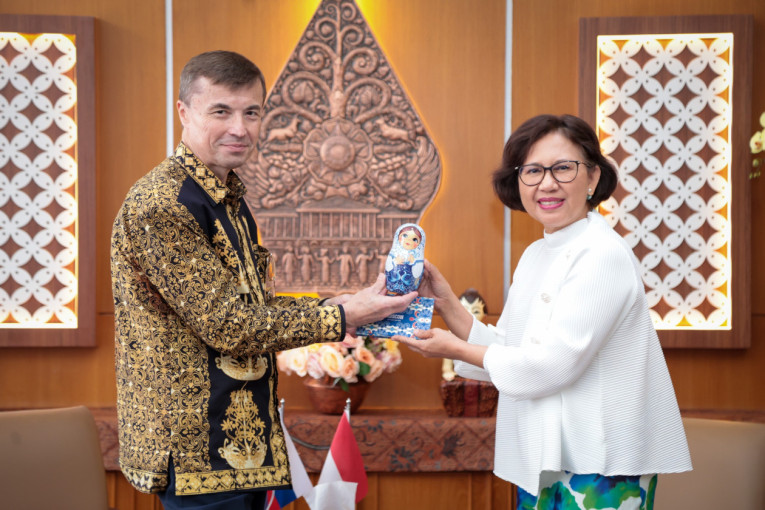
Russian Ambassador to Indonesia Sergei Gennadievich Tolchenov visited Universitas Gadjah Mada (UGM) with the Russian House on Wednesday (Oct. 7) at the UGM Central Office Building. The visit aimed to strengthen cooperation in education and research between UGM and Russian educational institutions. Sergei discussed several key initiatives, including plans to establish a Russian Studies program at UGM’s Faculty of Cultural Sciences (FIB UGM), strengthen nuclear energy research, and develop joint research in tropical and polar regions.
Regarding plans to establish Russian Studies at FIB UGM, Sergei said that developing the study of Russian language and culture could create broader academic opportunities for Indonesian students and foster cross-border educational cooperation. Expanding Russian language education could also strengthen academic relations between Indonesia and Russia.
Valeria Sharova, Head of Education at Russian House, added that Russian House currently offers Russian language instruction and is working to expand access to language learning. This includes building teaching capacity by giving international students opportunities to study Russian as a foreign language.
“This is a very, very intensive program. We plan to continue this work, perhaps in the future,” Valeria said.

In addition to developing Russian Studies, the meeting also addressed opportunities for Indonesian citizens to pursue higher education in Russia through the Russian Government Scholarship and the Rosatom Scholarship. Both programs were seen as opportunities for UGM students and academics to gain educational experience while expanding academic cooperation with Russian institutions.
UGM Rector Professor Ova Emilia also proposed developing double-degree programs with Russian universities for UGM students. The programs are expected to give selected students the opportunity to study at both institutions as part of their academic experience.
“We are actually interested in double degrees. Sometimes, we combine them with programs for undergraduate students. We try to select the best candidates and then prepare them to undertake a double-degree program in Russia and continue their studies there,” Professor Ova Emilia said.
In response to the proposal, Sergei said that double-degree programs could be through agreements between UGM and partner universities in Russia. These institutional partnerships could help identify suitable partners and determine the support needed to implement the programs.
Opportunities for Tropical and Polar Research
The discussion then turned to opportunities for joint research in tropical and polar regions. Sergei said that such cooperation could cover various areas, including studies of the northern regions and the development of the Northern Maritime Route, which connects Asia-Pacific and Europe through northern waters.
“This is not just about higher education. It also has a practical, dynamic dimension, as we now discuss the Northern Maritime Route more frequently. Ships can travel from Asia-Pacific to Europe not only through the Indian Ocean but also through the Arctic Ocean. This route is shorter and more efficient,” Sergei said.

According to Sergei, developing this field could also create opportunities for Indonesian companies and scientists to participate in research activities and international cooperation.
“This project also aims to invite more companies from Indonesia and more Indonesian scientists to work together in this field,” he said.
Strengthening Human Resources in Nuclear Energy
Meanwhile, during a discussion with UGM’s Nuclear Engineering Study Program, Sergei also explored opportunities to develop human resources for the nuclear energy sector. Developing nuclear energy in Indonesia would require experts from various fields, including scientists, engineers, technicians, and skilled workers to support the construction and operation of nuclear power plants.
According to Sergei, Indonesia must anticipate these workforce needs early, as building a nuclear power plant is a lengthy process that requires thorough human resource preparation.
“In this regard, Indonesia needs not only scientists but also engineers, workers, technicians, and others. Building a nuclear power plant is not easy, and it cannot be done quickly. We have time, but we must be honest about that,” Sergei said.
Through the visit, UGM and the Russian delegation discussed several opportunities for further development, ranging from strengthening Russian Studies and expanding access to education through scholarship programs to developing joint research in tropical and polar regions and nuclear energy. These discussions marked an initial step toward identifying cooperation that aligns with both parties’ academic and research needs.
Author: Zabrina Kumara
Editor: Gusti Grehenson
Post-editor: Jasmine Ferdian
Photos: Donnie