


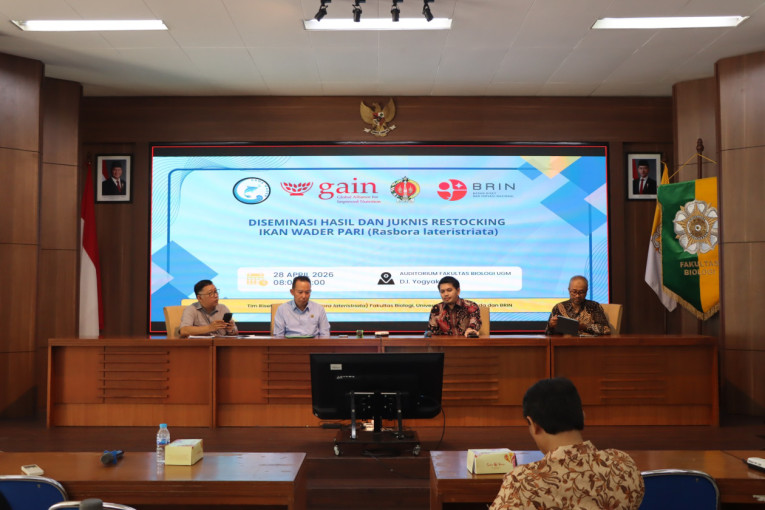
Restocking fish seeds in waters and rivers aims not only to maintain fish populations but also to ensure comprehensive ecosystem protection. In addition, this effort is intended to reduce the impacts of overfishing and improve habitat quality. This conservation activity also provides an environmentally friendly, natural source of protein and supports local economies. Currently, fish habitats in rivers are declining due to illegal fishing practices, such as the use of electric shocks and fish poisons. Therefore, strict law enforcement and strengthened national regulations on fish restocking, particularly for small fish in inland waters, are urgently needed.
These issues were highlighted during the dissemination of research findings and technical guidelines for restocking wader pari fish (Rasbora lateristriata) on Tuesday (Apr. 28). The event was attended by various stakeholders, both in person at the Tropical Biology Auditorium, Faculty of Biology UGM (Biology UGM), and online via Microsoft Teams. The event was initiated by the Gama Wader research team from Biology UGM with support from the Global Alliance for Improved Nutrition (GAIN), the National Research and Innovation Agency (BRIN), and the Yogyakarta Marine and Fisheries Agency.
Head of the Gama Wader research team, Professor Bambang Retnoaji, explained that the researchers have developed a draft of staged guidelines for implementing conservation-based restocking. These technical guidelines are designed not only to maintain fish populations but also to provide environmentally friendly natural protein sources and support community livelihoods. He outlined several key stages, including site identification, habitat assessment, seed selection, release processes, and long-term monitoring and evaluation to ensure effective and sustainable implementation.
“Monitoring is a critical post-stocking adaptation phase to determine survival rates and growth,” he explained.
Biology UGM lecturer and research team member, Dr. Luthfi Nurhidayat, stated that the primary pilot locations for restocking in the Special Region of Yogyakarta are the Baros River and Gandok River, as both are considered to have suitable habitat conditions, with 5,000 fish seeds released in each river. Monitoring was conducted approximately four months after restocking, a timeframe chosen because the wader pari fish enter their initial reproductive cycle during this period.
The results showed that within three to four months, new fish larvae were already found, indicating that the population had begun to grow independently without relying entirely on initial interventions.
“Interestingly, the presence of wader fish also increases the diversity of other fish species. This restocking effort also boosts phytoplankton and zooplankton levels,” he said.
In addition, the UGM team conducted studies covering ecological, economic, and social aspects. Dr. Nurhidayat emphasized that habitat quality is a key factor in determining suitable locations, including water conditions, the availability of natural feed such as phytoplankton, and threats like illegal fishing practices. He also appreciated the strong role of community involvement.
“We contributed around 30 percent, while the remaining 70 percent came from the community. They conduct monitoring, which provides stronger protection,” he noted.
Head of the Yogyakarta Marine and Fisheries Agency, Hery Sulistio Hermawan, expressed hope that the dissemination would not stop at discussion forums but would continue through concrete cross-sector actions.
“Therefore, collaborative activities with sustainable strategies like this are very important,” he said.
In his presentation, Hery explained that conservation should be understood not only as maintaining fish populations but also as encompassing comprehensive ecosystem protection. Furthermore, these efforts aim to reduce the impacts of overfishing and improve habitat quality.
“In its implementation, conservation programs will be carried out through several stages, from participatory planning and community involvement to regular supervision and monitoring,” he said.
A GAIN representative, Dr. Ibnu Budiman, also emphasized the need to strengthen the supply chain for small fish as a source of nutritious food in Indonesia. He explained that GAIN, as an organization working in food and nutrition, supports the development of local fish not only from an ecological perspective but also for food security.
“We aim to strengthen the supply chain of small fish that are highly nutritious, environmentally friendly, and contribute to food security,” he said.
He added that the results of nearly one year of research conducted with the UGM research team and BRIN are expected to serve as a basis for developing technical guidelines for restocking local fish, particularly in river ecosystems.
“We hope these recommendations can be adopted by various stakeholders, leading to increased populations and production of small fish, as well as supporting food availability and affordability for communities,” he added.
Regarding the development of a policy brief, Zamroni from the BRIN team emphasized the need to strengthen national regulations on fish restocking, particularly for small fish in inland waters. He noted that existing regulations remain general, necessitating more specific technical guidelines.
“Several aspects that need to be strengthened in the proposed new guidelines include clarity of broodstock sources, genetic protocols, monitoring methodologies, and clear role distribution,” he concluded.
Author: Hanifah
Editor: Gusti Grehenson
Post-editor: Jasmine Ferdian
Photo: Ika