


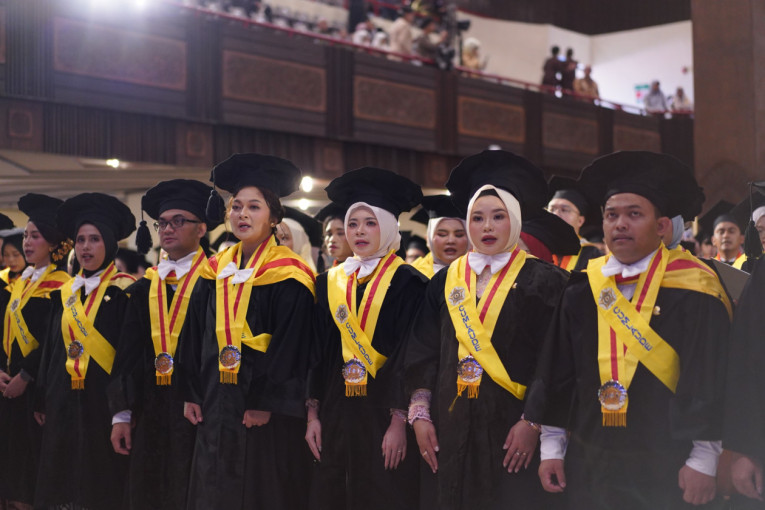
Universitas Gadjah Mada (UGM) held its Postgraduate Graduation Ceremony for the First Period of the 2026/2027 Academic Year on Wednesday (Oct. 28). The two-day graduation had 1,339 graduates from nine faculties participating on the first day and 1,185 on the second. During this period, the average time to complete a degree was two years and two months for master’s programs, three years and seven months for specialist programs, two years and two months for subspecialist programs, and four years and nine months for doctoral programs.
UGM Rector Professor Ova Emilia said postgraduate graduation should mark the beginning of graduates expanding their knowledge and contributing to society. UGM continues to develop its postgraduate curricula to keep pace with changes in the national and global education landscape while strengthening research focused on practical applications for society. Graduates are expected to think critically, generate innovations, and help address the nation’s various challenges.
“I am confident that today’s postgraduate graduates have the capacity and capabilities to become pioneers of innovation, think critically in producing knowledge, contribute to development, and make a meaningful impact by addressing societal problems,” Ova said.
Recent achievements also demonstrate UGM’s growing academic reputation and innovation ecosystem. In October 2026, UGM retained its Five Star Plus rating in the Healthy University Rating System organized by the ASEAN University Network Health Promotion Network.
In the Times Higher Education World University Rankings (THE WUR) 2027, moving into the 801–1,000 band from the previous 1,201–1,500 band. UGM also ranked first among Indonesian universities, having commercialized 35 patents.

UGM strengthened its research ecosystem through the Global Innovation & Future Technology Summit (GIFTS), which connects innovations developed by students and members of the academic community with opportunities for further development.
In addition, 17 UGM faculty members were included in the World Top 2% Scientists 2026 list compiled through a collaboration between Stanford University and Elsevier. These achievements promote the practical application of research findings and expand society’s scientific knowledge.
“UGM hopes that graduates will carry forward the spirit of innovation and integrity cultivated during their studies at the university,” she said.
Rahman Hidayat, Deputy Secretary-General VII of the Central Board of the UGM Alumni Family (Kagama), reminded graduates to regard their academic degrees as a foundation for lifelong learning and continued contributions to society.
Technological changes and increasingly complex social challenges require graduates to continually update their knowledge and apply it appropriately. He also emphasized data-driven analysis, orderly implementation, and transparent evaluation in addressing public issues.
“A master’s, doctoral, specialist, or subspecialist degree shows that you have attained a certain level of education. However, a degree does not mean that the learning process is over. In fact, the real challenges begin after graduation,” Rahman said.
Rahman also underscored integrity and fellowship as values graduates should carry after leaving campus. In his view, academic qualifications must be a responsibility to improve how people think, make decisions, and address the nation’s challenges.
Kagama is expected to serve as a collaborative space where alumni can build networks and expand their contributions across various fields.
“A degree is a personal achievement. The benefits of knowledge are a social responsibility, and integrity is what gives meaning to both,” he said.

Representing the graduates, Aghnan Yarits Anggara from UGM’s Master of Management program shared his experience of realizing his dream of pursuing further education at UGM. He recalled aspiring to earn his undergraduate degree at UGM after graduating from high school, a goal that had not come to fruition at the time.
Nine years later, he pursued a master’s program, an experience that broadened his perspective in both his professional and personal life.
“Perhaps our presence here as graduates today is the fruit of dreams we once forgot or left behind,” he said.
Classroom experiences also taught Aghnan to appreciate diverse perspectives when addressing a problem. Through discussions and case studies, he and his classmates learned that a single problem can have multiple answers, depending on each person’s experiences and perspectives.
This process strengthened their ability to listen, consider other people’s views, and make decisions with broader goals in mind. He expressed his gratitude to the lecturers, educational staff, families, and everyone who had supported the graduates throughout their educational journeys.
“These differences taught us the art of listening before making decisions,” he said.

Aghnan encouraged his fellow graduates to treat graduation as the beginning of new dreams and to share the knowledge they had gained. He hoped that the values instilled during their studies at UGM would continue to guide their work and help them benefit others.
Graduation marks the end of the classroom journey, but the responsibility to put knowledge into practice continues across professional fields and in service to society.
“Because dreams and knowledge have one thing in common: neither will ever be exhausted by sharing,” he concluded.
Author: Triya Andriyani
Post-editor: Jasmine Ferdian
Photos: Firsto