


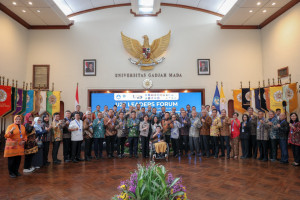
Twenty-four leaders of Indonesian State Universities with Legal Entity Status (PTN-BH), united under the U25 network, agreed to advance the development of inclusive and violence-free campuses. The commitment emerged during the U25 Leader Forum held at the UGM Senate Hall on Thursday (Jul. 30).
Rector of Universitas Gadjah Mada (UGM), Professor Ova Emilia, said universities are responsible not only for producing outstanding graduates through education and scientific advancement but also for promoting human well-being, social inclusion, and the common good by creating safe, inclusive, equitable, and violence-free campuses.
“This aligns with the concept of human flourishing, which UGM is currently promoting,” she said.

Professor Ova Emilia added that UGM has taken concrete steps toward an inclusive, violence-free campus by issuing Rector Regulation No. 1 of 2020 on the Prevention of Sexual Violence within the UGM Community and by introducing the Healthy Relationships Guidelines for positive interactions among all members of the university.
“We developed these guidelines to ensure healthier relationships among students, educational staff, and faculty members,” she explained.
Major General TNI Budi Pramono, an associate professor and special staff member to the Chief of the Presidential Staff Office of the Republic of Indonesia, emphasized that PTN-BH universities play a strategic role in developing high-quality human resources in support of the Golden Indonesia 2045 vision. Universities are responsible for educational spaces that are safe, inclusive, disability-friendly, and free from discrimination and violence.
“The university of the future creates a learning environment that is safe, inclusive, and equitable while providing equal opportunities for every member of the campus community to learn, grow, innovate, and excel without discrimination,” he said.
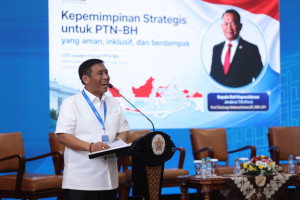
National resilience in the 21st century is not solely based on military strength but on human resources and social cohesion. Consequently, the success of PTN-BH universities should no longer be measured by the number of scientific publications but by the extent to which graduates and research innovations create tangible solutions and societal impact. For this transformation, Budi encouraged university leaders to implement three strategic pillars: Integrity Leadership, Innovative Leadership, and Collaborative Leadership.
Acting Inspector General of the Ministry of Higher Education, Science, and Technology, Nur Syarifah, said the government strengthens its commitment to creating campuses that are safe, inclusive, and free from all forms of violence through the implementation of Minister of Education, Culture, Research, and Technology Regulation No. 55 of 2024. The regulation expands the scope by placing prevention at the center while ensuring that case resolution puts victims’ interests and safety.
“Previously, the regulation focused only on sexual violence. It now covers the prevention and handling of physical violence, psychological violence, bullying, intolerance, discrimination, and online gender-based violence,” she explained.
To support these goals, university leaders must take concrete measures, including budget allocation and establishing and protecting task forces entitled to receive specialized support.
In addition, the need for organizational culture transformation to eliminate the normalization of violence, including sexist jokes, bullying disguised as discipline, and abuse of power. Concealing cases of violence under the pretext of “protecting the university’s reputation” reflects institutional failure, as universities should serve as safe spaces for nurturing individuals with integrity rather than create trauma.
“Universities should not only produce academically competent graduates but also provide learning environments that are safe, comfortable, inclusive, meaningful, and free from all forms of violence,” she said.
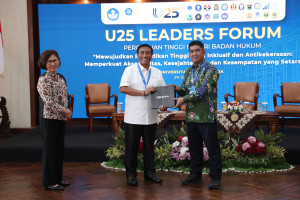
The forum continued with a talk show titled “Universitas Inklusif dan Antikekerasan: Aksesibilitas, Kesejahteraan, dan Kesempatan” (Inclusive and Violence-Free Universities: Accessibility, Well-Being, and Equal Opportunities), featuring five speakers: Rector of Institut Teknologi Sepuluh Nopember (ITS) Professor Bambang Pramujati, Rector of Universitas Islam Internasional Indonesia (UIII) Professor Jamhari Makruf, Chair of UGM’s Task Force for the Prevention and Handling of Sexual Violence Professor Yayi Suryo Prabandari, Chair of UGM’s Mental Health Service Unit Dr. Restu Tri Handoyo, and Chair of UGM’s Disability Services Unit Dr. Wuri Handayani, The discussion was moderated by UGM Vice Rector for Education and Teaching Professor Wening Udasmoro.
The discussion underscored the importance of comprehensively transforming campus culture. Participants agreed that the success of higher education institutions should be measured not only by academic achievements but also by their ability to create inclusive, violence-free environments for students.
“An inclusive campus is not merely one that treats everyone equally upon entering the university. It ensures everyone has equal opportunities to learn, grow, contribute, and reach their full potential,” said Professor Bambang Pramujati.
Meanwhile, Professor Yayi Suryo Prabandari noted that government regulations on the Prevention and Handling of Sexual Violence (PPKS) provide a strong foundation. However, effective implementation requires exemplary leadership, continuous education, and the courage to abandon long-standing practices, such as degrading sexist jokes, by treating them as serious violations that must be addressed without exception.
“Universities serve as a crucible not only for cognitive development but also for mental and social growth in equal measure, so that graduates become not only competent professionals but also good human beings,” she said.
Professor Yayi also emphasized that effective PPKS task forces can encourage victims to report incidents while implementing mental health screening from the beginning of student orientation.
From the perspective of promoting mental well-being across campus, Dr. Restu Handoyo emphasized the importance of collaboration among all campus stakeholders, including faculty members, peer counselors, and professional healthcare providers. Through synergy, universities can support students’ optimal development while ensuring both physical and psychological protection.
“Mental health is not merely an individual issue, it must also be viewed through a broader systemic approach. Individuals can build resilience, but campus culture, relationships, and interactions should also become central to efforts to improve the mental health of students and the entire academic community,” he concluded.
Dr. Wuri Handayani also reminded participants that an inclusive campus is fundamentally about respecting human dignity, which is only achievable through providing equal opportunities for everyone, including persons with disabilities.
“The key to humanizing people is ensuring equal opportunities through inclusive education. Disability can happen to anyone at any time. Therefore, providing accessibility is essential,” she concluded.
Author: Leony
Editor: Gusti Grehenson
Post-editor: Jasmine Ferdian
Photo: Firsto