


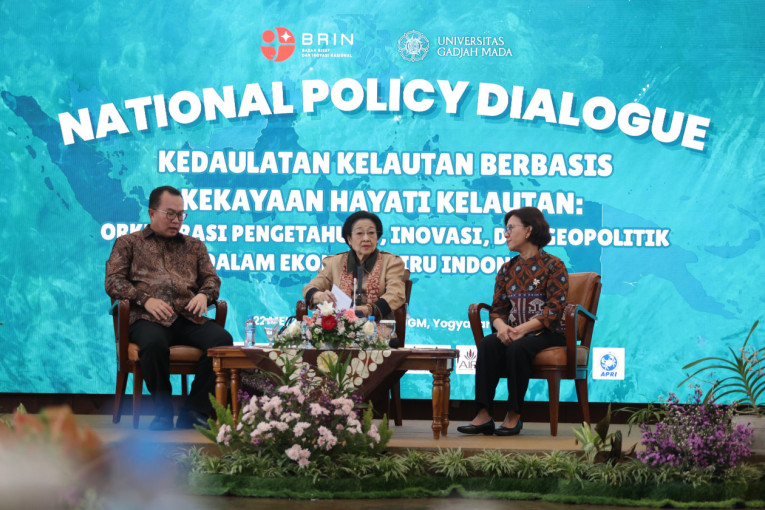
Amid intensifying global geopolitical competition and increasing contestation over marine resources, Indonesia is being urged to reaffirm its identity as a maritime nation. Strengthening research, innovation, and the management of marine biodiversity is considered essential to reinforcing national sovereignty while advancing a sustainable blue economy. Indonesia’s strategic position between the Indian and Pacific Oceans presents both significant opportunities and challenges in safeguarding sovereignty and independently managing marine resources.
The fifth President of the Republic of Indonesia and Chair of the Steering Committee of the National Research and Innovation Agency (BRIN), Prof. Dr. (HC). Megawati Soekarnoputri stated that Indonesia has yet to fully utilize its maritime potential as a foundation for national development. According to her, Indonesia possesses abundant marine biodiversity and a strategic position in the Indian and Pacific Oceans.
“Indonesia is not merely a land-based country. We are a maritime nation with a strategic position in the Indian and Pacific Ocean regions,” she emphasized during the National Policy Dialogue titled “Kedaulatan Kelautan Berbasis Kekayaan Hayati Kelautan: Orkestrasi Pengetahuan, Inovasi, dan Geopolitik dalam Ekonomi Biru Indonesia” (Maritime Sovereignty Based on Marine Biodiversity: Orchestrating Knowledge, Innovation, and Geopolitics in Indonesia’s Blue Economy) at the UGM Senate Hall on Friday (May. 22).
Megawati reminded the audience that the concept of Tanah Air should shape Indonesia’s perspective in viewing the sea as both a unifying force and a source of civilization. She also revisited the geopolitical vision of Indonesia’s first President, Soekarno, who positioned Indonesia as a global maritime power.
She further stressed the importance of Pancasila as the foundation of national development. According to her, strengthening research, innovation, and maritime sovereignty must remain rooted in national identity and the spirit of self-reliance inherited from the nation’s founding figures.
“Never forget the nation’s own history. Pancasila embodies universal values respected by the international community,” she said.
According to Megawati, strengthening the maritime sector cannot rely solely on resource exploitation but must also be supported by mastery of science, technology, and national research. She therefore urged BRIN and universities to integrate research with industrial needs and public policy so that research outcomes can provide tangible benefits to society. She also emphasized the importance of protecting Intellectual Property Rights (IPR) related to Indonesia’s biological resources to prevent them from being claimed by other countries.
“Please continue promoting the importance of patents, because once something is patented, it becomes part of international law,” she explained.
Megawati further stated that universities should develop strategic focuses in advancing knowledge and science. She described UGM as a center for the development of Pancasila and democracy, Bogor Agricultural University as a center for food sovereignty, Universitas Indonesia as a center for medicine and financial systems, and Bandung Institute of Technology as a center for industrial and military technology.
“I envision a city of intellect. UGM, for instance, for Pancasila and democracy, IPB for food sovereignty, UI for medicine and financial systems, and ITB for industrial and military technology,” she remarked.
In the context of national development, she also emphasized the importance of a long-term, sustainable direction. She argued that Indonesia needs a clear state policy framework to ensure that development priorities do not drastically change with every leadership transition. According to her, the concept of planned comprehensive development should be revived to maintain continuity in the nation’s development vision.
“When presidents change, the direction of development should not entirely change as well. We must have a long-term development framework for the future of the nation,” she said.
Megawati also highlighted various environmental issues and national development approaches that she believes are increasingly drifting away from the spirit of national sovereignty. She criticized extractive approaches to natural resource management, which she said have contributed to environmental degradation, the conversion of agricultural land, and the neglect of indigenous peoples’ rights. According to her, respecting customary law and local community rights in natural resource governance is essential.
“Yesterday, I cried while watching the film Pesta Babi. What it portrayed is real. So many forests have been converted into palm oil plantations. For what purpose? There are indigenous traditions, customary laws, and territorial rights. They only ask to be respected. Is that wrong?” she asserted.
Megawati concluded her remarks by encouraging all elements of the nation to strengthen confidence in Indonesia’s own capabilities and to stand independently in managing national natural resources. According to her, Indonesia must not depend on other countries in managing its natural wealth or determining the direction of national development.
“A great nation believes in its own strength. The sea must once again become the path toward the advancement of Indonesian civilization,” she concluded.
Author: Cyntia Noviana
Editor: Gusti Grehenson
Post-editor: Rajendra Arya
Photo: Firsto