


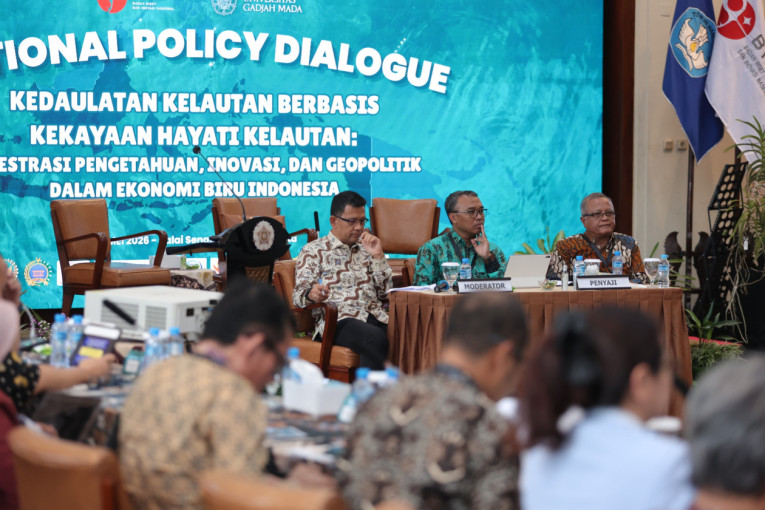
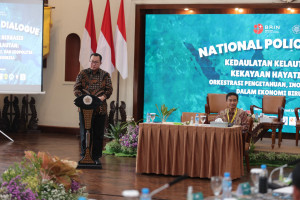
The maritime sector has the potential to become a national development paradigm through strengthening research, technology, and innovation based on Indonesia’s marine resources. Therefore, it must remain at the forefront of national development amid challenges in food, energy, health, the environment, and global geopolitics. Conveyed by Head of Indonesia’s National Research and Innovation Agency (BRIN), Professor Arif Satria, during the National Policy Dialogue titled “Kedaulatan Kelautan Berbasis Kekayaan Hayati Kelautan: Orkestrasi Pengetahuan, Inovasi, dan Geopolitik dalam Ekonomi Biru Indonesia” (Marine Sovereignty Based on Marine Biodiversity: Orchestrating Knowledge, Innovation, and Geopolitics in Indonesia’s Blue Economy) held at the Senate Hall of Universitas Gadjah Mada (UGM) on Friday (May. 22).
According to Professor Arif, BRIN will strengthen oceanographic and marine biodiversity research capacity to reinforce Indonesia’s position in global negotiations concerning marine resources. In efforts to integrate local knowledge from coastal communities with modern science.
“Coastal communities possess important empirical experience because they live and interact directly with the sea every day. This is important and must go hand in hand with science,” he explained.
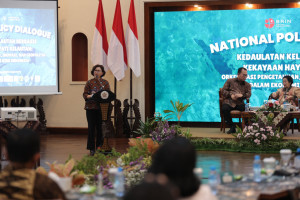
Rector of UGM, Professor Ova Emilia, noted the importance of strengthening downstream research and marine innovation to reinforce Indonesia’s maritime sovereignty. According to Professor Ova Emilia, marine biodiversity is not only a natural asset that must be preserved, but also a source of knowledge, innovation, and public welfare.
“Developing an integrated marine research and innovation ecosystem is essential to support the downstream implementation of research outcomes for the needs of society and national industries,” she stated.
However, Professor Ova Emilia noted that universities often face challenges when research outcomes remain limited to documents without tangible implementation. Therefore, she expressed hope that BRIN could accelerate the downstream implementation of various research and innovations produced by Indonesian academics.
Professor Ova Emilia affirmed that UGM is ready to become a strategic partner for the government and other institutions in developing a sustainable, inclusive, and globally competitive maritime sector.
“UGM is ready to become a strategic partner of the government and various other institutions in sustainable, inclusive, and globally competitive maritime development,” Professor Ova Emilia concluded.
Meanwhile, Vice Rector for Research, Business Development, and Cooperation, Dr. Danang Sri Hadmoko, stated that Indonesia’s vast marine biodiversity holds significant potential not only as an economic asset but also as a source of future development in science and technology.
“Indonesia possesses extraordinary wealth in terms of biodiversity, geodiversity, and cultural diversity, including highly rich coastal and marine ecosystems,” he said.
Dr. Hadmoko explained that UGM views marine biodiversity as one of the important frontiers for the future of national research and innovation. As a result, marine studies at UGM are no longer focused solely on species inventory but have expanded toward genomic approaches, bioinformatics, and environmental DNA research.
Dr. Hadmoko added that UGM is currently conducting various studies on marine bioprospecting, bioactive compounds, and the utilization of microalgae for biofuels, bioremediation, cosmetics, and pharmaceuticals.
“These studies are intended to support energy transition, environmental health, and the strengthening of Indonesia’s blue economy,” he concluded.
Author: Cyntia Noviana
Editor: Gusti Grehenson
Post-editor: Jasmine Ferdian
Photo: Firsto