


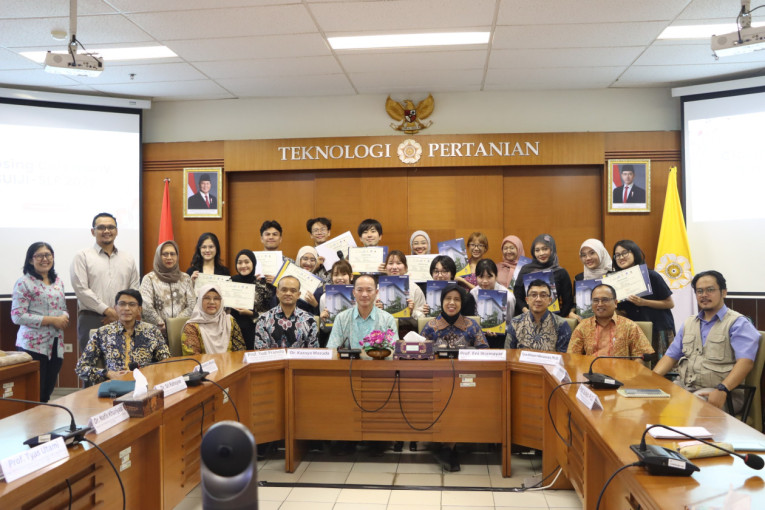
A total of five students from Japan and 14 students from UGM collaborated in a 10-day community service program in Imogiri, Bantul. The program was organized as part of efforts to strengthen international collaboration and service-based learning through cross-cultural engagement under the Six University Initiative Japan Indonesia – Service Learning Program (SUIJI-SLP) 2026.
The five Japanese students comprised three from Ehime University, one from Kagawa University, and one from Kochi University. Meanwhile, the 14 UGM students came from the Faculty of Agricultural Technology (FTP UGM), the Faculty of Agriculture (Agriculture UGM), and the Faculty of Animal Science (FKH UGM)
Ryoma, a student from Kagawa University, shared his experience of observing cultural differences between Japan and Indonesia during the activities in Imogiri, Bantul. According to Ryoma, one of the most noticeable aspects of the program was the cultural differences between the two countries, both in daily habits and in food culture.
In addition, he said he encountered challenges related to differences in community perspectives on agricultural issues, particularly regarding pests affecting rice crops.
“I became interested in the rice farming issues in the village. From interviews with several residents, I found differing opinions about rice pests and how to address them, which became a challenge for me in understanding the actual conditions,” Ryoma said during the Closing Ceremony and Farewell Dinner held on Thursday (Mar. 5) at the Operation Room, Unit I Building, FTP UGM.
During the closing session, the students presented the results of their activities throughout the community service program in the Imogiri area, Bantul. Throughout the program, students conducted village observations and interviews with residents to better understand local agricultural conditions and community life.
They also participated in various cultural activities with local residents, including eco-print workshops, making Indonesian snacks, learning batik, and playing the gamelan. In addition, the students visited a sheep farm and learned from villagers how to produce traditional herbal drinks (jamu) and tempe.
Responding to the students’ presentations, Head of the UGM Subdirectorate of International Cooperation, Tyas Ikhsan Himawan, expressed appreciation for the collaboration fostered through the SUIJI-SLP 2026 program. He added that international cooperation is a very important aspect for universities.
“At UGM, we highly value international collaboration programs because we believe that strengthening cooperation between Indonesia and Japan will have a greater impact, not only in academics and research but also in community service,” he said.
Vice Dean for Research, Community Service, and Cooperation at Agriculture UGM, Professor Subejo, said that the program provides students with direct experience in understanding rural life and agricultural practices through cross-country collaboration. He noted that the interaction between Indonesian and Japanese students during community service activities is an initial step toward generating ideas to improve agricultural practices and rural livelihoods.
“You learn not only about agriculture but also about rural life and social relations within village communities. In the end, you can collaborate to propose ideas to improve rural livelihoods and agricultural practices in the field,” he said.
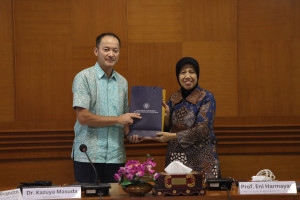
Associate Professor Dr. Kazuya Masuda, a supervisor of the SUIJI-SLP 2026 program from Kochi University, also expressed appreciation for the warm reception throughout the program. He hopes the program will become the starting point for lasting relationships between students from both countries, even after it ends.
“I have participated in this program since 2017. Every time I join, I always discover something new. Thank you very much for welcoming us and for your support and warm hospitality. I hope the students will continue to maintain communication and the friendships formed through this program,” he said.
Dean of FTP UGM, Professor Eni Harmayani, expressed appreciation to all participants from Indonesia and Japan who took part in the community service program. She said that the SUIJI-SLP program is not only an academic activity but also a cross-cultural learning platform that allows students to learn directly from community life, local culture, and various real-world challenges related to sustainable development. She also hopes that the experience gained during the program will prepare students to strengthen collaboration and global leadership in the future.
“More than just an academic activity, this program serves as a platform for cross-cultural learning and mutual understanding, where students learn not only in classrooms but also directly from community life, local culture, and real sustainability challenges,” she said.
Writer: Cyntia Noviana
Editor: Gusti Grehenson
Post-editor: Zabrina Kumara
Photo: Ika Agustine