


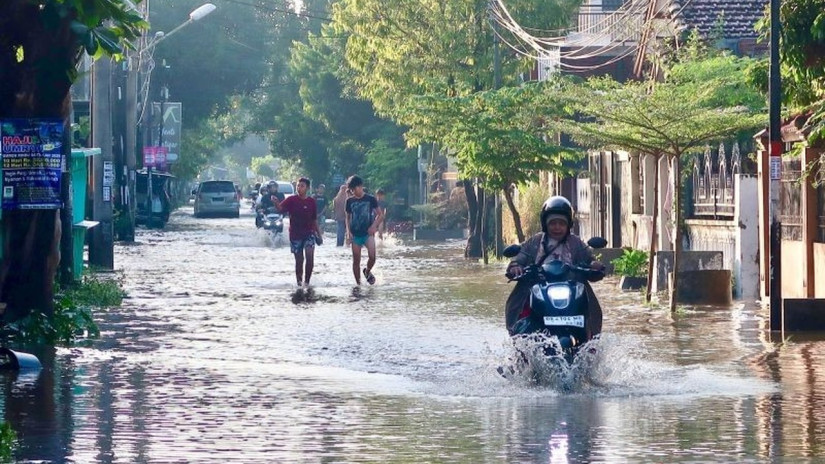
Climate change has damaged transportation infrastructure, particularly road conditions, in Indonesia. Extreme rainfall patterns, floods, landslides, rising sea levels, and thermal pressure on pavement materials in infrastructure structures require new approaches that are more adaptive, anticipatory, and sustainable in planning and managing road infrastructure development.
“The impacts of climate change are now significantly challenging conventional design approaches that have long relied heavily on historical data. In Indonesia’s context, these challenges are even greater due to the country’s highly diverse geographical conditions,” said Professor Siti Malkhamah, Acting Head of the Center for Transportation and Logistics Studies (Pustral) at Universitas Gadjah Mada, during the webinar Resilient Roads: Infrastructure Adaptation Against Climate Change recently.
Professor Malkhamah acknowledged that Indonesia’s geographical conditions vary greatly, ranging from mountainous regions prone to landslides and coastal areas subject to tidal flooding to regions with high rainfall that can accelerate road surface deterioration and disrupt interregional connectivity.
Therefore, according to her, the resilience of road infrastructure to climate change can no longer be viewed solely as a technical issue but must also be considered a crucial part of the national sustainable development agenda.
The webinar Resilient Roads: Infrastructure Adaptation Against Climate Change was organized by the Pustral UGM in collaboration with HK ExpertTalk of PT Hutama Karya. Several speakers participated in the event, including Pantja Dharma Oetojo, Director of Engineering and Bridges at the Directorate of Highways, Ministry of Public Works; Kun Hartawan Adi Satria, Acting Director of PT Hutama Membelin Trans Papua; and Dr. Mukhammad Rizka Fahmi Amrozi, an expert team member at Pustral UGM and a lecturer at the Department of Civil and Environmental Engineering, UGM.
Pantja Dharma Oetojo presented on the theme Climate-Resilient Road Infrastructure Technology. He stated that current practices in Indonesia for sustainable, climate-resilient road infrastructure include AI-based detection of road pavement damage. Several initiatives include monitoring road conditions, implementing performance-based road management systems, utilizing local pavement materials to improve sustainability, and applying environmentally friendly technologies.
“In principle, these steps represent a combination of digital innovation and material adaptation,” he explained.
He expressed hope that an integrated approach to future road infrastructure development would result in longer pavement service life, improved resilience to the impacts of climate change, and reduced costs and emissions throughout the product life cycle.
Various collaboration opportunities are also expected to emerge, including material performance evaluation, pilot projects integrating digital technology and materials, and partnerships with other countries.
Kun Hartawan Adi Satria added that PT Hutama Karya has prepared a resilient road approach for the Public-Private Partnership (PPP) Trans Papua Project, specifically the Mamberamo–Elelim segment in Papua Highlands. Climate anticipation measures, he noted, have been implemented since the planning stage. Road elevation and bridge structures are designed through hydrological analysis to ensure resilience against flooding, high water flows, and changes in soil conditions resulting from extreme weather.
He explained that climate anticipation and risk mitigation measures, as well as technical planning strategies, are implemented through several design updates. These include planning high-capacity drainage systems to anticipate extreme rainfall, raising road elevations to prevent inundation, designing slope reinforcement, such as soil nailing and geotextiles, to maintain soil stability, and determining route alignment based on geotechnical and hydrological analyses.
“Climate and risk anticipation measures are also implemented through quality control and occupational health and safety supervision,” he said.
Dr. Mukhammad Rizka Fahmi Amrozi explained that resilient infrastructure is guided by several fundamental principles to ensure that systems can withstand and recover from disruptions. While continuing to serve the public effectively, resilient infrastructure is built on the core principle of robustness, namely the physical strength and structural integrity that enable it to withstand pressure and shocks without significant loss of function.
Author: Agung Nugroho
Post-editor: Jasmine Ferdian
Photo: Merdeka.com