


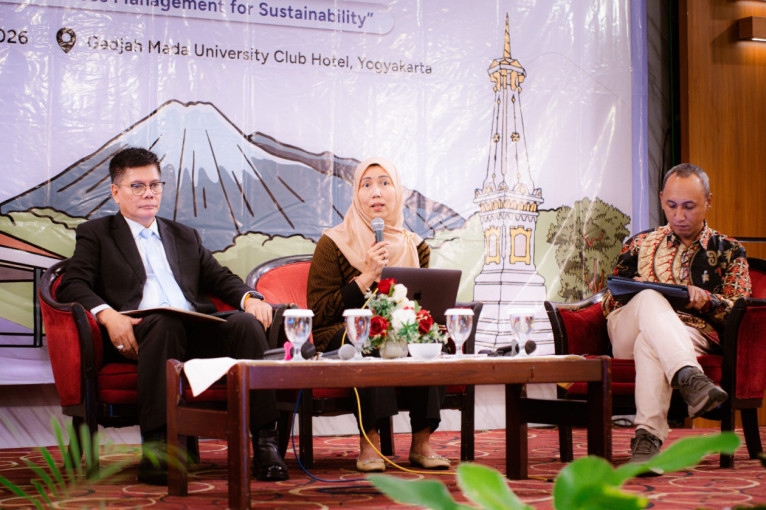
A total of 60 researchers from five countries participated in the 7th International Conference on Environmental Resources Management in the Global Region (ICERM), organized by the Faculty of Geography at Universitas Gadjah Mada on Tuesday (May 19) at UC Hotel. The participating countries included Indonesia, Malaysia, India, Taiwan, and Japan.
This year’s conference carried the theme “Human Resources Management for Sustainability.” Held biennially, the conference serves as a platform for exchanging scientific ideas while formulating data-driven policy recommendations to support environmental sustainability.
The first guest speaker, Professor S. Suriyanarayanan from JSS Science and Technology University, introduced the Sponge City concept as a nature-based solution. Green infrastructure, such as urban forests and wetlands, is designed to absorb, store, and filter rainwater to reduce flood risks while improving biodiversity.
“Engineering solutions alone cannot solve the climate crisis. The key is for humans to learn how to live in harmony with nature,” Professor Suriyanarayanan explained in a statement received by reporters on Friday (May 22).
Meanwhile, Professor Jian Bang Deng from Tamkang University presented his research on international migration in Indonesia. He explained that Taiwan, Hong Kong, South Korea, and Singapore are major destinations for workers from Central Java and East Java.
He found that many former migrant workers had successfully become entrepreneurs in their hometowns. According to him, the migration system benefits both sides by reducing unemployment in countries of origin while addressing labor shortages caused by aging populations in destination countries.
“Migration can create transformative impacts in home villages through innovation and human resource development derived from acquired skills,” said Professor Deng.
Another guest speaker, Professor Makoto Takahashi from Nagoya University, shared Japan’s experience in dealing with tsunami risks in the southern region of the country. One of the current challenges, he noted, is the aging population. He emphasized the importance of social memory within communities to maintain disaster awareness.
“The issue today is that many elderly residents are unwilling to relocate despite living in disaster-prone areas,” Professor Takahashi said.
In addition to the guest speakers, the conference also featured keynote sessions. Dr. Dyah Rahmawati Hizbaron from the Faculty of Geography UGM discussed human geography and urban risk management. Meanwhile, Dr. Khamarrul Azahari Bin Razak from Universiti Teknologi Malaysia presented on community-based complex disaster risk reduction. The final keynote speaker, Dr. Abdul Haris Achadi from the National Search and Rescue Agency (BASARNAS), shared practical perspectives on disaster and emergency management.
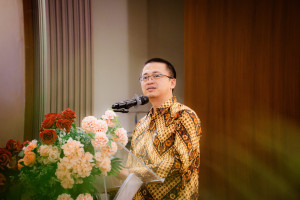
Dean of the Faculty of Geography UGM, Professor Muhammad Kamal, expressed full support for the conference as a strategic platform for UGM to expand its international networks. He emphasized that the essence of disaster mitigation and environmental preservation ultimately lies in human preparedness and governance.
“We hope this conference will encourage global collaboration in the form of joint research, student exchanges, and the formulation of inclusive spatial planning policies,” he stated.
Chair of ICERM 2026, Professor Sri Rum Giyarsih, expressed hope that the conference would contribute to academic development, particularly in environmental geography.
She added that the conference could also benefit policymakers in formulating appropriate development policies informed by research findings from scholars across countries.
Author: Jesi
Editor: Gusti Grehenson
Post-Editor: Zabrina Kumara
Photo: Faculty of Geography Documentation & Jesi