


State expenditure in the 2026 State Budget (APBN) has reached Rp3,843 trillion. This government spending allocation is among the highest in the ASEAN region. Nevertheless, the large allocation of state spending is not the determining factor for development success, particularly in improving public welfare.
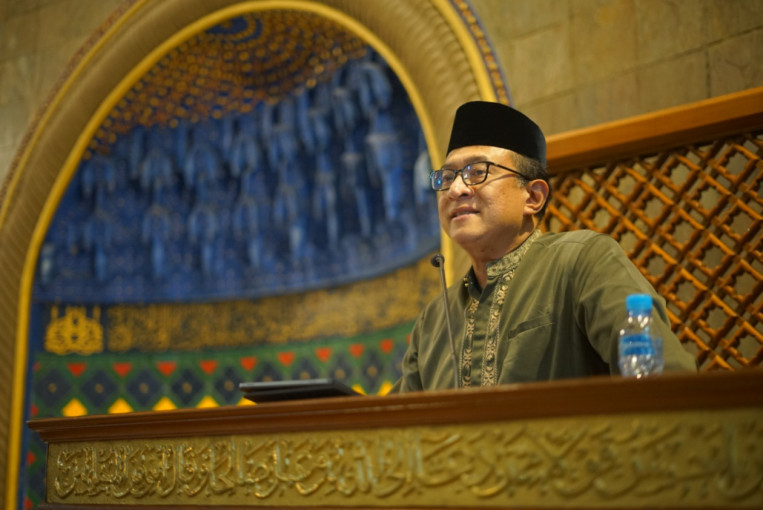
“A large budget does not guarantee the achievement of welfare,” said Elan Satriawan, P. hD., an economist at Universitas Gadjah Mada, during the Ramadan Public Lecture discussion titled “Assessing the Efficiency of Human Development Spending in Indonesia” held at the UGM Campus Mosque on Monday (Mar. 9).
Through the state budget allocation, Elan hopes that both the government and the public will ensure that this spending truly generates a meaningful impact. As an example, Elan pointed to the teacher certification program, which consumes a large portion of the budget but has yet to produce significant improvements in teachers’ capacity and student performance. He cited a publication in the Quarterly Journal of Economics that found that increases in teacher incentives and capacity were not accompanied by improvements in student academic outcomes.
According to Elan, the role of the state is not merely to manage budgets, administration, and security. More fundamentally, it must formulate policies that bring benefits and progress to its citizens. Other responsibilities of the state include providing public needs, facilities, and basic access so that people can live decently.

For Elan, the Rp3,843 trillion in the state budget originates from taxes, which belong entirely to the people. Therefore, it must be used as effectively as possible.
“When corruption, waste, or misallocation occurs, it constitutes a violation of public trust, not merely a technical administrative error,” he said.
However, Elan noted that several issues remain in the use and management of the trillions of rupiah in the state budget, and that these issues have yet to have a significant impact on public welfare development. According to him, bureaucratic spending still dominates substantive spending, including expenditures for meetings, official travel, and similar activities. In addition, result-based accountability remains weak. He explained that Key Performance Indicator (KPI) assessments in ministries and government agencies still emphasize budget absorption rather than outcomes.
“I believe this reflects flaws in policy design as well as institutional fragmentation,” he explained.
Elan believes the government needs to shift KPIs from merely measuring administrative budget absorption to evaluating performance based on societal impact. Therefore, strengthening integrated data systems across ministries and government agencies is necessary so they can rely on the same information base. In addition, evidence-based evaluations are essential to ensure that every funded program produces tangible outcomes aligned with its objectives. This is because the main challenge in Indonesia’s human development is not a lack of funding, but rather limited effectiveness and weak evidence-based policy governance.
“This is where the active role of civil society and academics becomes crucial, because even the smallest voices can serve as valuable feedback for the government,” he said.
Author: Hanifah
Editor : Gusti Grehenson
Post-editor: Jasmine Ferdian
Photo : RDK UGM