


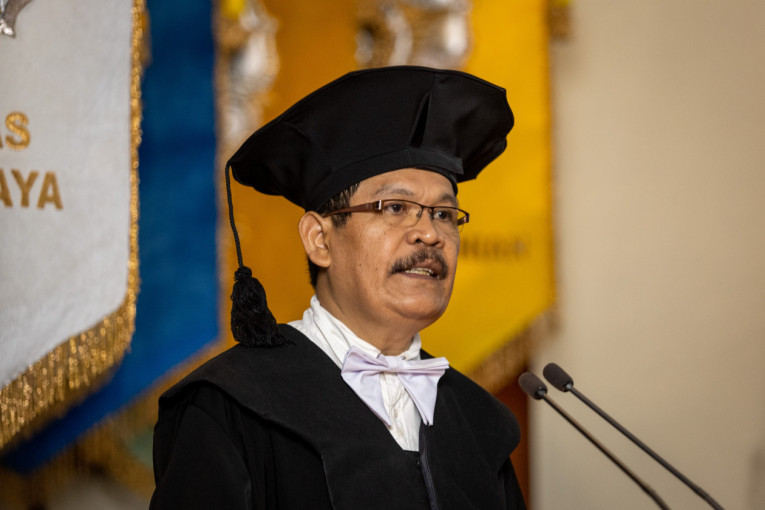
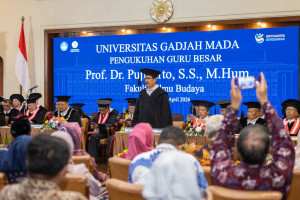
A lecturer in the Indonesian Language and Literature Study Program at the Faculty of Cultural Sciences Universitas Gadjah Mada (FIB UGM), Professor Pujiharto, was inaugurated as Professor of Postmodern Literature at the Senate Hall, UGM Central Building, on Tuesday (Feb. 14).
In his inaugural speech titled “Postmodern Indonesian Literature,” Professor Pujiharto outlined a fundamental shift in the landscape of Indonesian literature, particularly the transition from the modernist to the postmodern era. He emphasized that understanding postmodern literature is not merely about chronological sequence, but about recognizing changes in poetics.
“Postmodern Indonesian literature raises ontological themes. Epistemological poetics characterizes modernist novels, whereas ontological poetics characterizes postmodernist novels,” he explained.
Furthermore, Professor Pujiharto noted that a work of fiction can be considered ontological when it implicitly presents formal strategies concerning the existence of worlds.
“Issues surrounding the existence of fictional worlds and their inhabitants, as well as reflections on the plurality and diversity of worlds conveyed implicitly through formal strategies, are dominant characteristics of ontological fiction,” he elaborated.
In practice, the Chair of the Indonesian Language and Literature Study Program Association (PROBSI) examined the novels Telegram (1973) and Pabrik (1967) by Putu Wijaya. In Telegram, he highlighted a narrative structure that moves from the text’s real world to recurring imagined worlds.
“An ontological scandal occurs, causing the text to flicker between the reality within the novel and actual reality. Throughout the story, events move back and forth between epistemological and ontological dimensions until the end,” he explained.
Beyond literary analysis, Professor Pujiharto connected ontological plurality in literature to contemporary society, which increasingly relies on artificial intelligence (AI), leading to hyperreality or the absence of clear origins. According to him, ontological plurality is becoming more anarchic alongside the widespread use of AI in everyday life.
“The use of AI has created worlds that collide with one another, making it difficult for us to distinguish what is real and what is artificial,” he said.
Through this deconstruction and understanding of poetics, Professor Pujiharto hopes that modern society will be better prepared to face the uncertainty of facts in the future.
“The changes taking place require all of us to be ready to face them, especially universities, which have long been regarded as the forefront of change,” he concluded.
Author: Aldi Firmansyah
Editor: Gusti Grehenson
Post Editor: Zabrina Kumara
Photo: Donnie