


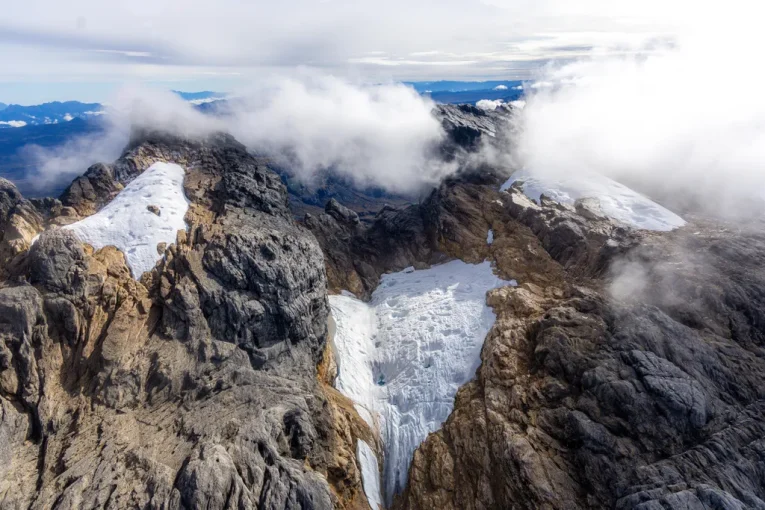
The ice layer that has covered Puncak Jaya in Papua for thousands of years is predicted to disappear as global temperatures rise. At the end of 2024, the Meteorology, Climatology, and Geophysics Agency conducted glacier monitoring at Puncak Sudirman in the Jayawijaya Mountains, Papua, revealing that the ice cover area shrank by 0.11–0.16 square kilometers from 0.23 square kilometers recorded in 2022.
A report titled “Climate Chronicles published in April 2026 by Nature Reviews Earth & Environment, also revealed similar findings, noting that glaciers worldwide lost approximately 408 gigatons of mass in 2025. The data ranked 2025 as the sixth-worst year since records began in 1975.
Hydrometeorology, Urban Climate, and Environmental Climatology expert from the Faculty of Geography at Universitas Gadjah Mada (Geography UGM), Dr. Emilya Nurjani, stated that glacier area and thickness in both the Northern and Southern Hemispheres have been declining. More specifically, she mentioned two tropical glacier locations experiencing significant degradation: the summit of Mount Kilimanjaro in Africa and Puncak Jaya in Indonesia.
According to Dr. Nurjani, the reduction in the ice layer is caused by the impact of shortwave solar radiation, which is the primary energy source driving weather and climate on Earth. She explained that any type of land use or land cover on the Earth’s surface absorbs and releases energy from solar radiation, including agricultural land clearing, settlements, reservoirs, concrete surfaces, and even ice and snow in polar regions.
Furthermore, the ratio of solar energy reflected by land cover on Earth is referred to as albedo. Ice and glaciers have the highest albedo because most solar radiation is reflected back into the atmosphere, allowing glacier landforms to remain intact.
“Massive land use and land cover changes on the Earth’s surface reduce the albedo reflected into the atmosphere, causing a buildup of radiative energy in the atmosphere, leading to global warming and resulting in glacier melt,” she explained on Friday (April 17).
The environmental climatology expert further explained that one consequence of glacier shrinkage is the melting of ice in many polar and mountainous regions in Europe. Melting ice contributes to rising sea levels. Increased sea volume leads to sea level rise and the submergence of low-lying land areas.
“The impact felt by communities in Indonesia includes coastal abrasion and sea level rise in areas such as Semarang and the northern coast of Java. Many experts have studied this phenomenon, although sea level rise is not solely caused by increased ocean water volume,” she said.
Dr. Nurjani added that cross-sectoral mitigation efforts are necessary to prevent further increases in the Earth’s surface temperature and reduce glacier shrinkage. To prevent further impacts, decarbonization efforts must be pursued across sectors, and land-use regulations must be properly implemented.
“At the household level, we can contribute by saving electricity, reducing fossil fuel consumption, and, if possible, participating in tree-planting initiatives to help lower air temperatures in the long term,” she concluded.
Author: Ika Agustine
Editor: Gusti Grehenson
Post-editor: Rajendra Arya
Photo: BMKG