


The enactment of Law No. 32 of 2024, amending Law No. 5 of 1990 on the Conservation of Biological Natural Resources and Their Ecosystems (KSDAHE Law), has introduced a problematic shift in Indonesia’s conservation paradigm. Rather than prioritizing ecological justice and inclusivity, the regulation is seen to marginalize the communal position of Indigenous Peoples and Local Communities.
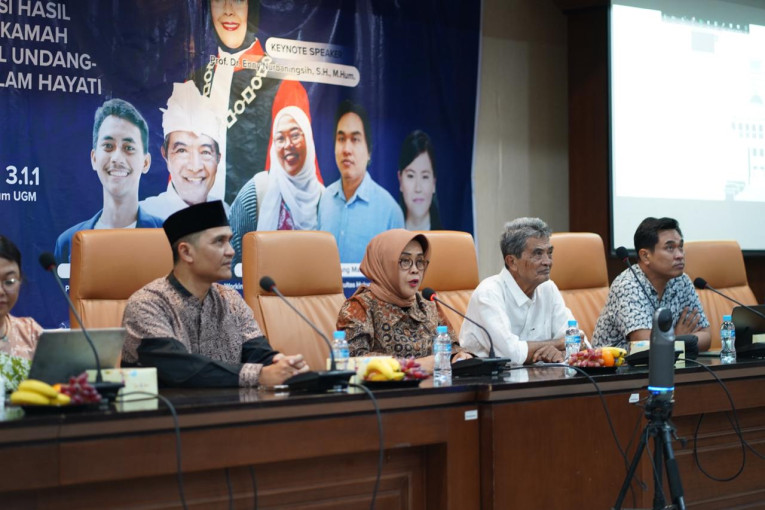
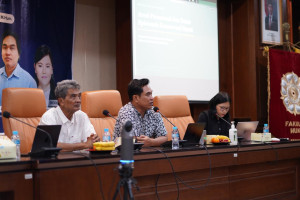
The legal construction of the KSDAHE Law does not recognize Indigenous Peoples as rights-holders but merely as participating entities under centralized state control. This issue emerged during a Public Lecture and Dissemination of the Constitutional Court Decision Examination on the formal review of the KSDAHE Law, held on Friday (Apr. 24) at the UGM Faculty of Law.
Constitutional Court Justice of the Republic of Indonesia, Professor Enny Nurbaningsih, explained the Court’s decision to reject the formal review petition of the KSDAHE Law. She invited participants to examine the ruling comprehensively, including from the perspective of its benefits.
“The question is, if the law were annulled, would conditions improve? Or would we return to previous regulations that were unable to address current challenges?” she said.
She emphasized that in assessing a law, it is essential to balance procedural aspects with its broader societal benefits. According to her, evaluating Constitutional Court decisions requires not only examining the ruling itself but also understanding the ratio decidendi, or the legal reasoning underlying it.
In her presentation, Professor Nurbaningsih highlighted the complexity of formal judicial review. She noted that many petitions are filed only after a law has been enacted, resulting in limited evidence.
“To prove formal defects, the legislative process should be monitored from the beginning, from the National Legislation Program to deliberations in the House of Representatives. This is not easy,” she explained.
The most frequently contested issue concerns public participation, which is often deemed insufficiently meaningful. However, she argued that the definition of “meaningful” participation remains debated and difficult to substantiate without comprehensive data.
She also stressed that all formal review proceedings at the Constitutional Court are open to the public, ensuring transparency and accessibility.
Furthermore, Professor Nurbaningsih connected the discussion to the constitutional foundations of environmental protection in Indonesia. She underscored the importance of Article 28H(1) of the 1945 Constitution, which guarantees the right to a good and healthy environment, and of Article 33, which emphasizes sustainability in natural resource management. According to her, these provisions demonstrate that Indonesia has adopted the concept of environmental constitutionalism, or a “green constitution.”
“Our Constitution is highly progressive. It not only guarantees rights but also affirms the state’s responsibility in managing natural resources,” she said.
Nevertheless, she acknowledged that implementing these principles remains challenging, citing weak law enforcement, increasing environmental degradation, and ongoing conflicts in natural resource governance.
The discussion also highlighted regulatory disharmony and strong sectoral egos as major obstacles in managing natural resources in Indonesia. Although regulations continue to expand, sometimes leading to what is described as “regulatory obesity”, substantive reform has progressed slowly due to competing economic and political interests.
“We are facing policy fragmentation, overlapping regulations, and complex conflicts of interest. These factors hinder optimal natural resource management,” she explained.
Professor Nurbaningsih encouraged strengthening public participation in the legislative process, including leveraging digital technology to gather broader input from the public. She also urged academics and students to continue conducting research and monitoring policies in the natural resource sector.
“The Constitution has provided clear direction. Our shared task is to ensure its implementation so that natural resources remain sustainable and can be enjoyed by future generations,” she concluded.
Chair of the UGM Center for Constitutional Democracy and Human Rights Studies (Pandekha), Dr. Yance Arizona, stated that it is crucial for academics to examine Constitutional Court rulings, as many decisions significantly influence social and political conditions, including efforts to protect human rights and the environment.
“Various Constitutional Court decisions are worth discussing. If there are criticisms and inputs, I believe the Court will welcome them from the academic community,” he said.
Chair of the ICCAs Indonesia Working Group, Cindy Julianty, added that collaboration with Pandekha represents a strategic step in addressing natural resource issues within a legal framework.
“We see this activity as a concrete follow-up to the post-decision examination process,” she said.
Author: Jelita Agustine
Editor: Gusti Grehenson
Post-editor: Jasmine Ferdian
Photo: Salwa