


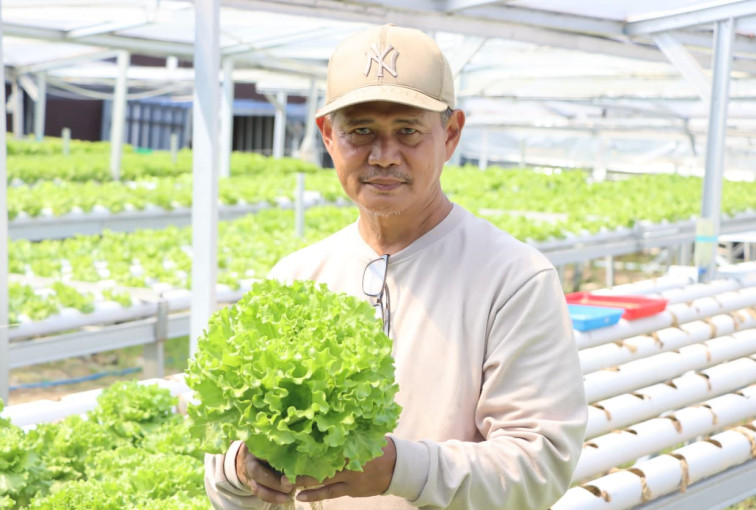
A stretch of fresh green lettuce stands in stark contrast to the neatly stacked folders that once lined his desk at the UGM Public Relations Office. For Arta Wahana, a retired educational staff member of Universitas Gadjah Mada (UGM), retirement is not a time to stop being productive. With his agile and skillful hands, cultivating lettuce is not merely a way to fill his spare time, but a new way to stay active and maintain his fitness.
Arta explained that the 650-square-meter garden has transformed the rhythm of his life, from leaving in the morning and returning in the evening, to now departing even earlier and finishing before noon. During his time as a staff member at the Graduate School Library at UGM, he worked overtime until 7 p.m. nearly three times a week. Later, when he was assigned to the university’s Public Relations Office, he consistently worked from morning until evening.
“Now, working in the garden, I have to leave even before dawn because people are already waiting to pick up the lettuce. But the working hours here are shorter—I finish by 10 a.m. In fact, during harvest days, I’m done by 9 a.m.,” he said on Tuesday (Apr. 28).
Arta is a retired member of the educational staff at the UGM Public Relations Office, having retired in 2024. He has served at UGM since 1989. Before joining the Public Relations Office, he was assigned to the Graduate School Library until 2010.
“I started working in 1989 and retired in early 2024. Previously, I worked at the Graduate School Library, where I recorded book loans, assisted in finding books, and cataloged them. When the library was merged, I was transferred to the UGM Public Relations Office to help prepare press conferences, record videos, and perform other tasks,” he recalled.

While transferring lettuce to the replanting table, Arta explained that his two gardens in Pakem and Plosokuning use a hydroponic system. This is made possible through the knowledge and network of his second daughter, who graduated from an agriculture program.
“My daughter is currently pursuing agriculture, learning together with friends to cultivate lettuce. I support by helping physically every day. My son-in-law prepares the nutrients, and my daughter handles the marketing,” he explained.
Furthermore, Arta shared another reason for choosing to enter the agricultural sector after retirement.
“When I was young, I also worked in rice fields, so I know a little about growing plants. Beyond that, it feels more peaceful—starting the day seeing fresh green plants. It’s both physical exercise and spiritual reflection, because in the garden I can sweat while also praying for fertility,” he said.
In cultivating lettuce, Arta admitted that he initially encountered several challenges, ranging from plants that failed to grow properly, wilted, or even died.
“In the early days, many of the lettuce plants died. After investigating, it turned out they lacked nutrients. The water temperature was also too high because it was stored in drums. Now we use well water. We also clean the channels in case they are clogged with moss and regularly check the nutrients,” he explained.

Successfully overcoming these technical challenges has ultimately led to increased garden productivity. To maintain supply continuity, Arta implements a rotational planting system across eight production tables. With an average growing period of 40 days, he organizes the schedule so that harvesting can be carried out in rotation.
“Now, we can harvest around 20–30 kilograms every day. There are eight tables, and each table can be harvested approximately every five days,” he explained.
Arta added that the price of hydroponic lettuce is currently relatively high, ranging from Rp20,000 to Rp25,000 per kilogram. With a sales volume of 20–30 kilograms, he earns an average daily turnover of around Rp400,000 to Rp750,000. However, he noted that market conditions are often fluctuating.
“Prices depend heavily on the supply of soil-grown lettuce. During the dry season, lettuce from Kopeng is harvested in large quantities, causing prices to drop to as low as Rp6,000. This affects hydroponic lettuce prices. Thankfully, demand for hydroponic lettuce remains high. Many people prefer it,” he explained.
Concluding the conversation, Arta shared a message for fellow retirees to remain active and make use of their available resources.
“To fellow retirees, if you have time and land—whether large or small—let’s start planting. You can consume it yourself and eventually learn to generate income from it,” he concluded.
Author: Aldi Firmansyah
Editor: Gusti Grehenson
Post-editor: Zahra
Photo: Jesi