


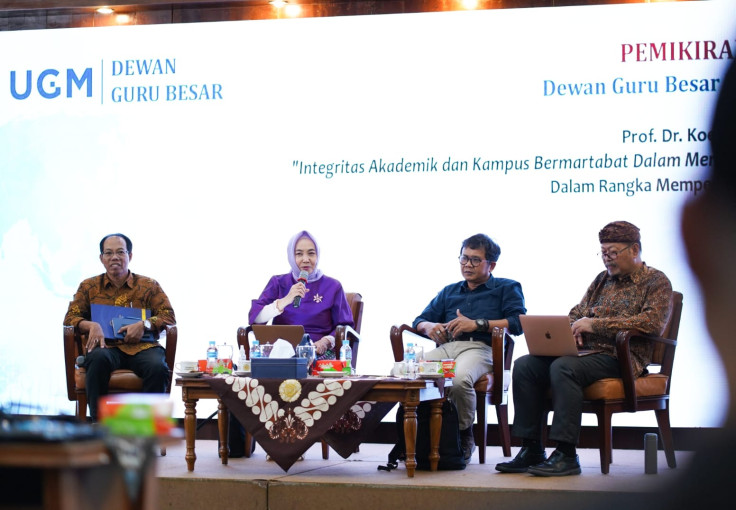
Academic integrity in higher education faces significant challenges amid the widespread use of artificial intelligence (AI) and the complexity of Indonesia’s education regulations. This phenomenon requires universities not only to tighten formal rules but also to restore campuses as homes for honest ideas grounded in humanistic values.
This issue emerged during the 47th Bulaksumur Thought Discussion organized by the Universitas Gadjah Mada (UGM) Council of Professors, titled “Academic Integrity and a Dignified Campus in Building Together with Society,” held at the Senate Hall of the UGM Central Building on Wednesday (Apr. 22).
Chair of the UGM Academic Senate, Professor Sulistiowati, highlighted several challenges in regulating academic integrity in Indonesia, ranging from regulatory fragmentation, the AI and plagiarism emergency, weak enforcement, and inconsistent sanctions. Regarding regulation, she encouraged the government to promptly draft a dedicated Government Regulation that integrates all existing policies.
“There needs to be a Government Regulation on academic integrity that governs everything from prevention to law enforcement, guidance, and supervision,” she stated.
Furthermore, she emphasized the urgency of academic honesty amid the AI and plagiarism emergency, citing the profound principle of the former UGM Rector, Koesnadi Hardjasoemantri. For her, the motto ‘the campus is a home for honest ideas, and academic honesty is not merely a rule but the very soul of knowledge itself’ underscores that academic honesty is not optional but the foundation of a dignified campus.
“The best international models include independent regulators, criminalizing academic ghostwriters, and AI policies, all of which need to be adapted while considering Indonesia’s cultural context. Ultimately, a dignified campus begins with the moral courage of its leaders, as exemplified by Professor Koesnadi,” she explained.
Meanwhile, UGM Vice Rector for Student Affairs, Community Service, and Alumni, Dr. Arie Sujito, stated that academic integrity is closely linked to the responsibilities of lecturers and students in carrying out educational and research programs. Dr. Sujito also referred to the ideology of education and emancipatory nationalism mandated by Pancasila and the Preamble of the Constitution, reflecting on Professor Koesnadi’s idea that campuses must always remain attentive to environmental issues and avoid becoming ivory towers.
UGM Rector for the 2014-2017 period, Professor Dwikorita Karnawati, revisited Professor Koesnadi’s teaching on students’ humanistic values amid the rapid advancement of AI.
According to her, the human aspect serves as the primary safeguard against students becoming mere “robots” of science and technology.
“The key principle to emulate is student humanism, which must be nurtured so that students do not become robots of science and technology,” she remarked.
She also highlighted how today’s technological ease often results in student assignments that appear visually perfect but lack substantive depth.
“The trap of technological ‘robots’ becomes evident in the speed and polish of student reports. However, when asked questions, they often struggle. This is where the role of higher education becomes crucial. The duty of lecturers is to engage in dialogue to deepen information, philosophy, and practical understanding in the field,” she emphasized.
Professor Ova affirmed that UGM continues to promote the academic forum as a space for the ethical, wise, and responsible expression of opinions. The university is also committed to fostering an academic culture of integrity with zero tolerance for plagiarism.
“Safeguarding academic integrity will shape the character of a dignified academic community and contribute meaningfully to national development,” she concluded.
Author/Photo: Aldi Firmansyah
Editor: Gusti Grehenson
Post-editor: Rajendra Arya