


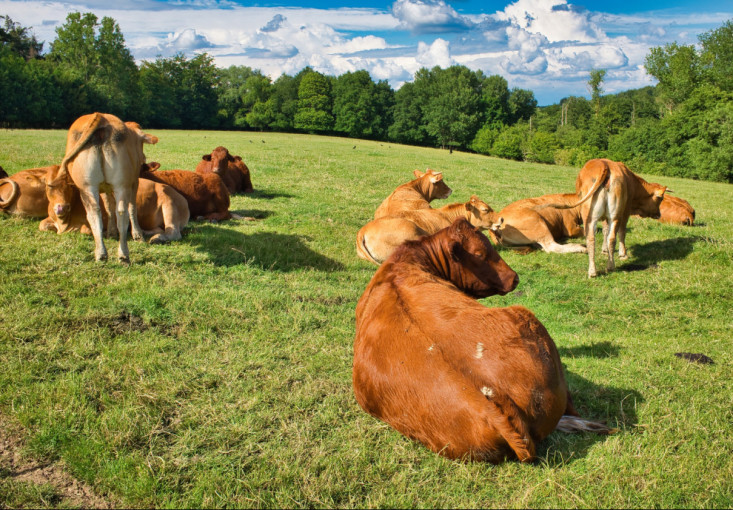
The weakening of the rupiah against the US dollar has caused the price of imported Australian cattle to rise. In addition, cattle prices in Australia have increased since late 2025 due to intensifying export competition in the global market and geopolitical uncertainty. This situation has become a warning sign for Indonesia’s animal-based food security. Although the condition benefits local farmers by driving up domestic cattle prices, dependence on imports still leaves national beef prices vulnerable to external shocks.
Professor Panjono, a professor at the Faculty of Animal Science, Universitas Gadjah Mada (Animal Science UGM), stated that rising imported cattle prices have a positive impact on local farmers, as this can increase domestic cattle prices.
“When imported cattle prices rise, it actually benefits farmers as business actors because domestic cattle prices will automatically increase as well,” he said on Tuesday (May 12).
However, from a national perspective, Professor Panjono explained that this condition demonstrates how Indonesia’s food security, particularly for beef commodities, remains vulnerable to external shocks such as exchange rate fluctuations, geopolitical conditions, and global market dynamics.
According to him, if imported cattle prices continue to remain high, import volumes could decline. As a result, the slaughter of local cattle would increase to meet market demand. If this continues over the long term, it could lead to a decline in the national cattle population.
“If imports decrease, domestic slaughter rates will increase. If this continues, our cattle population could decline, eventually leading to shortages,” he explained.
Meanwhile, the government’s target for the national cattle population still faces major challenges. He noted that the Ministry of Agriculture aims for the cattle population to reach 19.9 million head in 2026, while the population in 2025 was only around 13.5 million head. According to him, the significant gap indicates that increasing the population will require extraordinary measures, ranging from accelerating breeding programs and improving breeder productivity to controlling the slaughter of productive livestock.
“This means there is still a shortage of more than six million head. If slaughter rates increase, the target will certainly become even more difficult to achieve,” he said.
In addition, sharp exchange rate fluctuations have made it difficult for beef cattle business operators to calculate purchasing costs, selling prices, and profit projections. According to Professor Panjono, the beef cattle industry primarily needs exchange rate stability. With a stable exchange rate, business operators can plan more accurately and reduce the risk of losses caused by sudden price changes.
“What is most important for beef cattle businesses is not merely a lower dollar exchange rate, but stability in the rupiah-to-dollar exchange rate. If it is stable, they can calculate costs and selling prices with greater certainty,” he explained.
According to Professor Panjono, the issue of high imported cattle prices cannot be resolved through a single policy. The government needs to implement a phased strategy that includes short, medium-, and long-term measures to maintain beef supply while strengthening the national cattle population.
In the short term, imports of beef and feeder cattle are still necessary to maintain supply availability and prevent sharp price increases in the market.
“At the same time, the public can be encouraged to utilize alternative protein sources such as chicken, eggs, fish, and tempeh to reduce pressure on beef demand,” he added.
In the medium term, he said the government needs to ensure the sustainability of the feedlot industry through easier access to imports, regulatory certainty, and stable rupiah exchange rates. The continuity of feedlot operations is crucial because the sector contributes economic value, absorbs labor, and maintains supply continuity.
“If the exchange rate cannot decrease, at the very least it must remain stable so business operators can calculate operational costs with certainty,” he stated.
As for the long-term strategy, it should focus on increasing the national cattle population through large-scale breeding programs. One of the most realistic approaches, according to Professor Panjono, is utilizing palm oil plantations, coconut plantations, and industrial forest areas.
“The long-term strategy is to increase the population through breeding programs and the integration of cattle farming with plantations and forestry. In this way, the feedlot industry may eventually no longer need to rely on imported feeder cattle from Australia,” he said.
The weakening rupiah exchange rate and global geopolitical conditions could create momentum for accelerating Indonesia’s efforts toward beef self-sufficiency by increasing livestock populations, strengthening breeding programs, and utilizing plantation and forestry land through integrated systems.
With consistent strategies and long-term policy support, Indonesia is considered to have significant potential to build a more independent livestock industry.
“Food security, especially for beef, can only truly become strong if we are able to increase the population and reduce dependence on imports,” Professor Panjono concluded.
Author: Cyntia Noviana
Editor: Gusti Grehenson
Post-Editor: Zabrina Kumara
Photo: Magnific